
The decision to keep customer service in-house or outsource it is one of the most strategic choices a B2B business can make. Yet most companies agonize over this decision without real data.
Here’s the reality: in-house customer support sounds appealing. You control everything. Your team knows your product inside and out. But the hidden costs — salaries, benefits, training, technology, management overhead, and scaling friction — often make it economically untenable.
Outsourced customer service, on the other hand, promises flexibility and cost savings. But which outsourcing partner actually delivers quality? How do you avoid the horror stories of offshore call centers that damage your brand?
At VocalsConnected, we’ve spent over a decade helping Irvine-based businesses navigate this exact decision. We’ve worked with companies who tried to build in-house teams only to abandon the effort. We’ve also partnered with businesses who outsourced poorly and had to rebuild their customer support reputation.
The truth? There’s no universal right answer — but there are right answers for your business, at your stage, with your budget and goals.
In this guide, we’ll break down the financial, operational, and strategic tradeoffs between outsourced vs in-house customer service in Irvine, so you can make an informed decision backed by real numbers.

The Real Costs of In-House Customer Service
Most business leaders do not realize how much it really costs to build and maintain a customer support team in their company. They just look at the salary. That is it.. That is only a small part of the problem.
Direct Labor Costs
Let us start with the things: salaries and benefits.
A customer service representative who is not new to the job in the Irvine area earns around 35,000 to 45,000 dollars every year. This is their salary. On top of that you have to add:
Benefits like health insurance, dental and vision: this costs around 8,000 to 12,000 dollars per year
Payroll taxes like FICA and unemployment: this is 10 percent of their salary
Workers compensation insurance: this is around 2 to 3 percent of what you pay them
So one customer service representative actually costs you around 47,000 to 62,000 dollars per year.
If you have a team of 10 customer service representatives it will cost you around 470,000 to 620,000 dollars every year. This is, for the labor costs of the customer support team.
Hidden Infrastructure & Technology Costs
Beyond payroll, in-house teams require infrastructure:
| Cost Category | Annual Estimate |
|---|---|
| Phone system & VoIP licensing | 3,000–8,000 |
| CRM software (HubSpot, Salesforce, Zendesk) | 5,000–25,000+ |
| Workforce management/scheduling tools | 2,000–6,000 |
| Quality assurance & call recording software | 3,000–8,000 |
| Office space per agent (~100 sq ft @ $50/sq ft) | 5,000–6,000 per agent |
| Equipment (headsets, computers, furniture) | 2,000–3,000 per agent |
For a 10-person team, technology and space costs alone can run 80,000–80,000–150,000+ annually.
Recruitment, Training & Turnover Costs
The customer service industry has a problem with people quitting their jobs. This happens a lot with around 30 to 45 percent of people leaving every year. That means they have to keep finding people and teaching them how to do the job.
There are a lot of costs that come with this. Here are some of them:
* Recruiting and hiring: it can cost between 1,500 and 3,000 dollars to hire someone
* Teaching the person how to do the job: this can take around 40 to 80 hours
* Getting the person to the point where they are really good at their job: this can take around 30 to 60 days
* Creating and updating the information that the customer service people need to do their jobs: this is something that has to be done all the time
For a team of 10 people if 40 percent of them leave every year that means you have to replace 4 people. This can cost around 6,000 to 12,000 dollars just to hire people and that does not even include the time that the new people are not doing their jobs very well because they are still learning. The customer service industry has a problem, with people quitting their jobs and it costs a lot of money. The customer service industry is spending a lot of money on recruiting and training. It is a big deal.
Management & Supervision Overhead
In-house teams need management.
They have to pay a supervisor or manager.
The supervisor or manager salary is 50,000 to 75,000 dollars per year.
Managing an in-house team takes a lot of time.
This time is spent on hiring people training people, scheduling and checking the quality of work.
This is time that could be spent on thinking about the future of the company.
Let us think about this for a moment.
A team of ten people who work in-house to support the company costs a lot of money.
In-house teams cost 600,000 to 850,000 dollars, per year.
This includes the cost of people working, benefits, technology, space and management.
In-house teams need management.
They have to pay a supervisor or manager.
The supervisor or manager salary is 50,000 to 75,000 dollars per year.
Managing an in-house team takes a lot of time.
This time is spent on hiring people training people, scheduling and checking the quality of work.
This is time that could be spent on thinking about the future of the company.
Let us think about this for a moment.
A team of ten people who work in-house to support the company costs a lot of money.
In-house teams cost 600,000 to 850,000 dollars, per year.
This includes the cost of people working, benefits, technology, space and management.
Now let’s examine the outsourced model. VocalsConnected and similar BPO providers bundle labor, technology, and management into a single monthly cost structure.
Pricing Models & Cost Predictability
Outsourced customer service typically operates on one of these models:
| Model | Structure | Cost Range |
|---|---|---|
| Per-Agent Monthly | Fixed cost per agent | 2,500–4,500/agent/month |
| Per-Call Handling | Cost per inbound call handled | 1–3 per call |
| Per-Minute Billing | Cost per minute of handling time | 0.50–1.50/minute |
| Hybrid/Blended | Combination of above | Custom |
For a typical business handling 500–1,000 inbound support calls monthly, outsourcing costs between 2,000–2,000–6,000 monthly (24,000–72,000 annually).
No Hidden Overhead
Unlike in-house models outsourced services are transparent:
* No benefits or payroll taxes. The provider handles them
* No office space costs. Work takes place in a call center
* No equipment investment. The Business Process Outsourcing (BPO) company owns all the technology
* No management time. Strategic oversight only is needed
* Scalability without friction. You can add agents away instantly
is rewritten as
Unlike in-house models outsourced services are transparent:
* No. Payroll taxes. Handled by the provider
* No office space costs. Work happens in a call center
* No equipment investment. BPO owns the technology
* No management time. You only need oversight
* Scalability, without friction. You can instantly add agents
Head-to-Head Comparison: Key Metrics
Let’s compare the two models across critical business dimensions:
H3: Cost per Call Handled
| Metric | In-House | Outsourced |
|---|---|---|
| Annual labor cost (10 agents) | 600,000–850,000 | 240,000–540,000 |
| Technology & infrastructure | 80,000–150,000 | Included |
| Management overhead | 50,000–75,000 | Included |
| Total annual cost | 730,000–730,000–1,075,000 | 240,000–240,000–540,000 |
| Cost per call (10,000 calls/year) | 73–73–107.50 | 24–24–54 |
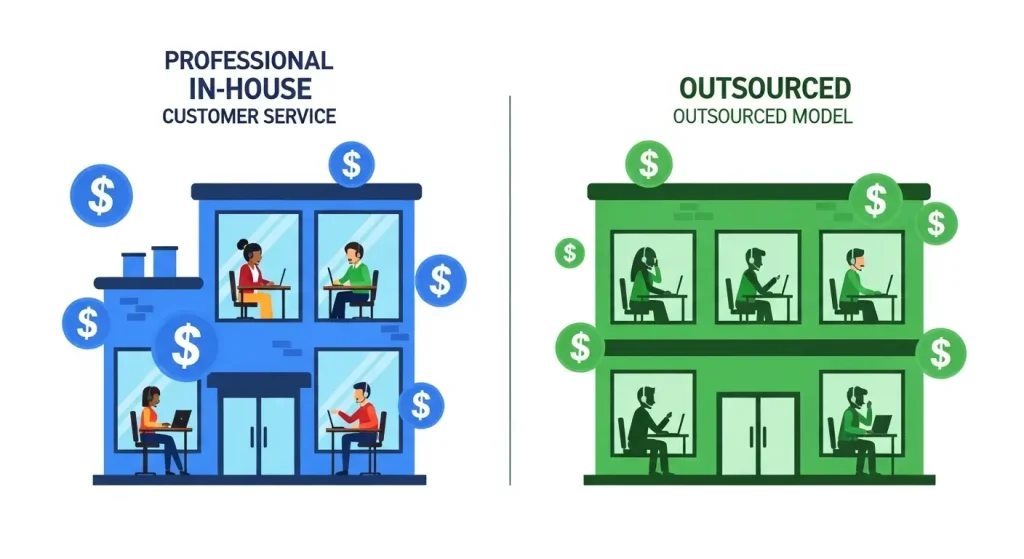
Quality & Customer Experience
This is where the in-house team should have the hand. But that is not always the case.
In-House Advantages:
* The in-house team has control over what the brand says
* The in-house team knows the product well
* The in-house team is loyal and stable
In-House Disadvantages:
* The quality of training depends on what the company can afford
* When people leave their jobs a lot the service is not consistent
* The in-house team can not work all the time without getting paid more
* The in-house team gets tired of doing the tasks
* The in-house team does not know what other companies are doing
Outsourced Advantages with a partner like VocalsConnected:
* The partner has training that never ends
* The partner makes sure the quality is always good
* The partner has scripts and workflows that are proven to work
* The partner can manage how well the team is doing
* The partner can work all the time without getting tired
* The partner knows what works best in the industry
Outsourced Disadvantages:
* The company has control over how things are said
* The company needs to talk to the partner a lot
* The partner does not know the product well as the, in-house team
Scalability & Flexibility
| Dimension | In-House | Outsourced |
|---|---|---|
| Add 5 more agents | 30–60 days (hire, train, ramp) | 3–7 days |
| Reduce capacity | Costly (severance, recruitment drain) | Flexible (pay only for what you use) |
| Handle seasonal spikes | Hire temps (lower quality) | Scale up instantly |
| Expand to new markets | Hire locally (region-specific costs) | Flip a switch |
| 24/7 coverage expansion | Expensive overtime/shift work | Built-in capability |
Speed to Launch & Deployment
In-House Timeline:
- Week 1–2: Recruiting and job postings
- Week 3–4: Interviews and hiring
- Week 5–6: Onboarding and product training
- Week 7–8: Call listening and QA ramp
- Week 9–12: Full independence (best case)
Total: 9–12 weeks before first productive call
Outsourced Timeline (VocalsConnected):
- Day 1–2: Discovery call and requirements gathering
- Day 3–5: Campaign planning and CRM setup
- Day 6–7: Team assignment and brief training
- Day 8+: Live calls, monitored and optimized
Total: 7–10 days before full operation
Winner: Outsourced (8–10 week advantage)
What to Look for in an Outsourcing Partner
When you think outsourcing is the way to go for your business in Irvine, which it usually’s picking the right company to work with is really important. Here are some things you should not compromise on:
CRM Integration & Transparency
You need to make sure the company you choose can work well with the tools you already use like HubSpot, Salesforce or Zendesk. You want to be able to see what is happening with your calls and results away not just get a report at the end of the month.
Scalability Proof
You should ask to talk to companies that started with just a few people and then grew to twenty or more. If the company you are thinking of working with had trouble growing they will probably have trouble helping your business succeed.
Quality Assurance Framework
You should make sure the company you choose has a system in place to ensure quality including:
Call recording and review processes
Written quality scorecards
Real-time performance dashboards
Monthly quality metrics
Industry Experience
It makes a big difference if the company you choose has experience working with businesses like yours like B2B SaaS support. You want to make sure they understand the challenges you face in your industry.
Training & Onboarding
You should ask about how the company trains employees. Can they get five people up to speed in less, than ten days? How do they make sure the new employees understand what your company does?
Flexibility & Customization
You do not want a company that just does things one way. You need a company that can make custom plans for your business including custom call scripts and workflows that fit your needs.

Frequently Asked Questions
What’s the typical cost difference between outsourced and in-house services?
The cost of outsourcing is usually 40 to 60 percent less than in-house on a per-call basis. For example in-house services cost between 73 and 107 dollars per call while outsourced services cost between 24 and 54 dollars per call. The gap in costs gets bigger as you scale up.
Can outsourced providers handle technical support?
Yes they can handle technical support as long as you choose a partner with technical expertise.. Similar advanced BPOs train specialized technical support teams with deep product knowledge on your product.
How quickly can an outsourced team be trained on our product?
It takes around 5 to 10 days for an outsourced team to be trained on your product with capability. They also get training as part of quality assurance. This is much faster than in-house training which takes around 8 to 12 weeks.
What happens if the outsourcing company fails or goes out of business?
That is why you choose an financially stable partner. VocalsConnected has been operating for over a decade with proven stability. Larger BPOs have disaster recovery plans in place.
Will outsourcing work with our CRM?
Any good provider will integrate with platforms like HubSpot, Salesforce and Zendesk. You should ask for references from clients using your CRM system.
Is there a minimum contract length?
Most providers require a minimum contract length of 3 to 12 months. They also offer flexibility for scaling up or down within that term. Some offer month-to-month contracts, for premium pricing.
Making the Decision: A Framework
Here is a simple framework to help you decide which model is right for you when it comes to customer service.
You should choose the in-house model if you get a lot of customer service calls than 15,000 every month.
The in-house model is also a choice if your product is very complicated and hard for people to learn about.
Customer service is a part of what your company is about so you want to make sure you are in charge of it.
You need to be in control of every interaction with your customers.
You have the money and the people to build a team to handle customer service.
You should choose the model if you get fewer than 15,000 customer service calls every month.
The outsourced model is a choice if you want to be able to grow or shrink your customer service team without any problems.
You want to save money on customer service.
You want to be able to help your customers 24 hours a day 7 days a week without having to pay extra for overtime.
You would rather focus on the parts of your business not on managing a team of people.
You want to be able to start helping your customers
You should choose the hybrid model if you want a small team in your company to oversee customer service.
You are willing to pay a little money to be in control of customer service.
You are moving away from having a team, in your company. You want to do it slowly.
Is there a minimum amount of time you have to use a customer service model?
Most companies that provide customer service require you to use their services for least 3 to 12 months.
You can usually. Remove services during that time.
Some companies will let you pay month to month. You have to pay a premium price.