
Customers do not stick to one way of communicating anymore. They might start talking on Instagram then move to live chat send an email when upset and make a call when they really need help. They want each of these interactions to feel connected, not like five conversations with five different people.
This is the reality for businesses in the US now. It’s why investing in omnichannel customer support outsourcing has become very important for growing companies. It’s not just about answering questions. It’s about creating an consistent experience that is available all the time, which helps build customer loyalty in a market where people can easily switch to another company.
At VocalsConnected we help businesses in the US set up their support systems so that every channel is connected works with their CRM and can grow without losing that personal touch. This guide will explain how omnichannel outsourcing works what it includes and why its changing how customers are treated across industries, in the US.
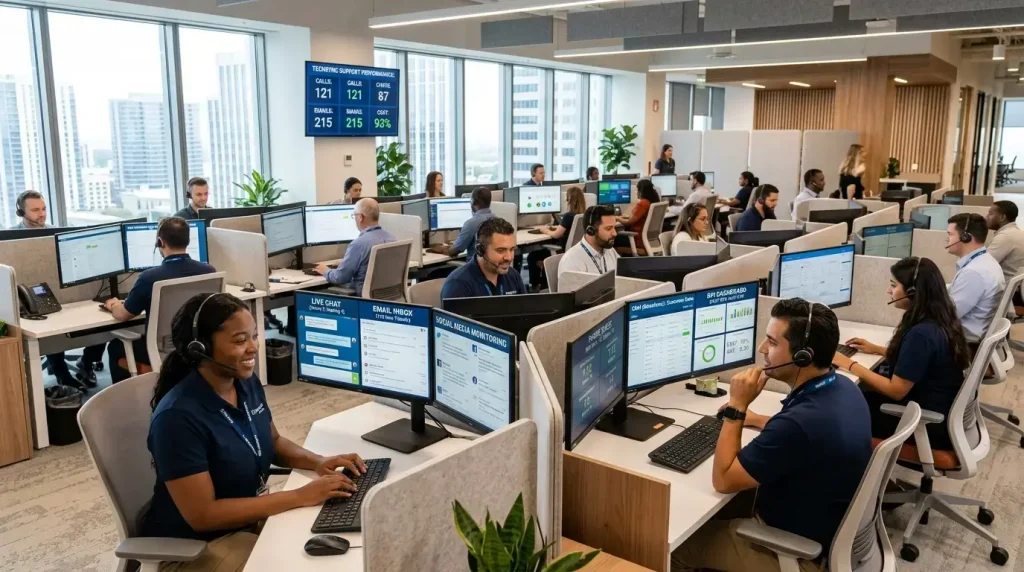
Why Modern Businesses Need Omnichannel Customer Support
The way of supporting customers. One phone number, only during business hours one team handling everything. Just doesn’t work anymore. Customers use devices, platforms and channels all the time. They want things fast, personalized and smooth.
Some big changes have made supporting customers across all channels an expectation, not a special extra:
- People now contact support more often through mobile messaging than email.
- Social media is now a way for customers to get help.
- Customers expect answers within minutes, not hours.
- They want to be able to help themselves. Also want to be able to talk to a live person.
- One bad experience can mean the end of a customer relationship.
- When all channels aren’t connected customers have to repeat themselves.
- Agents don’t have the story.
- Issues take longer to fix.
- Customers get less satisfied.
- Eventually they stop being customers.
Omnichannel support solves this by bringing all conversations into one continuous thread no matter where it started. It’s not a to-have feature anymore. For businesses, in the US that want to compete it’s the standard.
How Omnichannel Customer Support Outsourcing Improves Business Operations
Building a true omnichannel operation internally is expensive and slow. You need trained agents across every channel, integrated software, 24/7 staffing models, multilingual coverage, quality assurance teams, and analytics infrastructure. Most American businesses can’t justify that complexity in-house — and they don’t need to.
Outsourcing brings that entire stack ready-made. A strong partner provides trained talent, established workflows, integrated technology, and the operational discipline to run support at scale. The business gets the benefits of a world-class customer experience without building it from scratch.
Key operational improvements include:
- Faster response times across all channels
- Consistent service quality regardless of volume
- Reduced cost per interaction
- 24/7 coverage without overnight staffing strain
- Cleaner data flowing into your CRM and reporting tools
- Internal teams freed to focus on product, sales, and strategy
For companies weighing different operational models, our breakdown of outsourced customer support vs in-house explains where each approach truly wins.
Core Multichannel Customer Support Services Businesses Need
A real omnichannel operation is built from service layers. Each channel plays a role in the customer journey. The magic happens when they share data and context smoothly.
Here are the multichannel customer support services most American businesses use:
Live Chat and Website Support
Live chat is now the go-to channel for moving customers especially in ecommerce and SaaS. It mixes the speed of messaging with the friendliness of a person. Live chat turns visitors into buyers more often than almost any other touchpoint.
Good live chat operations typically handle:
- Pre-sale product questions
*. Checkout help
- Order status and shipping questions
- Account access and onboarding support
- Smart handoff to email or phone when needed
When connected to website behavior data live chat agents can engage proactively. Answering questions before a customer even thinks to ask. Live chat is key.
Email and Ticket Management Systems
Email is still the workhorse of support. Customers use it for issues, documentation and conversations they want a record of. A email and ticket management system ensures nothing gets lost. Every message is tagged correctly. SLAs are met consistently.
Modern ticketing platforms let teams:
- Categorize and route tickets automatically
- Track full conversation history per customer
- Apply macros and templates without sounding
- Escalate complex cases with full context
- Measure resolution time, satisfaction and reopen rates
Email support is vital.
Social Media and Phone Support
Social channels. Instagram, Facebook, X are now public customer service stages. How a brand responds is visible to thousands of customers. Phone support is still the channel customers turn to when they need reassurance.
Outsourced teams handle both with trained tone, brand voice alignment and quality monitoring. The result is a brand that sounds consistent whether a customer DMs on social picks up the phone or fires off an email, at midnight. All channels matter. Below is a comparison most U.S. Businesses run before upgrading to a unified model.
| Support Capability | Single-Channel Support | Omnichannel Support |
|---|---|---|
| Customer journey continuity | Fragmented | Unified across channels |
| Agent context | Limited to one channel | Full history available |
| Response speed | Varies widely | Consistent across channels |
| Customer effort | High (repeats info) | Low (seamless handoff) |
| Brand voice consistency | Hard to maintain | Centrally managed |
| Data and reporting | Siloed | Unified analytics |

Customer Experience Management Solutions and Customer Retention
Acquisition is what gets all the attention. Retention is what really matters when it comes to money. People who like a company will buy from them often they will spend more money each time they buy something and they will tell their friends about the company without the company having to pay for it. If a customer has an experience with the companys support team that is a quick way to lose them. On the hand if the support team does a good job that is a great way to keep the customers.
There are tools that help companies make their customers happy. These tools focus on the things that make customers like a company for a long time. For example how fast does the company answer a customers question? Does the answer seem like it was written for them? Does the person helping the customer already know about the customers purchases? Can the problem be solved without the customer having to talk to a lot of people? When a company gets help from outside to provide support to its customers on all channels it can really help keep the customers. Here are some ways it can do that:
- It can make sure the customer gets an answer quickly no matter how they contacted the company.
- It can make sure the customer does not have to explain their problem than once because the company is using a special tool to keep track of everything.
- It can make the conversation with the customer feel more personal because the company knows what the customer has bought before and how they like to shop.
- It can check in with the customer after the problem is solved to make sure everything is okay.
- It can even figure out which customers are not happy and might stop buying from the company so the company can try to help them before it’s too late.
For companies focused specifically on keeping customers longer, our resource on customer retention outsourcing goes deeper into the strategies that actually move the needle. The principle is simple. Customers don’t expect perfection. They expect to feel heard, helped, and respected. Omnichannel support, done right, delivers that consistently.
24/7 Omnichannel Support Services for Ecommerce and SaaS Companies
Ecommerce is always open. So are the people who use software as a service. A person in California can buy something from your store at 11 p.m.. Someone on the East Coast can have a problem with your software at 4 a.m. Meanwhile someone in another country can send a message to your store while your team is sleeping. Every time something like this happens, you. Keep a customer or lose one.
Having people available to help your customers 24 hours a day 7 days a week on every platform means your business is always open. Without making your team work all night.
This is really important for ecommerce and software as a service. Here is why:
- If someone can get help when they are checking out they are less likely to leave your site without paying.
- If someone has a problem with their order you can fix it before they get really upset and ask for their money back.
- If someone is having trouble using your software you can help them away. Before they get frustrated and quit.
- If someone is thinking about canceling their subscription you can talk to them. Change their mind.
- People in countries can get help at a time that is good for them.
Ecommerce platforms like Shopify make it easy to start and grow a store.. A lot of companies have trouble giving their customers good support. If you hire a team to provide 24/7 support on every platform you can fill this gap. Make support a way to keep revenue. Not just a cost. This is especially good, for companies. We have a guide that explains how small companies can outsource their customer support and offer service without spending a lot of money.
Role of CRM and AI in Omnichannel Customer Support Outsourcing
Technology is really what makes modern support work for people who buy things from different places. Without a system that keeps track of customer information and tools that use artificial intelligence even the best support people are limited by what they can see and how fast they can act. Together these systems turn teams that work outside of a company into a part of the business not someone you talk to on the phone.
Artificial Intelligence Powered Customer Support Automation
Artificial intelligence handles the parts of support so humans can focus on the conversations that actually need care and good judgment. The best way to do things is to use automation and people together. Not to replace one with the other.
There are common ways to use automation, such as:
- Chatbots that help with order status frequently asked questions and basic troubleshooting
- Automatically categorizing and routing tickets
- Suggested replies that help support people answer faster
- Finding out how customers feel to flag those who are frustrated
- Helping out after hours and seamlessly handing things over to humans in the morning
The result is that problems get solved faster it costs less to solve each ticket and support people have time to focus on important interactions.
CRM Integration and Customer Tracking
A customer relationship management system is like a memory of the relationship with the customer. When a support team that works outside of a company uses the system as the internal teams. Whether that is HubSpot, Salesforce, Zendesk or another platform. Every interaction is logged, searchable and can be used to take action.
This integration makes it possible to:
- See the picture of the customer across every channel
- Give responses based on order history and preferences
- Have a smooth handoff between support, sales and account management
- Get reports on satisfaction, resolution time and revenue impact
- Better forecast staffing and volume needs
- Predictive Analytics for Customer Experience
analytics takes old data and turns it into actions for the future. Of just reacting to problems after they happen support operations can anticipate them. There are practical ways to use predictive analytics, such as:
- Forecasting peak volume periods to staff accordingly
- Finding products, with rising complaint patterns
- Spotting risk of customers leaving based on interaction frequency or sentiment
- Predicting which customers are likely to respond to retention offers
- Finding trends that inform product and operations decisions
When artificial intelligence customer relationship management data and analytics work together support stops just reacting to problems.. Starts shaping the customer experience in a proactive way.
Industries That Benefit from Omnichannel Customer Support
While every business benefits from unified support some industries see really big benefits. This is because their customer journeys involve channels, quick decisions and emotional moments.
Industries that do well with omnichannel outsourcing include:
- Ecommerce and retail. They need help with pre-sale chat, post-purchase support and returns.
- SaaS and tech. They need help with onboarding fixing issues and renewals.
- Healthcare and wellness. They need help with appointment support, billing and patient inquiries.
- Financial services and fintech. They need help with account questions and dispute resolution.
- Travel and hospitality. They need help with bookings, cancellations and multilingual coverage.
- Subscription brands. They need help with retention, upgrades and preventing cancellations.
- Insurance. They need help with policy questions claims intake and document follow-up.
- Education and online learning. They need help with student support, enrollment and course assistance.
The common thing is that they all have a lot of customer interactions different types of issues and customers really care about the outcome. When customers care about what happens omnichannel support becomes an advantage. For a view of how outsourcing pays off across industries our guide on the benefits of outsourced customer support, in the USA is a good read.
Common Customer Support Challenges Businesses Face
Even well-run businesses hit familiar walls when their customer base grows. Knowing these pressure points in advance is what separates companies that scale support smoothly from those that get overwhelmed.
The most common challenges include:
- Inconsistent service quality across channels and shifts
- Long response times during peak periods or marketing pushes
- Fragmented tools that don’t share customer data
- Agent burnout from high volume and emotional fatigue
- Difficulty offering 24/7 coverage without overstaffing
- Rising support costs that outpace revenue growth
- Poor visibility into satisfaction, resolution, and trends
- Language and accessibility gaps for diverse customer bases
Here’s how those challenges typically compare between in-house and outsourced operations.
| Support Factor | In-House Operations | Outsourced Omnichannel Support |
|---|---|---|
| Coverage hours | Business hours only | 24/7/365 available |
| Channel breadth | Usually 1–3 channels | Full omnichannel coverage |
| Staffing flexibility | Slow to scale | Elastic and on-demand |
| Cost structure | Fixed and high | Variable and predictable |
| Technology stack | Self-managed | Provided and integrated |
| Quality during spikes | Drops noticeably | Maintained under SLA |
Cost is often the first concern leaders raise, which is why our detailed breakdown of customer support outsourcing cost USA is worth reviewing before making the move.
Future of Omnichannel Customer Support Outsourcing
The next part of customer support in the United States is being changed by three things: artificial intelligence making things very personal and being proactive. These things are changing support from fixing problems to a way to make the company grow.
There are things that are happening faster and faster:
- Artificial intelligence is handling more and more routine conversations
- Voice analytics is helping to make sure the quality of support is good and to coach the people who do support
- We are moving away from using different systems for support and using one system that has all the customer information
- Support is being proactive because it uses signals from how customers behave and models that predict what they will do
- Teams that have both humans and artificial intelligence are becoming the way to do things
- Companies are paying for support based on how happy customersre if they stay with the company and how much money they make
- Companies that have to follow a lot of rules about data privacy are making sure they have rules in place
The companies that will do well in the next ten years will think of customer support as a product they sell not just a part of the company. They will measure how well it is doing like a product put money into it like a product and design it like a product. Being able to work with customer support from different channels is what makes it possible for companies of all sizes to invest in customer support.
This is what we believe in at VocalsConnected. We combine people, systems and artificial intelligence to make one customer experience that is connected. We do this for every customer we work with at VocalsConnected. Customer support is a part of what we do at VocalsConnected and we want to make sure it is the best it can be, for our customers.
Final Thoughts on Omnichannel Customer Support Outsourcing
Customers in the U.S. have more choices than ever, and they’re quicker than ever to walk away from brands that frustrate them. The companies that hold on to their customers — and grow because of them — are the ones that show up consistently across every channel, respond quickly, personalize the experience, and make every interaction feel effortless.
Omnichannel customer support outsourcing makes that level of experience possible without overbuilding internal teams or stretching budgets thin. It gives American businesses access to trained talent, modern technology, integrated CRM workflows, AI-powered automation, and around-the-clock coverage — all wrapped into one operational partner.
Whether you’re a fast-growing ecommerce brand, a SaaS company scaling nationwide, or an established business modernizing how you serve customers, the right outsourcing partner becomes a true growth advantage. If you’re ready to explore what that could look like, our outsourced customer support solutions at VocalsConnected are built specifically for U.S. businesses that take customer experience seriously. Great support isn’t just a service. It’s how modern brands earn loyalty in a crowded market — and it’s how the smartest companies in America are quietly building their next decade of growth.