
Every time a patient tries to call a healthcare provider and cannot get through it is not a small problem. It is a patient who might go somewhere else a chance to make money that is lost and a persons health that is put at risk. Studies have shown that 26 percent of patients who cannot reach their healthcare provider will switch to a different provider. For people in charge of healthcare understanding how to make the experience better for patients when they call is no longer something that can be ignored. It is something that must be done.
Whether you are in charge of a hospital with many different types of doctors a small clinic that is independent or a company that provides healthcare services over the phone or internet the quality of the system you use to communicate with patients has a direct impact on how much money you make how happy your staff is and. Most importantly. How healthy your patients are. This guide will explain how professional healthcare call centers can improve the experience of patients from the first time they call to the time they become long-term patients.
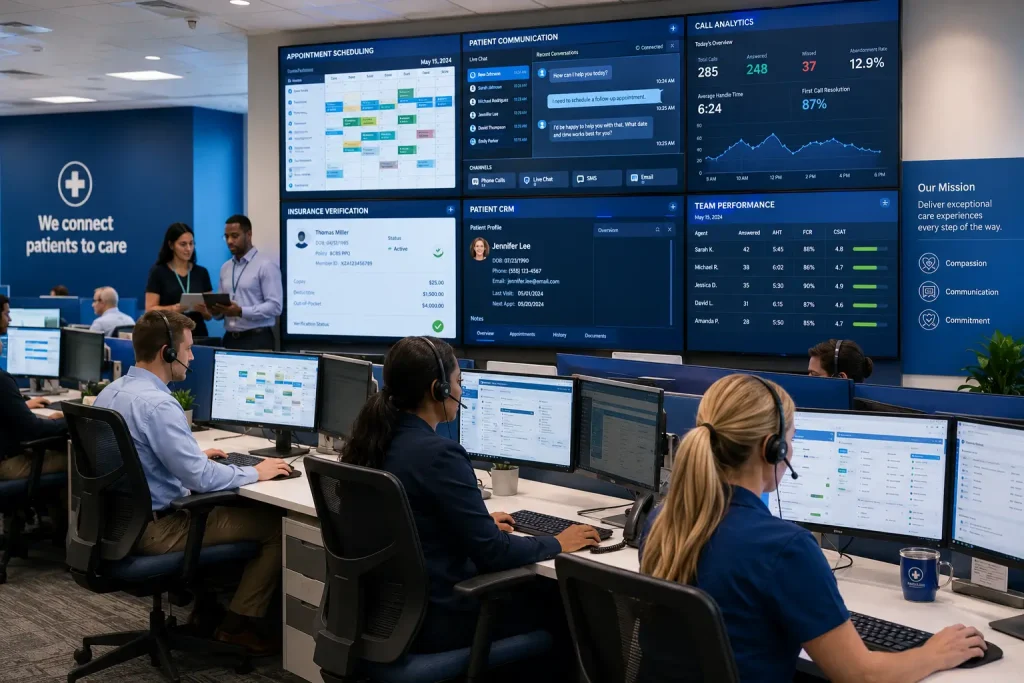
Why The Experience Of Patients Matters In Healthcare
The experience of patients has become very important in healthcare. It is no longer a nice thing to have. The Centers for Medicare and Medicaid Services ties the amount of money it pays to healthcare providers to how happy patientsre with their care. If patients are not happy the provider gets paid less.
This is not the only reason patient experience is important.
The Connection Between Communication And Patient Satisfaction
Research done by the National Institutes of Health has shown that patients who feel like they are being heard and are well-informed are much happier with their care. And they are more likely to do what their doctor tells them to do. Communication is not about doing paperwork. It is about providing good care.
When a patient calls to ask about symptoms they are having after surgery and gets a signal or a voicemail that is never returned it can lead to unnecessary trips to the emergency room or even real medical emergencies. Good communication can help prevent these problems by making sure patients get the care they need.
Here are some important facts to know:
- Eighty percent of mistakes made in healthcare happen because of communication when patients are being transferred from one caregiver to another
- Patients who are happy with the communication they receive are than twice as likely to recommend their healthcare provider to others
- If a healthcare provider can keep five percent more of its patients it can increase its revenue by twenty-five to ninety-five percent
Common Things That Frustrate Patients
If you ask patients what they do not like about healthcare they will usually give you the same answers:
- Having to wait on the phone for a time to make an appointment
- Being transferred from one person to another before getting to the person
- Not getting a call back after a procedure to check in
- Not being able to reach anyone outside of business hours
- Not being able to communicate with their healthcare provider using text messages or other digital methods
- Being confused about bills and insurance
These are not just complaints. They are signs of bigger problems with the way healthcare providers communicate with patients. A organized healthcare call center can help solve these problems.
How Poor Communication Affects How Long Patients Stay And How Much They Trust Their Healthcare Provider
When patients do not get communication from their healthcare provider it can have serious consequences. And this is not talked about enough in the healthcare industry. When patients experience communication it can lead to:
- Short-term problems like missed appointments and patients getting frustrated
- Mid-term problems like negative reviews and patients not following their treatment plans
- Long-term problems like patients switching to a different healthcare provider damage, to the reputation of the provider and lost revenue
In a competitive healthcare market how easy it is for patients to get in touch with their healthcare provider is a big part of what makes up the providers brand. Patients are starting to compare getting healthcare to getting any kind of service. If it is hard to get they will go somewhere else.
How Healthcare Call Centers Improve Patient Experience
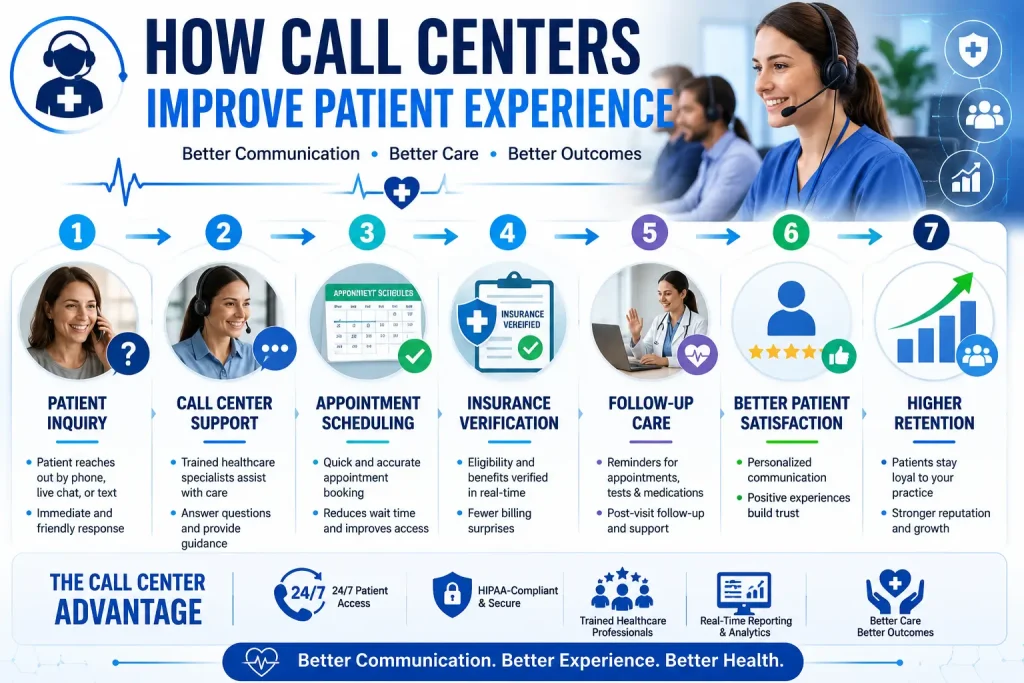
A healthcare call center is not a place that answers phones. It is a service that helps patients communicate with healthcare providers in a way. This service is available from the time a patient first asks for help to after they are discharged from the hospital.
Faster Appointment Scheduling and Reduced Wait Times
One thing about healthcare call centers is that they make it easier to schedule appointments. The people who work at the desk of a clinic have a lot to do. They have to check in patients help people who walk in do paperwork and answer phones. Sometimes things do not get done.
A special team that just handles scheduling appointments can help with this problem. This team can:
- Answer phones. Help people schedule appointments
- Use the computer systems as the healthcare providers
- Send reminders to patients so they do not forget their appointments
- Help patients cancel or reschedule appointments at the minute
This helps patients get appointments faster and reduces the time they have to wait. The people who work at the desk can then focus on helping patients who are in the clinic. If healthcare providers use a team to handle scheduling they can reduce the number of patients who do not show up for their appointments by 20-30%. This means they can make money.
24/7 Patient Support and Inquiry Management
People can get sick. Have questions at any time of day. A healthcare call center that is available 24 hours a day can help with this. They can:
- Help patients who call after hours and decide if they need to see a doctor away
- Send messages to doctors who are on call
- Help patients get prescriptions refilled
- Answer questions about lab results
- Send patients to the emergency room if they need to go
This is especially helpful for hospitals or clinics with many locations. It can help patients get the help they need and avoid going to the emergency room for things that’re not emergencies.
Follow-Ups and Better Care Coordination
After patients leave the hospital they often need help remembering what to do. A healthcare call center can call patients after they leave the hospital to check on them. They can
- Call patients who have chronic diseases like diabetes or heart disease to see how they are doing
- Help patients schedule appointments with specialists
- Remind patients to take their medicine
- Remind patients to get check-ups to prevent health problems
This can help patients stay healthy and avoid going to the hospital. It can also help patients feel more loyal, to their healthcare providers.
Reducing Missed Calls and Missed Opportunities
Here’s a number that should stop every healthcare administrator in their tracks: the average cost of a missed appointment in healthcare is 200–200–300 per no-show, with some specialties reporting figures significantly higher.
Now multiply that across the number of unanswered calls your practice fields daily.
The HIPAA Journal reports that healthcare data breaches and communication failures cost organizations billions annually — but the everyday cost of abandoned calls and missed scheduling opportunities is a slow, invisible drain that most practices never fully quantify.
The hidden economics of missed calls:
| Scenario | Estimated Annual Impact |
|---|---|
| 20 missed calls/day × $200 avg. patient value | $1.46M in potential revenue at risk |
| 15% no-show rate on 500 appointments/month | 18,000–22,500/month lost |
| Patient who switches providers after poor experience | Lifetime value loss: 1,400–8,000+ |
| Negative Google review from frustrated patient | Ongoing reputational cost |
A professionally staffed outsourced call center solution eliminates abandoned calls, captures after-hours inquiries, and converts inquiries into confirmed appointments — systematically closing the revenue leakage gap.
Improving Appointment Scheduling Efficiency
Appointment scheduling is more than answering phone calls. The best healthcare call centers use scheduling methods that are better than what hospital staff can do on their own.
This is what scheduling efficiency looks like in life:
- Callers get to the person to schedule an appointment the first time they call. No more waiting on hold for five minutes and then getting transferred to the wrong department
- Checking insurance before the appointment reduces the number of people who cancel at the minute because of insurance problems
- Automated reminders are sent to patients 72 hours and 24 hours before their appointments by phone, text message and email
- Managing a waitlist helps fill appointment slots and makes sure doctors have a full schedule
- Patients who speak languages can get help from people who speak their language
Practices that use a dedicated healthcare call center service see a big improvement in scheduling efficiency. It goes up by 35 to 50 percent. And they also save money on administrative overtime. When appointment schedules are full and running on time doctors can give care to their patients. It is that simple.
Making Insurance Verification and Pre-Visit Support Better
Insurance problems are one of the reasons why patients get frustrated and cancel their appointments. If a patient shows up for an appointment and finds out they do not have insurance or their referral was not processed the patient gets frustrated the doctors time is. It causes problems with billing.
Healthcare call centers can help patients before they visit the doctor by:
- Checking if patients have insurance before their appointments are confirmed
- Explaining to patients what their insurance covers and how much it will cost
- Following up on pre-authorization to prevent appointments from being canceled on the day of the procedure
- Giving patients instructions before their visit, such as what to eat or what medicine to take
- Helping patients sign up for the portal if they are not used to using digital tools
This helps in four ways: it reduces the number of appointments that are canceled on the day of the appointment it makes the check-in process faster it reduces the number of billing disputes and it makes patients happier with their experience before they see the doctor. The Centers for Medicare and Medicaid Services says that patient experience scores, which include how well patients are communicated with before their visit are becoming more important in value-based care models. So this is important, for operational reasons.
Providing Multichannel Patient Communication
Today’s healthcare patient doesn’t communicate exclusively by phone. The expectation — driven by every other consumer service from banking to retail — is that communication happens on the patient’s preferred channel, at the patient’s preferred time.
Healthcare organizations that offer only phone-based patient communication are operating with a significant competitive and experiential disadvantage.
A modern patient communication service delivers true omnichannel support:
Phone
Still the dominant channel for complex inquiries, urgent matters, and elderly or technologically limited populations. Professional agents trained in healthcare communication protocols manage inbound and outbound call volumes with compassion and accuracy.
SMS and Text Messaging
The highest open-rate communication channel available. Appointment reminders, lab result notifications, pre-visit instructions, and follow-up check-ins delivered via text see dramatically higher engagement than phone calls alone. HIPAA-compliant SMS platforms ensure security.
Live Chat and Web Messaging
Website visitors who can’t find what they need quickly will leave. A live chat function powered by a healthcare call center team captures these patients at the moment of highest intent — before they call a competitor.
Ideal for non-urgent, detailed communications: health education materials, care plan documentation, appointment summaries, and billing explanations. Automated email workflows reduce manual administrative burden.
Patient Portal Messaging
Secure portal communication for existing patients allows bidirectional messaging with care teams while maintaining full HIPAA compliance. Healthcare call center agents can manage portal inboxes, triage messages, and escalate urgent communications to clinical staff.
The multichannel impact:
| Channel | Best Use Case | Avg. Engagement Rate |
|---|---|---|
| Phone | Urgent queries, complex scheduling | 65–70% first-contact resolution |
| SMS | Appointment reminders, follow-ups | 95%+ open rate |
| Non-urgent communications, education | 20–35% open rate | |
| Live Chat | Website visitor conversion | 4x higher than email conversion |
| Patient Portal | Secure clinical messaging | 60% of patients prefer for non-urgent |
Supporting Telehealth and Virtual Care Services
The increase in telehealth because of COVID-19 has changed what patients expect from healthcare. Data from the CDC shows that people are using telehealth five times more than they did before the pandemic. And now patients expect to be able to get virtual care easily without any hassle. Healthcare call centers are very important for making work well.
They do a lot of things to help patients before their visits:
- They help patients fix technology problems so they can connect to video platforms
- They make sure patients have given their consent and filled out all the paperwork before their visits
- They check patients insurance to make sure it covers telehealth
- They send reminders about appointments and include links to the platform
During virtual visits healthcare call centers do things like:
- Transfer patients to clinical staff if there is a problem that needs more attention
- Help patients with technical issues in real time
- Take care of paperwork for healthcare providers
After virtual visits healthcare call centers:
- Help patients get their prescriptions
- Schedule follow-up appointments based on what the doctor said during the visit
- Check in with patients to see how they are doing
For healthcare systems that offer both in-person and virtual care being able to support both types of care through one system is a big advantage. This means that patients can get help and support no matter how they are getting their care. In person or virtually. Telehealth is a part of this and healthcare call centers play a critical role in making sure it works well. Telehealth services are a part of the healthcare system now and healthcare call centers are essential, for supporting these services.
Increasing Patient Retention Through Better Service
Patient acquisition in healthcare is expensive. Depending on the specialty and market, acquiring a new patient can cost 5–7x more than retaining an existing one. Yet most healthcare organizations invest disproportionately in marketing for new patients while underinvesting in retention infrastructure.
The communication quality delivered by a healthcare call center is one of the highest-ROI retention tools available.
How call centers drive retention:
- Consistent, positive communication experiences reinforce trust with every interaction
- Proactive outreach for preventive care, annual visits, and chronic disease management keeps patients engaged in their health
- Complaint resolution — handled promptly and empathetically — can convert a frustrated patient into a loyal advocate
- Post-visit follow-up demonstrates genuine care beyond the clinical encounter
- Recall campaigns re-engage patients who haven’t visited in 12–18 months
The HealthTech Magazine has highlighted patient engagement technology as one of the fastest-growing segments of healthcare IT investment — and for good reason. Organizations that deploy structured outreach programs through patient support services report 15–25% improvements in annual patient retention rates.
Consider the math: if your practice has 3,000 active patients with an average annual value of 1,200,a20720,000 in protected revenue** — annually.
How Call Centers Help Healthcare Staff Focus on Patient Care
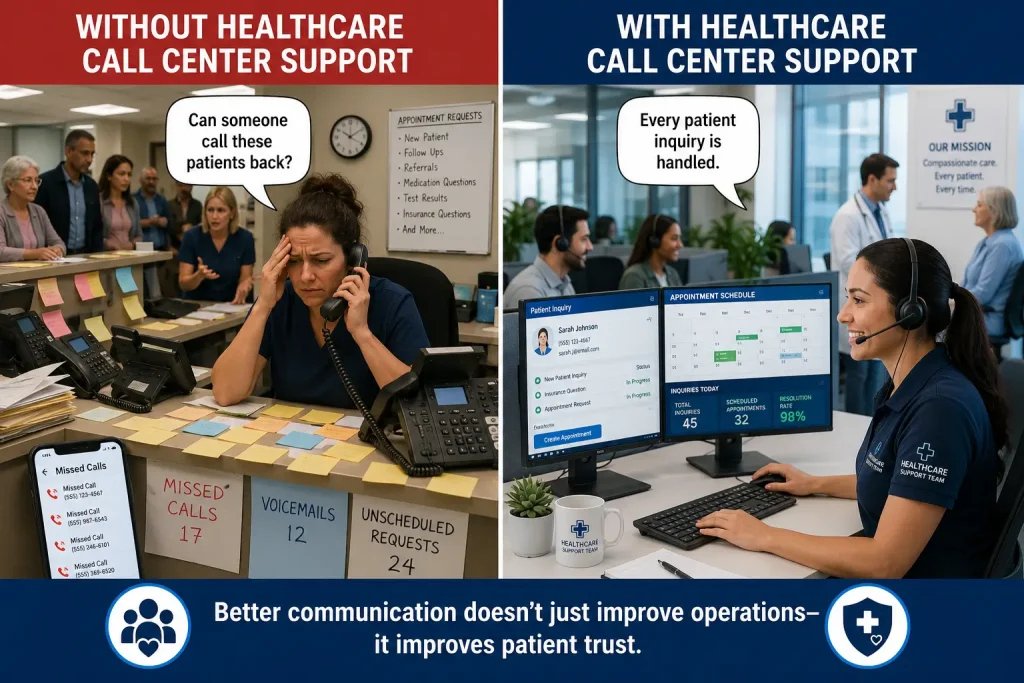
There is a quiet crisis in healthcare administration. Front desk teams, nurses, and clinical coordinators are drowning in communication tasks that consume their time, erode their energy, and pull them away from the work they trained to do.
The CDC has documented widespread burnout across healthcare professions — and administrative overload is consistently cited as a primary driver.
The administrative communication burden:
A typical clinic receptionist manages:
- 80–150+ inbound calls per day
- Scheduling, rescheduling, and cancellation requests
- Insurance verification inquiries
- Billing and payment questions
- Medication refill requests
- Clinical message routing to providers
This volume, combined with simultaneously managing in-person check-ins and administrative paperwork, creates an unsustainable workload. The consequences extend beyond staff wellbeing — overwhelmed front desk teams make errors, miss calls, provide rushed service, and contribute to patient dissatisfaction.
What happens when a healthcare call center absorbs this load:
| Staff Role | Time Recovered | Redirected To |
|---|---|---|
| Receptionists | 3–4 hours/day | In-person patient experience |
| Nurses | 1–2 hours/day | Direct patient care |
| Medical assistants | 1–2 hours/day | Clinical preparation and support |
| Admin managers | 2–3 hours/day | Operational oversight and quality |
The ripple effects are significant. When clinical staff aren’t interrupted by administrative call volume, patient care quality improves, error rates decrease, and job satisfaction — a critical factor in healthcare retention — climbs measurably.
Partnering with an outsourced healthcare BPO service is not a cost; it’s an investment in both your team and your patients.
AI in Healthcare Call Centers is the big thing.
AI is changing what Healthcare Call Centers can do. And organizations that start using AI to help with communication are getting ahead of the competition. AI Voice Assistants and Automated Triage are really useful. These smart voice systems can answer questions. Like confirming appointments giving directions or telling people about their prescriptions. Without needing a human to help. This means that agents have time to deal with harder questions and people get answers right away. Intelligent Call Routing is another thing about AI in Healthcare Call Centers.
AI looks at what the call’s about and connects the patient to the right person right away. No more listening to a recording that says “Press 1 for scheduling, press 2 for billing”. That can be really frustrating. Takes a long time. AI can also be used on channels. Like websites or apps. To help people with simple questions. These AI chatbots are taught to follow Healthcare rules. Can ask people about their symptoms tell them where to go for help and collect information before a visit. All day and night. Without needing an agent. Automated Reminder and Recall Campaigns are also very helpful. AI can look at which patients might not show up for their appointments and send them reminders in the way they like best.
AI can also find patients who’re overdue for check-ups and send them messages to come in. The important thing to remember is that AI in Healthcare Call Centers should be used to help humans. Not replace them. People who are sick or worried need to talk to a human who can understand how they feel. The best Healthcare Call Centers use AI to handle a lot of calls and simple tasks.. Make sure that people with serious or sensitive questions always get to talk to a human agent. AI in Healthcare Call Centers is a tool. But it should be used to make things better for people. Not to replace the humans who care for them. Healthcare Call Centers with AI are the way of the future.. They will make things better for everyone. AI, in Healthcare Call Centers is here to stay.. It will keep getting better and better.
Choosing the Right Healthcare Call Center Solution
Not all call centers are created equal — and in healthcare, choosing the wrong partner carries real risk. Here’s what healthcare decision-makers should evaluate:
HIPAA Compliance — Non-Negotiable
Every call, chat, SMS, and email that touches protected health information (PHI) must be handled in full compliance with HIPAA regulations. Verify that any prospective partner has documented security protocols, conducts regular staff training, and maintains Business Associate Agreement (BAA) readiness. The HIPAA Journal provides current compliance benchmarks worth reviewing.
Healthcare-Specific Training
General-purpose call centers can’t adequately serve healthcare patients. Look for partners whose agents receive training in medical terminology, clinical escalation protocols, empathy-based communication, and EHR systems navigation.
EHR/EMR Integration Capability
Seamless integration with your existing practice management system is non-negotiable for scheduling efficiency and data accuracy. Confirm compatibility with your specific platform before committing.
Scalability and Overflow Management
Healthcare call volume fluctuates — flu season, open enrollment periods, and public health events can spike demand overnight. Choose a partner with documented overflow capacity and elastic staffing models.
Quality Assurance and Reporting
Demand transparency. Monthly reporting on call volume, resolution rates, scheduling conversion, hold times, and patient satisfaction scores should be standard. You can’t improve what you don’t measure.
Multilingual Capabilities
Healthcare serves diverse communities. Bilingual and multilingual support isn’t a premium feature in many markets — it’s a basic access-to-care requirement.
Evaluation Checklist:
- HIPAA compliant with signed BAA capability
- Healthcare agent training program documented
- EHR/EMR integration experience
- 24/7/365 availability confirmed
- Omnichannel communication (phone, SMS, chat, email)
- Telehealth support protocols in place
- Transparent reporting and KPI dashboards
- Multilingual support available
- References from comparable healthcare organizations
- Clear escalation protocols for clinical emergencies