
Most people in charge who look at this question already know they need to think about getting help. They have felt the pressure of not having staff seen people give up and done the simple math on what it really costs to have a team that handles patient access all the time. This includes things like benefits people quitting and the cost of managers. What they have not found is an answer on how much getting outside help really costs. They want to know the numbers, any extra fees and if the money they save is really worth it.
This guide will cover all of that. It is not a basic look at the topic with some points listed out. It is a breakdown of the costs, like what a consultant would tell you if they had worked inside a healthcare organization and seen what happens when the phone is not answered.
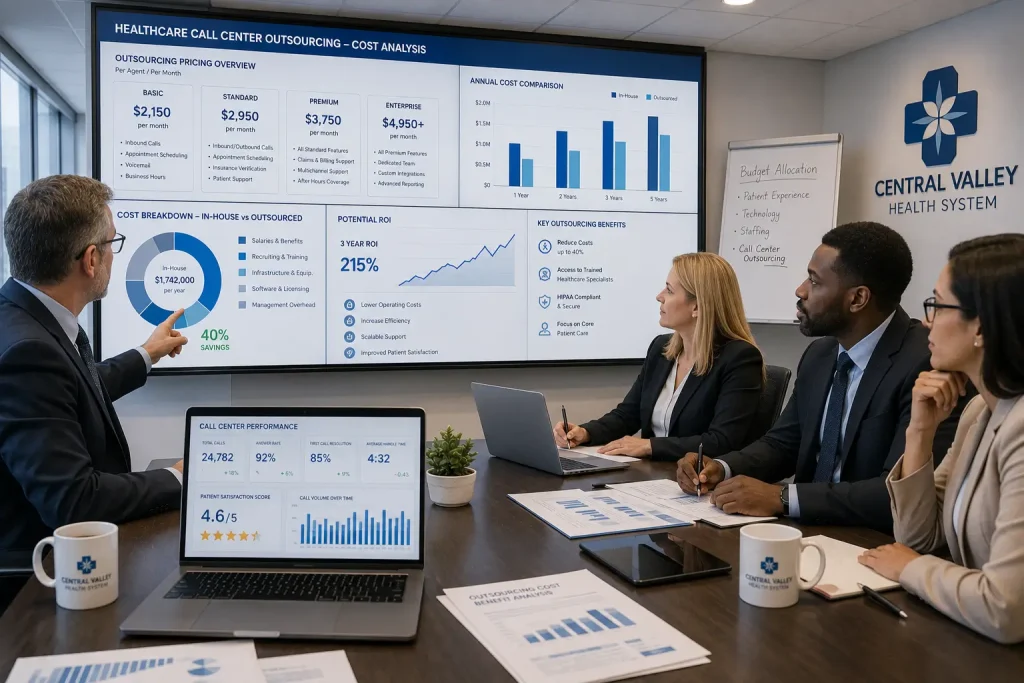
Understanding Healthcare Call Center Outsourcing Costs
When you think about outsourcing a healthcare call center the cost is not a simple number. Some vendors might give you a price without really understanding what you need but that is just a guess. The real cost of outsourcing a healthcare call center depends on a lot of things that can change the price a lot.. What you get for that price.
First you need to understand that the price of a healthcare call center is not about the people working there. You are also paying for things like making sure everything is done correctly getting the technology training the people who will be answering the calls and making sure the company can handle the number of calls you get. The question is not how much it costs per hour. How much it costs to handle each patient call and how that compares to what you are paying now.
What Determines The Price Of A Healthcare Call Center
There are a lot of things that can change the price of a healthcare call center:
- Where the people working for the vendor are from. This is the thing that can change the price. If the people are from the Philippines, India or Eastern Europe it will be cheaper. If they are from Latin America, Mexico or the Caribbean it will be in the middle. If they are from the United States it will be the expensive but they will understand the culture and language better and they will be more comfortable with the rules about keeping patient information safe.
- How complicated the work is. If the vendor is just handling things like scheduling appointments it will be cheaper than if they have to do more complicated things like answering medical questions checking insurance speaking different languages and handling emergency calls after hours. Doctors offices that have complicated systems for getting new patients will have to pay more than regular doctors offices.
- How many calls the vendor will. What the contract is like. If the vendor will handle a lot of calls and the contract is for a time they can usually give you a better price. If the vendor will only handle a calls or the contract is for a short time they will have to charge more to cover their costs.
- What hours the vendor will be working. If the vendor only works during the day it will be cheaper. If they also work in the evenings on weekends and on holidays it will cost more. Because they charge more for those hours or because they have a special system for handling after-hours calls.
- How hard it is to connect the vendors system to your system. If you use a system, like Epic, Athenahealth or eClinicalWorks the vendor will have to connect to it. That can be complicated and expensive.
Average Healthcare Call Center Outsourcing Cost
Here’s what the market actually looks like, broken down by workforce model.
Hourly Rates by Vendor Type
| Workforce Model | Hourly Rate Range | Best Suited For |
|---|---|---|
| Offshore (Philippines, India) | 8–15/hour | High-volume routine tasks, basic scheduling |
| Nearshore (LatAm, Mexico) | 15–28/hour | Bilingual support, after-hours, mid-complexity |
| U.S.-Based | 28–45+/hour | Complex workflows, high-compliance, cultural fit priority |
These are agent-level rates. Your blended cost includes management, QA, technology, and overhead layered on top — which typically adds 20–40% to pure agent cost depending on the vendor’s model.
Monthly Cost Estimates by Practice Size
| Organization Type | Estimated Monthly Cost | Annual Range |
|---|---|---|
| Small clinic (1–3 providers, ~50 calls/day) | 2,500–6,000 | 30,000–72,000 |
| Multi-location practice (5–15 sites, ~300 calls/day) | 12,000–28,000 | 144,000–336,000 |
| Large hospital / health system (enterprise, 1,000+ calls/day) | 35,000–90,000+ | 420,000–1,000,000+ |
These ranges assume standard daytime coverage with basic EHR integration. After-hours, specialty triage, and multilingual requirements all push toward the higher end.
Common Pricing Models Used by Vendors
The pricing structure is just as important as the rates. The model affects how well you can predict your costs and how much you might have to pay when things change.
There are a few models that vendors use.
- Per-minute pricing is one of them. You pay for the time you actually use. This is good for companies that do not make a lot of calls. If you make calls than usual one month you might get a big bill.
- Per-call pricing is another model. You pay a fixed rate for each call no matter how long it is. This works well when all your calls are similar. The problem is that the vendor might try to rush through calls to save time even if some calls are complicated.
- Per-agent pricing is when you have agents who only work for you. You pay them a fee no matter how many calls they get. This is good for companies that make a lot of calls and want to work with the agents all the time.
- Shared agent pools are when your calls are answered by a group of agents who also work for companies. This is cheaper. You might not always get the same agent. This is okay for calls or when you just need someone to answer the phone after hours.
- Hybrid pricing is when you pay a base rate for a number of calls and then you pay more for each call after that. This is good for companies that have periods sometimes like during holidays or sales events. The pricing models used by vendors are important to understand. The vendor uses these pricing models to determine your cost. The vendor uses per-minute pricing, per-call pricing, per-agent pricing, shared agent pools and hybrid pricing to charge you.
Why Healthcare Providers Outsource Call Centers
Before we talk about costs we need to understand what drives the decision to outsource. The thing is, the cost of not outsourcing is not always easy to see but it is very real. Lets say a mid-sized practice misses 40 calls a week. They do not see a line item that says “missed call losses” in their budget. What they see is a number of new patients a higher number of no-shows and a patient retention rate that keeps going down. These are the consequences of not having staff to answer the phone and they look like other problems. The Centers for Medicare & Medicaid Services thinks that patient experience and access are key to measuring quality and we know that communication and patient outcomes are connected.
The math is simple. If a practice misses 40 calls a week and 15 of those calls could have turned into appointments that is 15 appointments that did not happen. If each appointment is worth $200 that is $3,000 a week in appointments that never happened. This adds up to $156,000 in lost revenue each year. It is not because of a lack of doctors but because of a problem with the phone system. Having a call center that’s well-staffed can help cut costs but it can also help get back revenue that was lost without anyone realizing it.
For practices that are thinking about using a healthcare call center service this is often the reason they decide to go for it. The service does not have to be cheaper than doing it in-house to be worth it. It just has to cost less than what it would cost to do it in-house. The revenue that is lost when calls are missed.
Hidden Costs Providers Often Miss
This is where most comparisons between vendors go wrong. They compare the price of the contract to the cost of doing it in-house. They do not take into account the extra fees that are hidden in the contract. There are fees for setting up the service, which can be $2,000 to $10,000 or more. These fees cover things like documenting procedures integrating systems, training agents and testing. Some vendors will waive these fees if you sign a long-term contract. You should always ask about these fees.
There are also fees for integrating the vendors platform with your scheduling system and electronic health records. These fees can be $1,500 to $8,000 or more depending on your system and how complex it’s You may also have to pay extra for things like monitoring the quality of calls reporting on agent performance and tracking satisfaction. If these things are not included in the contract you will not get them. You will have to pay for them separately.
You may have to pay more for coverage on holidays or at night. This can be 1.25 to 1.75 times the rate. If your practice needs to be covered 365 days a year you should make sure to include this in your budget. There are also fees for overflow support. If you get calls than you expected you may have to pay 20-40% more than the standard rate for the extra calls.
You may have to pay extra for support in languages. While Spanish-language support is becoming more common some vendors charge extra for agents or send Spanish calls to a separate team that may not be as good.
Finally there may be fees, for ending the contract. Some vendors charge a penalty for ending the contract which can be one to three months of fees. You should understand what you are signing before you agree to it.
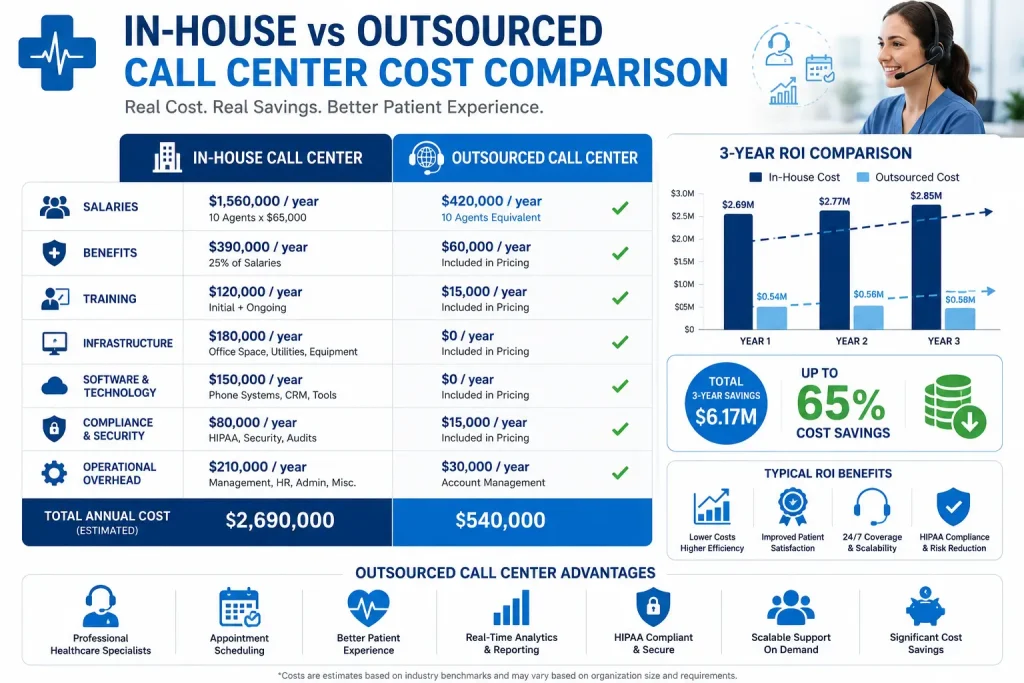
Cost Comparison: In-House vs Outsourced Teams
Let’s put the numbers next to each other the way a CFO actually needs to see them — fully loaded, not just salary line.
Estimated Annual Cost: In-House Patient Access Team
| Cost Component | Annual Estimate |
|---|---|
| Salaries (4 FTE front desk/access staff) | 160,000–220,000 |
| Benefits (health, PTO, retirement — ~30–35%) | 48,000–77,000 |
| Payroll taxes | 12,000–18,000 |
| Recruiting and training (with turnover) | 15,000–30,000 |
| Phone system and software licensing | 10,000–20,000 |
| QA and supervisory overhead | 20,000–40,000 |
| Office overhead (space, equipment) | 15,000–25,000 |
| After-hours coverage or answering service | 10,000–20,000 |
| Total estimated annual cost | 290,000–290,000–450,000 |
Estimated Annual Cost: Outsourced Equivalent Coverage
| Cost Component | Annual Estimate |
|---|---|
| Base service contract (equivalent coverage) | 144,000–240,000 |
| Onboarding and integration (amortized year 1) | 5,000–15,000 |
| QA and reporting add-ons | 6,000–12,000 |
| Holiday and after-hours premiums | 8,000–15,000 |
| Total estimated annual cost | 163,000–163,000–282,000 |
Realistic savings: 30–50% depending on your in-house staffing level, turnover history, and vendor selection. Year two savings typically improve as onboarding costs disappear.
The comparison shifts further in outsourcing’s favor when you factor in the management bandwidth recovered — practice managers who previously spent hours on scheduling, QA, and phone coverage issues redirect that time to higher-value work.
Factors That Increase Outsourcing Costs
Some organizations have to pay more for outsourcing services. There are factors that can increase these costs. It is an idea to know about these factors ahead of time so you are not surprised by the costs. One factor is calls. If the people answering the phones need to do more than just answer questions it will cost more. For example if they need to handle authorizations or referrals that is more complicated. Some medical specialties like cardiology or oncology also tend to have costs per call than regular doctors offices.
Another factor is language. If you need people who speak than one language that can cost more. Spanish is a language that is often included but other languages like Mandarin or Arabic can be more expensive. The length of the contract is also important. If you only want to sign up for a month at a time it will cost more. This is because the company you are hiring cannot spread out the costs of setting up the service over a period of time. If you sign up for a year or more you can often get a price.
If you need to increase the number of calls you are handling that can also cost more. For example if you are opening an office or running a campaign to get more patients the company you are hiring will need to train more people and get more equipment, which costs money. Some states have rules about patient privacy than others. For example California has a law called CMIA that’s stricter than the federal law called HIPAA. If you are in one of these states you may have to pay more for outsourcing services because there are companies that can meet the stricter rules.
How HIPAA Compliance Impacts Pricing
Following the rules of HIPAA is not optional it is required. However it is not free either. HIPAA compliance can affect the cost of outsourcing services in ways. Any company that handles calls on your behalf must sign an agreement promising to follow the rules. This is the requirement. What can vary is how thoroughly the company follows the rules and how much that costs.
Good companies include the cost of following HIPAA rules in their base price. This includes training their employees recording calls securely handling data in a way and having a plan in place in case of a breach. Some companies may quote you a price but that may be because they have not invested in following the rules, which can create problems for you.
The cost of not following the rules can be very high. If there is a breach you could be fined you could have to pay to fix the problem. Your reputation could be damaged. It is better to pay a little upfront to make sure the company you are hiring is following the rules. You should ask the company about their compliance procedures, such as how they train their employees how they handle information and what they would do in case of a breach.
If you are handling data and communications yourself you can look at the guidelines from AHIMA to see what the standards are, for following the rules. You can use these guidelines to evaluate the company you are hiring to make sure they are meeting the standards.
Cost Savings That Go Beyond Cutting Labor Costs
Getting Rid of Extra Costs and Administrative Work
The savings on labor costs are the noticeable but they don’t tell the whole story. When you outsource communication you get rid of several extra costs.
- Technology costs become simpler. The company you outsource to owns and takes care of the phone system software for recording calls, tools for monitoring quality and integrations for scheduling. You no longer have to pay for software licenses and the IT costs to manage them.
The cost of training goes away. Every time you hire a person for the front desk. And in healthcare you often have to hire many because people leave a lot. It takes weeks of training. When you outsource the company you work with takes on that cost. They hire, train supervise and keep the agents.
You get time to manage your practice. Managers who used to spend 30-40% of their time managing phone staff reviewing call logs and fixing coverage gaps can now use that time for things. The benefits of having time. Like better management and more strategic work. Are real but hard to show on a cost-comparison spreadsheet. You can save on facility costs. For organizations that are building or renovating not needing a space, for a call center is a significant cost saved.
The Return On Investment of Outsourced Healthcare Call Centers
The return on investment in healthcare outsourcing comes from two areas at the same time. Reducing costs and getting back revenue. And most people only think about the first one.
Improving How Resources Are Used Across Departments
When the staff at the front desk do not have to deal with a lot of phone calls they can go back to doing the work they were hired for. This includes checking in patients, processing insurance, coordinating care and providing support in person. This support directly affects how many patients are seen. The fact that staff can do their jobs again is very valuable. For example a clinical coordinator who spends two hours a day answering phone calls is not doing any coordination work during that time which means they are not doing any work that is worth money.
This is a deal when you think about it on a large scale. A big group with locations can use an outsourced partner to handle patient access. This means they do not have to have a lot of staff to answer phones at each location. Instead they can use those staff to do operational work. The group saves money. Can see more patients, which makes for a better experience for each patient.
For practices that want to improve their operations more using patient communication solutions that work with workflow management and customer relationship management tools can make things even more efficient. This is better than having a call center.
The other important thing is getting back revenue. If a practice can reduce the number of missed calls from 20 percent to 3 percent they can get bookings they would have lost reduce no-shows by sending reminders get appointments outside of regular hours and keep patients who might have left without saying anything. The financial impact of this is usually more, than the cost of outsourcing. Sometimes it is much more. Outsourced Healthcare Call Centers can really help with this.
How to Choose a Cost-Effective Vendor
The price of a vendor is not the important thing to consider. If you choose the vendor and they miss calls frustrate patients or fail to meet HIPAA requirements that will cost you more in the long run. So what should you actually look for in a vendor.
First you need to know what you are paying for. Ask the vendor for a breakdown of their costs, including the base rate, integration fees, quality assurance fees, holiday premiums, overflow rates and exit terms. If a vendor is not willing to provide this information that is a flag. You also need to consider the vendors experience in the healthcare industry. Just because a vendor has experience with call centers does not mean they understand the needs of healthcare providers. Ask for references from healthcare practices that’re similar to yours and actually contact those references to ask about their experiences.
The vendors ability to integrate with your technology systems is also crucial. Make sure they can work with your electronic health records system and scheduling platform. Ask them to explain their integration process and provide the cost in writing before you sign a contract. Compliance with regulations is also essential. Ask the vendor for their HIPAA training documentation, business associate agreement breach response protocol and a summary of their security infrastructure. The quality of this documentation will give you an idea of how the vendor takes compliance.
You should also understand what kind of performance metrics. Reporting you can expect from the vendor. What data will they provide, how often and in what format. You should be able to track metrics such as answer rate, abandonment rate, average handle time, appointment conversion and patient satisfaction.
A reputable vendor will offer a trial or pilot period. This will give you the opportunity to evaluate their performance before committing to a contract. Healthcare practices that want to improve their patient management systems can benefit from outsourcing their call center operations to a vendor that can integrate with their existing systems.
Recovering Revenue Through Better Patient Communication
A mistake when choosing a vendor is to focus solely on the cost. Instead you should consider how revenue you are losing due to missed calls, no-shows and patient churn and how much of that revenue the vendor can help you recover.
For example if a vendor costs $180,000 per year but can help you recover $240,000 in lost revenue that is not a cost. It is a gain of $60,000. Vendors that can demonstrate their ability to capture appointments reduce no-shows. Improve patient retention can provide you with the data you need to make a strong case, for investing in their services. Be sure to ask for this information. The HealthIT.gov website has documented the benefits of patient engagement and communication systems, including better clinical outcomes and operational efficiency.
AI Cost Savings in Healthcare Call Centers
AI is reshaping what outsourcing costs and what it’s capable of, and any evaluation that ignores it is already behind the market.
AI voice agents handle inbound calls for routine requests — appointment scheduling, hours and directions, prescription refill routing, balance inquiries — without a human agent. This deflects 20–40% of call volume in well-implemented systems, reducing the per-call cost significantly.
Automated scheduling allows patients to book, reschedule, and cancel appointments through voice or digital interfaces at any hour without an agent. The cost per scheduled appointment drops dramatically. No-show rates fall because reminders trigger automatically.
Smart call routing reads caller intent in real time and routes to the right destination — clinical nurse line, billing, scheduling, specific provider — without a phone tree maze. Handle time drops, first-call resolution improves.
Chatbot triage deflects web and app-based inquiries before they become phone calls. Patients who can get a quick answer through a chat interface don’t need to call at all, reducing the volume your agents handle.
Predictive analytics identifies patterns — peak call windows, appointment cancellation risk, patient churn signals — and lets you staff and communicate proactively rather than reactively.
The cost impact is real. Organizations that deploy AI alongside human agent support consistently report 15–35% reductions in per-call cost compared to human-only operations, while maintaining or improving patient satisfaction when the AI-to-human handoff is well designed. The organizations that get it wrong treat AI as a cost-cutting replacement rather than a capability amplifier — patients feel the difference immediately.
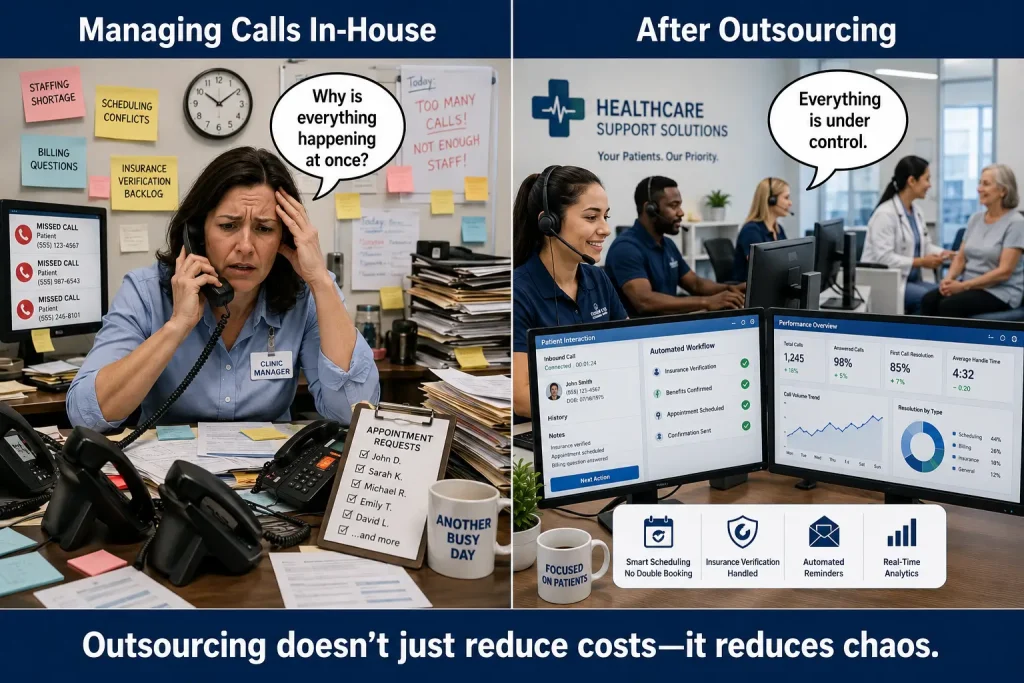
Is Healthcare Call Center Outsourcing Worth It?
For the vast majority of U.S. healthcare organizations, yes — with the qualification that it’s only worth it if done with a healthcare-specific partner who can demonstrate real performance metrics, transparent pricing, and genuine HIPAA discipline.
The math is straightforward: most organizations that run fully loaded in-house cost comparisons find that outsourcing delivers 30–50% cost savings. When you add revenue recovery from reduced missed calls and improved patient retention, the ROI often reaches the point where outsourcing isn’t just cheaper than in-house — it’s cheaper than the cost of doing nothing. The organizations that don’t get ROI from outsourcing are typically those that chose based on price alone, underinvested in onboarding, or handed off patient communication without defining protocols, metrics, or success criteria. The model works; the execution determines whether it works for you.
Small clinics and single-location practices should almost always outsource at least after-hours and overflow coverage. The in-house cost structure simply doesn’t work at low volume. Growing multi-location practices benefit most from outsourcing as a scalability engine — the phone infrastructure scales with the organization without the headcount lag that in-house staffing creates.
Large hospitals and health systems tend toward hybrid: an internal patient access department for complex, clinical, and relationship-intensive work, supplemented by outsourced capacity for overflow, after-hours, and high-volume routine transactions. Whatever your size, the conversation starts with an honest look at what your current phone lines are costing you — in direct overhead and in the revenue you can’t see because it’s walking out through calls that never got answered.
Ready to Know What Your Phone Lines Are Actually Costing You?
Most practices that go through this analysis are surprised by two numbers: how much their current approach is costing them, and how much revenue they’ve been quietly losing to missed calls. Both numbers are fixable.
Vocals Connected works with U.S. healthcare organizations — practices, clinics, multi-location groups, and telehealth providers — to build patient communication operations that reflect the quality of the care they deliver. Whether you need full-service outsourcing, overflow support, after-hours coverage, or help optimizing the systems underneath your patient access workflow, we start with your actual numbers rather than a generic proposal.
Contact Us to talk through what your current patient communication is costing, what better would look like, and what it would actually take to get there.