
Sit at the desk of a busy U.S. Medical practice for one hour, and you will learn more about the financial health of that medical practice than you would from a lot of profit and loss statements. The phone is the key. By 8:20 on a Monday, the phone lines are busy. A coordinator is checking in a patient at the counter while two people are waiting on hold. A nurse comes out. Asks about a request to refill a prescription from over the weekend. Somebody has been trying to reach the billing department since Friday. Nobody has called them back. Three people will hang up before 9:00. It is not because the staff did anything wrong.
The thing that most owners of practices do not understand is that the problem with the phone is not that the staff is not doing their job. It is that the staff is being asked to do two things at a time. Take care of the patient who is there and answer the phone for the patient who is calling. It is just not possible to do both things at the same time. So calls get missed. Every time a call gets missed, it is a patient who is not being taken care of. This patient could be one who would have come back to the medical practice many times or a patient who has been coming to the medical practice for a long time and has decided to go somewhere else because it is easier to get in touch with them. Maybe the patient had a question about their health. Because they did not get an answer, they did not come to their appointment or they had to go to the emergency room, or their health problem got worse.
I have spent a lot of time working with practices, and I see the same thing happening over and over again. Medical practices spend a lot of money on making sure the doctors and nurses are the best they can be, on making the office look nice, and on computer systems to keep track of information. When it comes to the phone, they just kind of leave it up to whoever happens to be working that day. This is where a company like Vocals Connected can really help. What I am going to talk about is not something to make you want to buy something from Vocals Connected. It is my opinion, from working with medical practices, about how talking to patients can help medical practices make more money, keep patients coming back, and just run more smoothly. And how to do it without wasting a lot of money.
What Are Healthcare Call Center Services?
The simple truth is that healthcare call center services handle phone calls with patients for practices, clinics, hospitals, and telehealth providers. But saying it like that does not do it justice. It is actually a lot more than that. This is why a lot of people in charge think of it as a cost that needs to be kept low instead of something that can help their business grow.
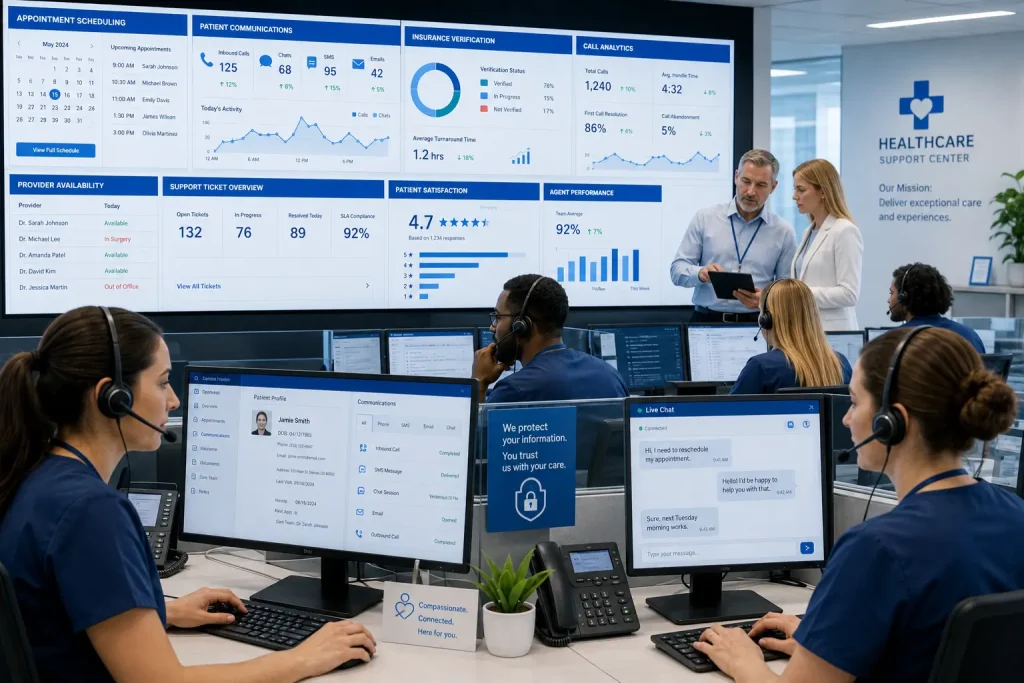
A real medical call center is not a bunch of people sitting in a room reading from a script. It is like a part of your office that handles patient calls. The people who work there are trained to book appointments, change appointments, check if patients have insurance, and help with patient issues. They can even help with getting prescriptions refilled and answering billing questions. They do all of this while sounding like they work directly for your practice, not like some generic company.
The best medical call centers have three parts. First, they have people who understand how medical offices work and can talk to patients in a kind and caring way. Second, they have technology that connects with your scheduling system and patient records so information can be shared quickly and easily. Third, they follow all the rules and regulations, like HIPAA, to keep information safe and private.
Some medical practices handle their phone calls while others pay someone else to do it. Some do a bit of both. What matters most is that patients can quickly get help from someone who knows what they are talking about, get their issue resolved in one phone call, and feel like they were treated with care. When this happens, it can have an impact. More patients book appointments, patients are happier, staff are less overwhelmed, and the medical practice can keep more of its money.
The people who work at these call centers are like the desk staff but on the phone. They help patients. Make sure they have a good experience. This is important because patients often call when they are worried or scared. The people who answer the phone need to be kind and helpful. A good healthcare call center service makes a difference. It helps patients get the help they need quickly and easily. It also helps medical practices run smoothly and make more money. This is why it is so important to get it.
Why Patient Communication Matters More Than Ever in Healthcare
People’s expectations of healthcare have. The healthcare system has not kept up. For example, when people can change their flight plans on their phone in a few seconds, they do not understand why they have to wait on the phone for eleven minutes to confirm a doctor’s appointment for dermatology. Other industries have taught people to expect responses, and they compare their healthcare providers to those industries, whether that is fair or not.
This is not just about making people happy. It actually affects how well people get better and the financial situation of the healthcare practice. The American Medical Association has done a lot of research that shows when doctors and patients communicate well, patients trust their doctors more and are more likely to follow their advice. When patients feel like they can talk to their doctors easily, they are more likely to keep their appointments, take their medicine, and stay with the doctor. The American Medical Association has found that good communication between patients and doctors leads to results in many areas.
There is also an aspect to consider. In parts of the United States, patients have many choices for their healthcare. When a new patient is looking for a doctor, they do not owe anything to any doctor. If one doctor’s office sends them to voicemail but another doctor’s office answers the phone and can see them soon, the first doctor will lose that patient without even knowing it. This kind of loss will not show up in any marketing reports.
The government also agrees that good communication is important for healthcare. The Agency for Healthcare Research and Quality thinks that patient experience is a part of good healthcare, not just a nice thing to have. When the Agency for Healthcare Research and Quality says that being responsive to patients is part of providing care, answering the phone becomes more than just an administrative task. It becomes a way to provide good care and build a good reputation. That is the point of this discussion about healthcare and patient communication and the importance of the Agency for Healthcare Research and Quality and the American Medical Association.
Common Challenges Healthcare Providers Face Without Call Center Support
Before we can find solutions we need to take a look at how communication breaks down. Most practices are living with problems that they have stopped noticing. This dysfunction becomes like background noise. We do not fix background noise.
Missed Patient Calls and Lost Revenue
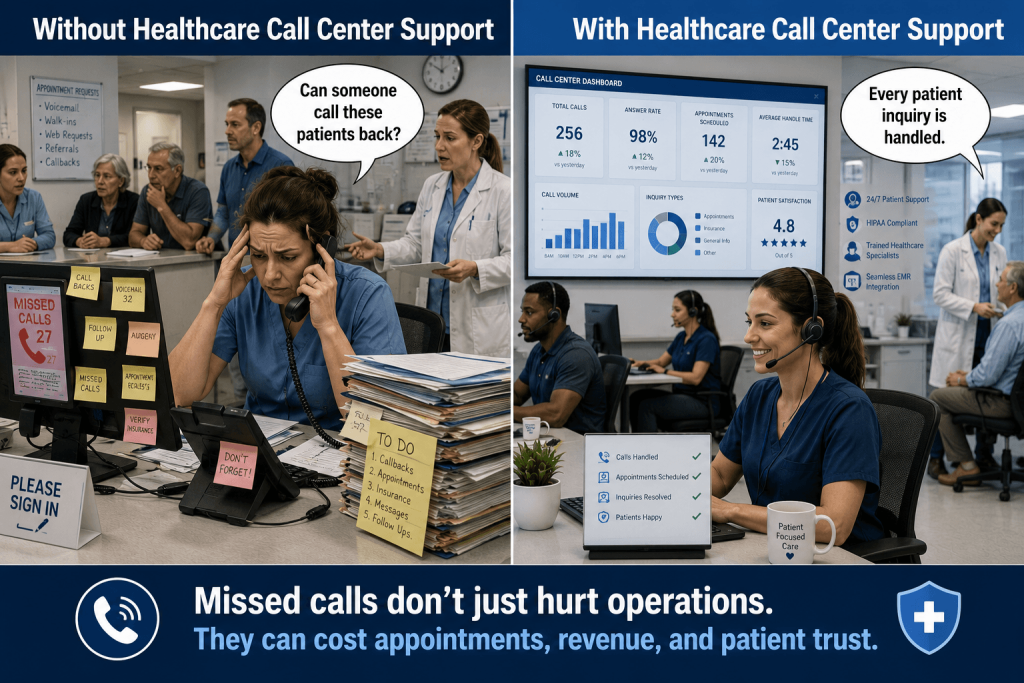
I want to give you some numbers to think about because when we talk about things in terms it is easy to ignore the problem. Let us say your practice gets 200 calls a day and misses 15% of them. This is an estimate for a front desk that is short staffed during peak hours. That is 30 missed calls every day or about 600 missed calls a month. If we assume that one in five of these missed calls was from a new patient trying to book an appointment and your average new patient is worth $1,200 in the first year then that is about 120 lost new patients a year and $144,000 in lost revenue. Nobody did anything the phone just rang at the wrong time.
The damage gets worse with existing patients. When someone cannot reach you about a concern they do not always call back. Instead they might go to care or the emergency room or they might wait and let a small issue become a big problem or they might just switch to a different practice. Losing patients is expensive. It is hard to see until you measure it. Missed calls are one of the reasons patients leave and it is mostly invisible.
Appointment Scheduling Bottlenecks
Scheduling appointments is where things go wrong. Your front desk wants to help the patient who is standing there the patient who’s on the phone and the patient who needs a refill all at the same time.. They cannot do all of these things at once. So calls get put on hold by accident of on purpose. The patient who is standing at the desk always gets helped first which means the patient on the phone gets put on hold.
This creates a pattern: on your busiest days when you are seeing the most patients you are also answering the fewest phone calls. The more patients you see the fewer calls you answer. For practices with locations this problem gets even worse because each location is trying to solve the same problem on its own without any help from the other locations. One office might be very busy while another office is quiet and the calls do not get passed between them. Specialized practices, like cardiology or orthopedics have a harder time because their phone calls are often more complicated and take longer.
Administrative Staff Burnout
This is the part that keeps practice administrators up at night. The problem with the phone is also a problem with the people who answer it. The staff who work at the desk and answer phones already have a hard time keeping their jobs and the constant pressure of answering phones makes it even harder. When staff spend all day apologizing for putting people on hold and trying to manage chaos they get burned out. When they get burned out they quit. When they quit you have to hire and train people and the problem gets even worse while you are trying to fill the gap.
It is a cycle: not having enough staff causes missed calls missed calls cause stress stress causes staff to quit and staff quitting makes the problem of not having enough staff even worse. If you get some help with answering phones either by hiring more staff or by using an outside service you can break this cycle and give your staff the time they need to focus on the patients who are actually, in the office.
Benefits of Healthcare Call Center Services
Now the good part, which tends to surprise the people who approved the spending because it shows up in places than they expected.
Improved Patient Experience
The thing patients notice is that someone actually answers the phone. This sounds too simple to matter. It is the foundation of everything else. A patient who reaches an competent person on the first try forms an instant judgment: this practice is well organized. That impression stays with them when they go into the exam room and when they write reviews on websites that now influence a lot of patient decisions.

Good support also means being consistent. Your front desk has days and bad days just like everyone else. A run patient communication operation provides the same quality at 8 a.m. On Monday and 4:45 p.m. On Friday, when your in-house team is tired. For after-hours coverage it is a change. A patient who calls at 9 p.m. With a worry and reaches a person instead of a recording remembers exactly how that felt.
Higher Appointment Booking Rates
This is the benefit that pays for the Patient Communication service outright. When every call is answered and every booking opportunity is captured your conversion rate goes up. As importantly your no-show rate usually goes down because reminders and easy rescheduling keep the schedule full. I have seen practices get back patients they did not know they were losing. Patients who needed to cancel could not get through to rebook and just disappeared. If you multiply that across a month you are looking at a lot of chairs that reliable coverage and reminders turn back into revenue.
Better Operational Efficiency
When phone volume moves off the clinical floor, your in-house staff reclaim their day. Nurses stop fielding scheduling calls. The front desk stops triaging billing questions mid-check-in. Everyone does the work they were actually trained and paid to do.
This is where your underlying systems decide whether efficiency is real or theatrical. A call center is only as good as its connection to your data. If agents see live availability, patient history, and insurance status, they resolve in one call instead of three. That’s why smart practices pair call center improvements with cleaner back-end systems—getting your scheduling, patient records, and communication tools to actually talk to one another is a project worth doing right, and bringing in CRM Implementation Consulting early prevents the disconnected, double-entry mess that quietly taxes so many practices for years.
Types of Healthcare Call Center Services
Not every doctors office needs all the services so it is helpful to look at the options and choose the ones that are actually causing problems. Inbound patient support is the important part: making appointments and changing them answering general questions checking insurance and sending clinical questions to the right people. Doctors offices start with this because it is where they are having the most trouble.
Some companies provide answering services for when the office is closed and for when they are too busy. Of patients leaving a message on a machine they talk to a real person who follows the offices rules. Taking messages telling the doctor about urgent problems and helping with simple things until the office opens again. Appointment scheduling services do more than just make appointments. They also help with confirming appointments sending reminders filling openings when someone cancels and reminding patients to come for check-ups and other care they might have forgotten about.
Patient communication services also include calling patients to check in see how they are doing and remind them to pay their bills. This is done by a person, not a machine, which makes it more personal. Telehealth support services are an area that has grown because of virtual doctors visits. This has created problems like helping patients who are having trouble using the video platform giving them instructions before their visit and coordinating between virtual and in-person care. The website HealthIT.gov has shown how much patient care is moving online and how this is making work for doctors and their staff. The resources on HealthIT.gov make it clear that as more care is done online the workload is getting bigger not smaller.
All of these services rely on the technology that the doctors office uses to manage information. This is why it is so important to have a system in place. If you have never used a system like this before it might be helpful to learn what a CRM consultant does. They help set up a system that turns interactions, with patients into a clear and organized patient record that the whole staff can see.
Healthcare Call Center Services for Different Types of Medical Providers
Generic call center advice does not work well for providers. This is because a dental office and a large hospital system have different needs. A good partner understands these differences; a bad one uses the approach for everyone and gets frustrating results. Primary care and family practices handle a volume of calls. They deal with visits, prescription refills, test results and referrals. The goal is to answer calls and route patients correctly. This is important because incorrect routing can have consequences.
Specialty practices like cardiology orthopedics and dermatology have calls. These calls involve insurance approvals, test coordination and referrals. They take a time to resolve. Agents need training to handle these calls. A call center that treats these calls like bookings will upset both patients and referring doctors. Dental practices rely heavily on their schedule. They focus on reminding patients about appointments. A missed appointment can make a difference, in their daily profit. They benefit from automated reminders and reactivation campaigns.
Urgent care centers have call volumes. Patients are often anxious. Want quick answers. They need to know wait times, locations and triage information. This helps them decide whether to visit the urgent care center or the emergency room. Telehealth providers need call center support that understands scheduling and basic tech issues. If a patient can’t connect to their video visit it can lead to reviews and missed appointments. Good telehealth support helps prevent these problems.
Hospitals and large medical groups benefit from patient access. This means consolidating services into one coordinated hub. This approach reduces fragmentation. Makes it easier for patients to get the help they need. It eliminates the need for patients to repeat their information times.
In-House vs Outsourced Healthcare Call Center Services
When it comes to deciding between in-house and outsourced healthcare call center services administrators have a time. The truth is, it really depends on the size of your practice how fast you are growing and how time your management team has to handle things.
If you build an in-house call center you get to be in charge of everything. Your team knows the doctors, the way your office works and the people in your area. They are a part of your team. The downside is that it can be expensive to have a team that’s only busy at certain times and not so busy at other times. You have to pay for staff even when they’re not busy and you also have to pay for things like recruiting, training and equipment.. If a few people are out sick it can be hard to keep up with all the calls.
On the hand if you outsource your call center you give up some control but you get a team that is ready to go and can handle calls when you need them to. A good outsourcing partner will have trained staff, good technology and a way to follow the rules. You will only pay for the calls they handle so you do not have to worry about paying for time.. You will have to put in some work to get them started like teaching them how to handle calls the way you want them to.
For a lot of practices in the US a combination of in-house and outsourced call center services is the best way to go. You can keep a team in-house to handle complex or relationship-heavy calls and send other calls to an outsourcing partner. This way you get to keep the touch for important calls and still have the extra help you need when things get busy.
No matter which way you choose to go it is really important to have a system, in place to make sure everything runs smoothly. This means mapping out how calls will be handled, deciding how to handle calls and keeping track of how things are going. This is where a lot of call centers fall short.. With the right help like CRM Consulting Services you can turn your call center into a tool that really helps your practice grow.
Healthcare Call Center Outsourcing Costs
Let us talk about money in a way because vague answers about pricing do not help anyone. The cost of a healthcare call center in the United States usually follows a few models. You can pay for each minute or each call based on how you use the service. This is an option if you do not get many calls or if you only get calls at certain times of the year. You will not have to pay for the times when no one is using the service. The cost will go up as you get more calls. If you get a lot of calls at once it can be expensive.
You can also pay for an agent or a set number of hours. This is an option if you get a lot of calls all the time and you want the same people to answer your calls. The cost will be the same every month. The people who answer your calls will get to know your office and how it works.
Some services use a mix of a base rate and a rate based on how much you use the service. This is an option if you get a lot of calls at certain times but not at other times. The amount you will have to pay can vary a lot depending on what you need how hours you need the service and how complicated your needs are. A basic service that just answers calls when your office is closed will cost less than a service that can handle calls in many languages and has people who are trained in medicine and can use your computer system. Of just looking at the cost you should think about how much money the service can help you make. If a service costs an amount of money every month but it helps you get more patients then it is probably a good investment. A lot of people make the mistake of thinking that the cost of a call center is something they should try to minimize, when really it is something that can help them make money. If you choose the option and it does not do a good job it can end up costing you more money in the long run.
How to Choose the Right Healthcare Call Center Partner
When people are choosing a call center they usually focus on the cost and the features of the service. These things are important. They are not the only things you should consider. Here are some other things to think about.
It is very important that the call center follows the rules of the Health Insurance Portability and Accountability Act also known as HIPAA. Anyone can say they follow these rules. You should ask them how they train their employees to handle private health information how they keep track of when they tell people about a patients health what they do if there is a problem with someones health information and if they will sign an agreement that says they will follow the rules. You should also ask about the security of their computer system. Not just look at the badge on their website.
It is also important that the call center has experience working with healthcare companies. A company that only has experience working with telecommunications companies may not be able to understand the needs of a healthcare company. You should ask for references from healthcare companies that are similar to yours and then you should call those companies to ask about their experiences.
The call center should also be able to work with your computer system so that they can make appointments and get information about patients. If they cannot do this it will be less efficient. Your employees will have to do more work. You should ask the call center how they can work with your computer system and what it will take to set it up.
The people who work at the call center are also very important. While some things can be automated there are some things that require a touch. The best call centers use automation to help with tasks but they also have people who can talk to patients and understand their needs. You should ask the call center how they decide when to use automation and when to use a human and make sure it is what you want for your patients.
You should also be able to see how well the call center is doing. A good call center will give you reports that show how calls they answer how many calls they miss how long it takes to handle each call how many appointments they make and how happy patients are with the service. If a call center is not willing to give you this information it may be a sign that they are not doing a job. Finally you should think about whether the call center’s a good fit, for your company. The people who work at the call center will be representing your company so you want to make sure they are people you would want to represent you. If they do not seem like the fit it does not matter what features they offer.
Future Trends in Healthcare Customer Support
The few years are going to change how patients communicate with healthcare providers and U.S. Practices that adapt quickly will be ahead of the game. AI-assisted support is getting fast. We are moving away from phone menus and towards systems that really understand what patients need handle simple tasks from start to finish and pass on complex issues to humans when needed. The best approach is not to replace people with AI but to use AI to handle tasks so that people can focus on more important things. If you think of AI as a solution or a threat you will be wrong; if you see it as a tool that helps your team you will be right.
Patients now expect to communicate with healthcare providers through channels, including phone, text, online portal and chat. They also expect these channels to remember their conversations. When channels are not connected and each one starts from scratch it frustrates patients and wastes staff time. The technology to connect these channels. Healthcare providers that use it seem more responsive to patients.
Proactive outreach is becoming a practice. Of waiting for patients to call leading healthcare providers reach out to them with reminders for preventive care follow-ups for gaps in care and check-ins after discharge. This approach improves outcomes and revenue and patients expect healthcare providers to be proactive and attentive rather than passive.
Using data to personalize patient interactions ties everything. As patient management systems get smarter every interaction can be informed by a patients history and context. This is why the systems that support your call center are so important. The communication layer is only as good as the data that feeds it.
Frequently Asked Questions
- What do healthcare call center services include?
These services typically cover communication with patients, including scheduling and rescheduling appointments, verifying insurance coordinating prescription refills handling calls answering questions after hours recovering from missed appointments sending reminders and handling billing and administrative questions. These tasks are handled by trained agents who’re aware of HIPAA rules and are connected to your scheduling system and electronic health records.
- Are healthcare call centers HIPAA compliant?
A reputable call center partner should be HIPAA compliant. They should be able to prove it by showing how they handle protected health information train their agents secure their infrastructure handle breaches and sign a Business Associate Agreement. Compliance should be demonstrated, not just claimed.
- How much do healthcare call center services cost in the U.S.?
The cost of these services varies depending on the scope of work the hours of coverage and the complexity of the tasks. The cost is usually structured as a per-minute or per-call fee, a per-agent or dedicated fee or a hybrid model. When evaluating the cost consider the return on investment including recovered patients reduced missed appointments and freed-up staff time.
- Will an outsourced call center sound like my practice?
A good call center partner will sound like your practice if you onboard them properly. This means giving them your protocols, scripts, tone and escalation rules. Strong partners train their agents to represent your practice while weak ones sound like a generic vendor. That’s why references and trial calls are important.
- Can a call center integrate with my EHR and scheduling system?
Yes. It should. Efficient operations depend on agents having access, to live availability, patient history and insurance status. Ask any partner how they integrate with your system and what the implementation process looks like.