
I know a practice owner in the Midwest who thought his marketing was not doing well. He was not getting as many new patients as he wanted for two quarters, even though he was spending a lot of money on ads. He wanted to fire the company that was helping him with his marketing. Before he did that, we looked at his phone records. We found out that the people working at the desk were missing a lot of calls between 11 a.m. And 2 p.m. This is the time when his ads were making the most people call him. So the marketing was actually working. The problem was that the people at the desk were not answering the phone. He was not losing patients because his marketing was bad; he was losing patients because he was paying for ads to get them to call. Then he was not answering the phone.
This kind of thing happens a lot in practices in the U.S. People do not like to talk about it. That is why I get upset when someone says that a missed call is no deal; it is just a voicemail. A missed call from a patient is a deal. It means that the patient might not make an appointment, a patient who already goes to the practice might get frustrated, a patient might not get the treatment they need, a patient might not write a review, and the practice might lose money. There are companies, like Vocals Connected, that can help fix this problem. You have to be willing to look at the problem first. You have to measure how many calls you are missing. So let us look at the problem honestly and see how many calls we are missing from patients. The practice owner, his marketing, the practice owner and his phone records, the practice owner and his front desk all of these things are important to look at when we talk about patients and missed calls.
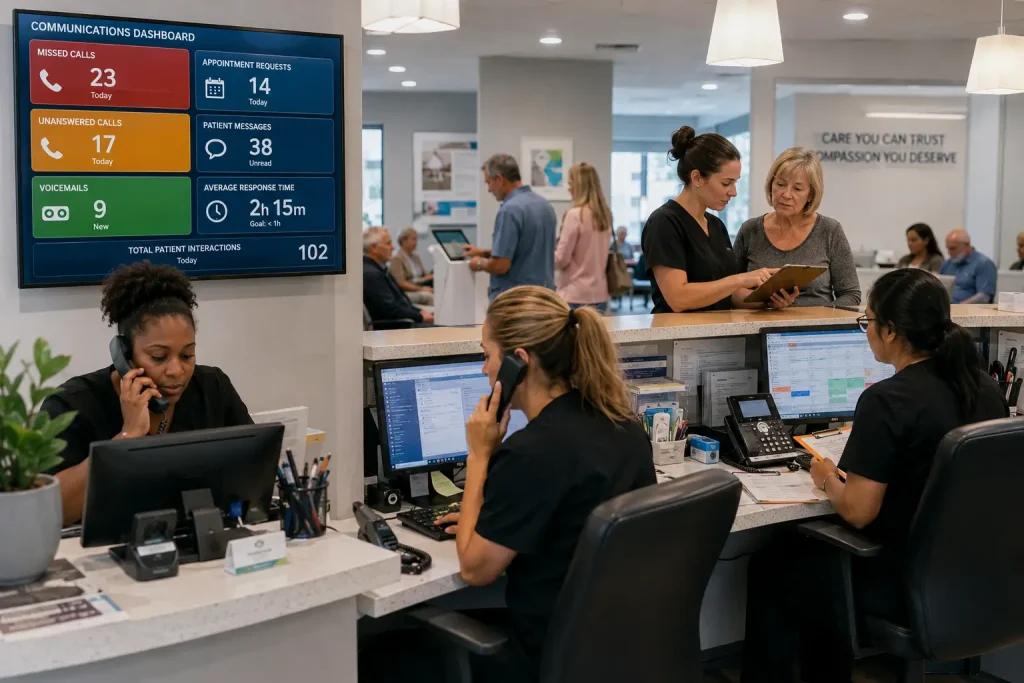
Why Every Missed Patient Call Matters
Healthcare leaders are taught to think about risk and quality metrics. This is why the financial impact of a ringing phone is often overlooked. The phone does not show up on a quality dashboard. It does not trigger an alert. It just rings, and sometimes nobody picks up, and the consequence happens later when it is hard to trace back.
What makes a missed call different from operational issues is that the person on the other end has already decided to engage with the healthcare practice. They have crossed the threshold in the entire patient acquisition and retention process. They reached for the phone. A new patient calling is someone who chose the practice over alternatives. An existing patient calling is someone giving the practice the chance to keep them rather than going to another practice. When that call goes unanswered, the practice is not failing to generate demand. The practice is squandering demand it already earned.
Patients do not behave the way the old voicemail model assumes. The assumption was that they would leave a message and patiently wait for a callback. In reality, many callers simply hang up. Dial the next provider or give up entirely. The call that was missed at 11:40 does not sit in a queue waiting for a callback. It is already gone, often to a competitor who answered on the ring.
The Hidden Revenue Impact of Missed Patient Calls
Let me explain the math in a way. Take a practice that handles 200 calls a day. Assume a 15% miss rate during peak periods. This is lower than what’s found at many understaffed offices. This means 30 calls daily, around 600 a month, roughly 7,200 a year. Not every missed call is a patient, so assume only one in five missed calls is a prospective new patient trying to book. This is 1,440 missed new-patient opportunities annually.
If the practice converts a small fraction of those. Say 10% would have booked and stayed. That is 144 new patients lost. At a first-year value of $1,200 per patient, the practice is looking at roughly $172,000 in first-year revenue that never materialized. If we project the lifetime value, the number gets very big fast.
This is the new-patient side. The existing-patient losses are more subtle and arguably worse. Every missed call from a patient is a no-show waiting to happen: a refill that does not get coordinated, a balance that does not get paid, or a relationship that erodes one frustration at a time. None of these show up as a “missed call”. They show up disguised as a month with a high no-show rate or an attrition number that cannot be fully explained.
The worst part is that this problem gets bigger as the practice gets more successful. The busier and more sought-after the practice becomes, the more calls it receives, and the more the front-desk capacity gets overwhelmed during peaks. Growth can make the problem worse unless the communication capacity grows with it. Missed patient calls matter because they are a loss for the practice. Missed patient calls matter because they can cost the practice a lot of money. Missed patient calls matter because they can hurt the practice’s relationships with its patients.

Common Reasons Healthcare Providers Miss Patient Calls
You have to know where the problem is coming from before you can fix it. From what I have seen, the problem usually happens in three areas.
High Call Volumes During Peak Hours
The number of calls healthcare providers get is not the same all the time. There are a lot of calls in the morning when people are getting ready for work, a lot of calls at lunchtime, and a lot of calls in the afternoon. If the front desk is only staffed for the number of calls, they will be overwhelmed during the busy times. This is what I see often: healthcare providers who seem to have enough staff but still miss a lot of calls during the busy times of the day.
Urgent care centers have a tough time with this, especially during flu season on weekends and when the weather is bad. The number of calls they get can increase suddenly. Be very hard to handle. Specialty clinics have a problem: their calls take a long time because they have to deal with things like getting permission from insurance companies and coordinating with other healthcare providers. Even if they do not get a lot of calls, the calls they do get can still be too much for them to handle.
Limited Front Desk Resources
The people who work at the desk have to do two jobs that are very different and cannot be done at the same time: they have to help the patients who are standing in front of them, and they have to answer the phone. When both things happen at the same time, the patient who is standing in front of them always gets helped first. You cannot put a person who is standing in front of you on hold. So the phone call is the one that gets missed, not because someone decided to ignore it. Because it is just not possible to do both things at the same time. A dental practice that has two people working at the front desk during a busy time of day cannot answer the phone and help the patients who are coming in and leaving at the same time. It is not a matter of the staff not being disciplined it is a matter of math.
After-Hours Patient Inquiries
Patients think about their health. Try to contact their healthcare providers at all times of day and night. They often try to contact them in the evenings, on weekends, and early in the morning. These are the times when healthcare providers are closed, so patients get a recording instead of a person. For patients, especially new patients who are trying to find a healthcare provider, getting a recording is the end of the line. They will hang up. Try to contact another healthcare provider who answers their phone. Healthcare providers miss these patient calls because they are not available to answer the phone when the patients call. Patient calls are missed when healthcare providers are not open. This is a problem that healthcare providers need to fix.
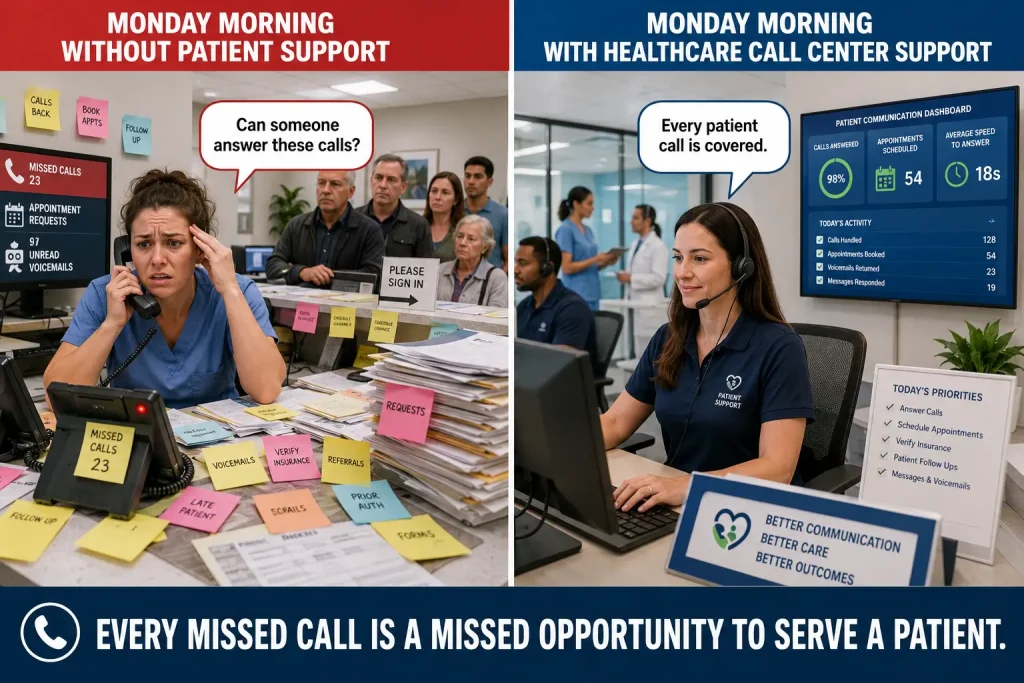
The Impact of Calls on Patient Experience and Retention
The main thing people think about is money, but patient experience is what is really going on underneath, and it needs to be looked at carefully.
Delayed Access to Care
When a patient tries to call you and cannot get through, they do not get the care they need away, and this causes a lot of problems. A patient who is worried about a symptom that is getting worse may wait a long time to get help, and then they have to go to urgent care or the emergency room, or their condition gets worse. This is a problem for the patient’s health first. Then it is a problem for the money, but it is both. The American Medical Association says that being able to get in touch with the doctor and getting care when you need it is very important for how the patient does, and they have done a lot of work to show that being able to reach the doctor is not just a nice thing to have; it is part of the care.
Patients Get Frustrated. Go to Other Doctors
Patients expect to be able to get things done quickly as they do in other parts of their life. When they can do anything else on their phone in just a few seconds and they cannot get a call back from their doctor’s office, it seems like the doctor does not care. Patients do something about it. The patient who is frustrated because they could not get a call back does not usually say anything; they just. Often, they write a review on their way out explaining why they are leaving. One call that is not returned can cost you a patient. It can also hurt your reputation with other people who might want to come to your office.
Patients Are Loyal
Patients become loyal to their doctor through a lot of small, reliable interactions, and they stop being loyal the same way. Each time a patient has trouble getting in touch with their doctor, the relationship gets a little weaker. The patient may not switch to a doctor after the first time they have a problem, but after the second and third time it starts to seem like a good idea to leave. By the time you notice that patients are leaving, the problem has already been going on for months, one missed call at a time. It is a lot cheaper to keep the patients you already have than it is to get new ones, which makes it very expensive when patients leave because of problems with communication.
The Problems Missed Patient Calls Cause
Missed patient calls do not just cost a medical practice money and make patients unhappy. They also make it harder for the practice to run smoothly. When patient calls are missed, the work does not go away. It comes back later. Is more complicated and expensive. The patient who could not book an appointment will call again tomorrow, which adds to the number of calls. The prescription refill that was not taken care of becomes a problem during clinic hours. The billing question that was not answered becomes an angrier call the following week. Missed patient calls lead to work, and this extra work is a waste of time and resources.
There is also a problem with staffing. Front desk and intake staff at practices in the United States often leave their jobs. The constant pressure of answering phones, dealing with patients, and saying sorry for long wait times all day makes staff feel tired and unhappy. When staff feel tired and unhappy, they are more likely to leave their jobs. When staff leave, there are no people to do the work, which means more patient calls are missed. This creates a cycle that’s hard to break. Once a medical practice is in this cycle, the problems with the phone and staffing become connected and cannot be solved separately.
The Agency for Healthcare Research and Quality believes that a medical practice must be able to operate and provide a good experience for patients in order to provide high-quality care. This is a reminder that a front office that is not organized is not just a minor problem. It is a risk to the quality of care that affects every patient who interacts with it. The Agency for Healthcare Research and Quality helps us understand that missed patient calls and poor staffing can affect the quality of care that patients receive.
Healthcare Call Center Services are really helpful in reducing missed opportunities.
This is where the problem meets a solution. Healthcare Call Center Services exist to help with communication when your in-house team is busy. These services do a lot more than just answer phone calls. When Healthcare Call Center Services handle overflow calls, after-hours calls, and routine volume calls, they help stop missed opportunities. Healthcare Call Center Services are very good at handling these types of calls.
One of the things about Healthcare Call Center Services is that they are available 24 hours a day, 7 days a week. This means that patients can talk to a person at any time even after hours. This is especially important for care centers and telehealth providers where patients need help at odd hours.
Healthcare Call Center Services also make it easier to schedule appointments. When patients call, they can talk to someone and schedule an appointment. This means that patients are more likely to schedule an appointment when they are motivated than waiting and possibly going somewhere else.
Healthcare Call Center Services also improve communication. When patients call, they get to talk to someone who’s calm and knowledgeable. This is true when your in-house team is busy. Patients like this consistency. It helps build loyalty to Healthcare Call Center Services. Patients feel like they can rely on Healthcare Call Center Services. That is important for building trust.
Strategies Healthcare Providers Can Use to Reduce Missed Calls
You do not always need to hire someone outside your practice to solve the problem. There are things you can do inside your practice to make a difference. First, you need to know how big the problem is. Look at your phone records to see how many calls you are not answering. Check the times of day when you are missing calls. This will help you see where the problem is.
Next, try to separate the person who answers the phone from the person who works at the counter during times. Even having one person just answer phones for a few hours can make a big difference. Make a plan to call back people who hang up while you are busy. Think about using scheduling and text messages to answer simple questions. This can help free up your staff to answer the calls that really need a person. The goal is to make sure you answer the calls.
Be honest about how much staff you can afford. If you are missing calls all day and you cannot afford to hire staff, it might be time to get some extra help. This can be a choice to make sure you answer all the calls that matter.
The Role of Technology in Modern Patient Communication
Technology is what makes everything work better when it is used in a certain way. It is not about adding technology to what we already do.
AI-Assisted Call Routing is an example of this.
This system can understand what a caller wants and send them to the person. It can also handle requests on its own and make sure that urgent matters are dealt with right away by a human. When this system is used well, it saves time. Let’s let humans focus on the conversations that really need their attention and care. When it is not used well, it can be very frustrating for patients and make them not want to call back.
CRM and Patient Management Systems are also very important.
The people who answer the phone at an office can only be as good as the information they have. When they can see a patient’s history and upcoming appointments in one place, they can solve problems in one call instead of three. The problem is that a lot of offices have different systems that do not talk to each other. This means that the people who answer the phone do not have all the information they need. CRM Consulting Services can help fix this problem. They can make sure that all the systems work together and share information. This is what makes the communication system work well.
Omnichannel Patient Support is what patients want.
Patients want to be able to call, text, or chat with their office and have all their conversations remembered. They do not want to have to start from the beginning every time they call. The website HealthIT.gov has information on how patients are using more and more digital ways to communicate with their medical offices. It also explains how this can be a lot of work for offices. When all these different ways of communicating are connected, it makes a big difference. It makes the medical office seem modern and responsive rather than fragmented and frustrating. Technology like this is what makes Patient Communication work well.
How to Measure the Cost of Missed Patient Calls
You cannot manage what you do not measure. The good news is that the cost of missed patient calls is more measurable than most administrators think. To do this, you need to have systems and clean data. This is where pairing measurement with CRM Implementation Consulting helps. You need to have information before you can do the math.
To start, you need to look at four numbers from your phone system and EHR. First, you need to look at your answer and abandonment rates. You should break these down by hour so you can see when you are busiest. Second, you need to know the value of a new patient. This includes how much they are worth in the year and over their lifetime. Third, you need to know your booking conversion rate for patient calls that you answer. This will help you guess how many missed patient calls would have turned into bookings. Fourth, you need to know your no-show rate and how many of these are because patients could not reach you to confirm or change their appointments.
If you multiply the number of missed patient calls by your conversion rate and the value of a patient, you can get a good idea of how much revenue you are losing. If you add the revenue you lose because of no-shows and the cost of losing patients, you will get a picture. This number is usually bigger than leaders think it is. It changes the way you think about spending money on support. Suddenly, spending a thousand dollars a month on patient support does not seem like a cost. It seems like a part of what you are already losing.
Building a Better Patient Communication Strategy
The practices that do a job with this do not just think about answering the phone better. They think about designing a communication system that works from start to finish. They look at how patients can reach them at any time and through any method. They find the gaps in the system. Fix them on purpose. They use changes, technology, and outside help to do this.
They make sure someone is in charge of answering the phone. This is like having someone in charge of collecting money. They set goals. Watch the numbers. If the number of abandoned calls starts to rise, they see it as a warning sign. They make sure that people who are skilled and caring are handling the calls. They use automation for calls. They also make sure they can handle calls as the practice grows. This way, the practice can get bigger without losing patients.
Importantly, they stop thinking of patient communication as just a cost. They start thinking of it as the door of the practice. It is one of the important things they can do to protect their revenue and grow their patient base. They think of communication as a good investment.
Frequently Asked Questions
- How many calls does a typical medical practice actually miss?
This really varies. Medical practices with understaffed front desks often miss a lot of calls. We are talking about 15 percent or more during the busiest times of the day. Some medical practices miss more calls than that. The only way to figure out how many calls your practice is missing is to look at the hourly answer and abandonment data from your phone system. Most medical practices are surprised when they see the numbers.
- Do patients really leave because of one missed call?
Sometimes patients do leave because of one missed call. Patients who are looking for a new doctor and are calling around to different medical practices. If they cannot get through to your practice, they will just call the next doctor on their list. For patients who already go to your practice, it is usually not just one missed call that makes them leave. It is usually because they have had a hard time getting through to your medical practice many times, and that makes them feel like it is okay to leave. Either way, missed calls are a reason why patients leave a medical practice.
- Isn’t voicemail enough for after-hours calls?
For some people who call a practice after-hours, voicemail might be okay. For people who really need to talk to a doctor or have urgent concerns, voicemail is not enough. A lot of these people will just hang up. Call a different doctor. If a medical practice has someone answering the phones after hours, they can catch these calls. Help these patients.
- How do I calculate what missed calls are costing my practice?
To figure out how much missed calls are costing your medical practice, you need to add up a few things. First, you need to know how many calls your practice is missing. Then you need to know how often you are able to book patients when you do answer the phone. You also need to know how much each patient is worth to your practice. Finally, you need to add in the costs of patients who do not show up for their appointments and patients who leave your practice because of communication problems. When you add all of these things up, you will probably be surprised at how much money missed calls are costing your medical practice.
- Will adding front-desk staff fix the problem?
Adding staff to the front desk of your medical practice can help with missed calls, but it is not a perfect solution. There will still be times when the phones are really busy, and your staff cannot keep up. There are also going to be times when your staff is not working, like after hours, and patients are still trying to call your practice. A lot of practices find that it works better to make some changes internally and also get some extra help to support the front desk staff. This can be an effective way to make sure that patients can get through to your medical practice when they call.
The Quiet Leak Worth Fixing First
Most medical offices spend a lot of money to get the phone to ring. They do things like marketing and building a reputation so patients will call them. Then they let a lot of these calls go to waste when the office is closed for lunch or at night. This is like filling a bucket with water when the bucket has a hole in it and getting upset with the water faucet.
The good thing is that this problem is easy to fix. You can figure out how many calls you are missing, and you can do things to stop it from happening. The Vocals Connected people can help you fix this problem. It will be worth it. When you fix this problem the Vocals Connected people can help you see how much money you were losing because of missed calls.
If you want to know how much money you are losing when people call your office and nobody answers. The missed calls. And you want to make a system so patients can always get in touch with you, then you should Contact Us at Vocals Connected. The people, at Vocals Connected will help you understand what is happening with your missed calls. Then they will help you fix the problem so you do not lose any more money.