
For businesses that are growing, getting a CRM platform seems like the next thing to do to make customer relationships better, make operations easier, and make more money. Buying CRM software is just the start. The hard part is putting the system in place correctly, making it work with the way the business already works, and making sure employees actually use it. A lot of CRM projects fail because businesses do not plan enough, do not manage data well, do not design workflows well, and do not manage change well. This is not because of the technology. Because businesses do not think about all the things they need to do to make it work. Without a plan for putting the system in place, businesses often have problems like employees not using it, customer data that is not correct, operations that are disrupted, and not getting the money back that they expected.
This is where CRM implementation consulting can help. Rather than just looking at putting the CRM system in place as a technical project, consultants who help with implementation focus on making the system work with what the business wants to achieve, what customers need, how sales work, and what the business wants to do in the long term. They help businesses figure out what they need, set up the system correctly, move customer data to the system, connect important tools, and create workflows that make employees more productive. This means the CRM system does more than store customer information. It actually helps the business make good decisions, work together, and engage with customers.
For businesses that want to improve customer support and sell more, putting a CRM system in place should be seen as a way to change the business, not just a way to install software. When it is done well, it creates a place for customer information, makes it easier for teams to see what is going on, and gives leaders the information they need to make good decisions. As the Vocals Connected CRM Consulting Services guide says, businesses that plan well and get help from experts are more likely to have happy customers, work more efficiently, and keep growing over time. This guide will walk you through the steps to put a CRM system in place, problems that come up and best practices that help businesses that are growing get the most out of their CRM investment.

What Is CRM Implementation Consulting?
CRM implementation consulting is the process of getting a customer relationship management system up and running to help a company achieve its business goals. When a company chooses a CRM system, that is the beginning. To make it work, the company needs to set it up, get it working with tools, and make sure employees know how to use it. CRM implementation consultants help companies do all these things. They make sure the CRM system is used in a way that helps the company take care of its customers sells more works better together, and make decisions.
A CRM implementation consultant works with people from all parts of the company to understand what is not working well and what can be improved. They look at how the company handles customer information, see how things are done now, and come up with a plan to make the CRM system work for the company. This plan might include changing the CRM system to fit the company’s needs, moving customer information into the system, connecting it to other tools, automating tasks that are done over and over, and setting up reports that give useful information. The consultant makes sure the CRM system is set up to work for the company and its customers, not just for the consultant’s approach.
The main goal of CRM implementation consulting is to create a system that helps the company grow and do well in the long term. When a CRM system is set up and working well, it helps companies understand their customers better, build relationships, get more work done, and make decisions based on facts. Companies that want to implement a CRM system should also know about Vocals Connected’s CRM Consulting Services. This service helps companies make a plan for their CRM system and make sure it is working with parts of the business. When this is done, the CRM system is not just a place to store information. It is a powerful tool that helps the company succeed and grow.
Why CRM Projects Often Fail
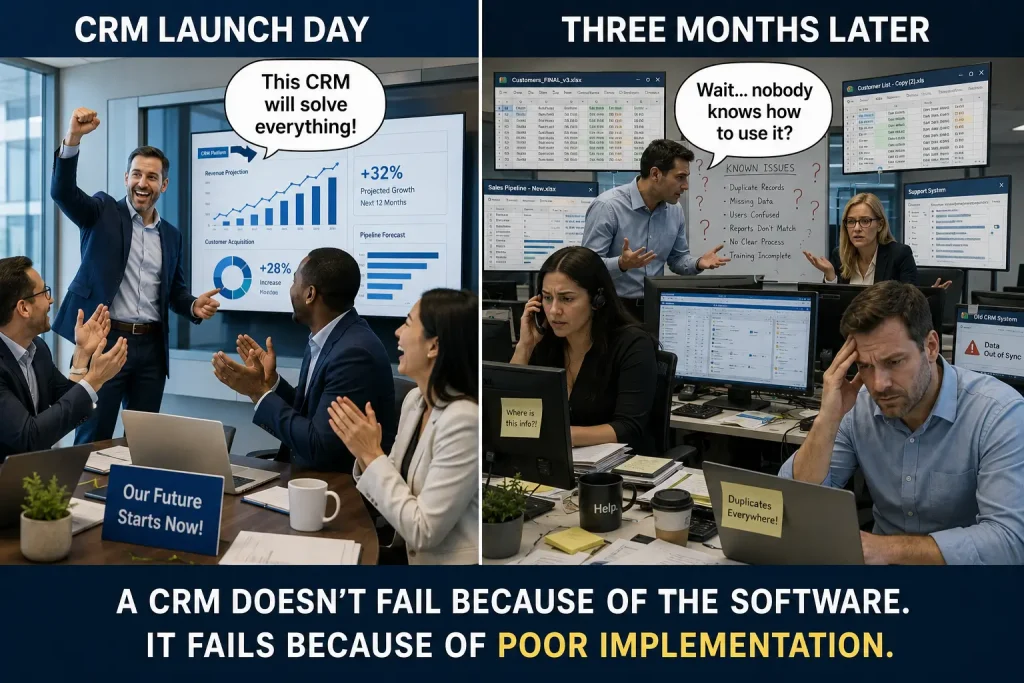
Many businesses spend a lot of time and money on CRM systems expecting improvements in customer management, sales, and efficiency. The truth is, CRM projects often fail before they can deliver results. The problem is usually not the CRM system itself. Instead, failures often come from poor planning, unclear goals, bad data preparation, and low user adoption. Companies often focus on choosing software features and forget about the people, processes, and strategy needed to make the system work. As a result, businesses end up with a CRM that looks good on paper but does not help much in operations.
One big reason CRM projects fail is the lack of a plan. Businesses often start using the CRM without understanding how it should support customer support, sales, reporting, and growth. Without a plan, teams may set up the system based on guesses rather than actual business needs. This creates confusion, inconsistent workflows, and frustration among employees who have to use the platform. In some cases, companies find out that the CRM does not match how their teams work, leading to low adoption rates and poor return on investment.
Data quality is another challenge that can ruin even the best CRM project. Moving inaccurate, incomplete, or duplicate customer records into a system creates problems from the start. Employees lose trust in the data, reporting becomes unreliable, and customer interactions become less effective. Also, many businesses underestimate the importance of employee training and change management. A CRM system cannot deliver results if users do not understand its purpose or see value in using it. Successful projects require leadership support, user engagement, ongoing training, and continuous optimization. When businesses address these factors from the start, they improve their chances of creating a CRM system that supports growth, strengthens customer relationships, and delivers long-term business value.
Benefits of CRM Implementation Consulting
A lot of companies think that once they buy a CRM platform, everything will just fall into place. They think that customer data will be organized, sales teams will be productive, and customer support will have a better understanding of every interaction. That is not usually what happens. A CRM can be a tool for a business, but if it is not set up correctly, it can become another expensive system that employees do not want to use. This is why companies often turn to CRM implementation consultants. Their job is not just to get the software up and running but to make sure the system actually works the way people do.
Think about all the CRM projects that start out with hopes and end in frustration. The leaders of the company want reports, the sales teams want more good opportunities, and the support teams want easier access to customer information. Six months later, employees are still using spreadsheets, important customer data is missing, and nobody trusts the reports. CRM implementation consulting can help prevent these problems by making a plan before things go wrong. Instead of just guessing what the business needs, consultants build a system around the way people really work, the way customers interact with the company, and what the company wants to achieve.
Faster CRM Adoption Across Teams
The biggest challenge with CRM projects is not the technology itself; it is getting people to actually use it. Employees do not like systems that make their jobs harder or add steps to their daily routine. If a CRM seems complicated, people will stop using it quickly.
CRM implementation consultants focus a lot on making the system easy to use and designing workflows that work. They help companies set up the system to fit the way they already do things. They make improvements that save time instead of creating more work. When support agents can easily see a customer’s history and sales teams can track opportunities, the CRM becomes a part of the routine instead of just another task. The faster employees see the benefits, the faster they will start using the CRM.
Reduced Implementation Risks
Most problems with CRM implementation do not happen after the system is launched; they happen during the planning stage. Companies often do not realize how much work is needed to get the system ready to move data, set up integrations to map out processes, and to train employees. One mistake during implementation can cause a lot of frustration and costly rework later.
This is where experienced consultants can make a difference. They have seen the mistakes before, and they know how to avoid them. From cleaning up customer data before moving it over to making sure departments are on the page, they reduce the risks that cause many CRM projects to fail. Even big CRM providers like Salesforce emphasize that planning, getting everyone involved, and setting goals are crucial to making the implementation a success.
Better Return on CRM Investment
A CRM should do more than store customer information. It should help companies close deals faster, make customers happier, and make decisions. A lot of companies never get to that point because the system is not used enough or it is not set up correctly.
CRM implementation consulting helps companies get value from every dollar they spend on the platform. By focusing on getting the technology set up, consultants create processes that improve visibility across customer support and sales teams, automate tasks that take a lot of time, and give leaders insights that mean something. When a CRM is set up correctly, it becomes more than software; it becomes a tool that helps companies build stronger relationships with customers, work more efficiently, and get real business results over time.
Step 1: Figure Out What Your Business Needs. Wants
Before you start setting up a CRM platform or moving customer information, you need to think about why you are doing this in the first place. A lot of projects go wrong because of this. Companies often think about what the software can do before they think about what problems they want to solve. Is your customer support team having trouble getting to customer information? Is your sales team not able to see what is going on with sales? Are you doing things by hand that are slowing you down? You need to answer these questions and figure out what you want to achieve with your business. You should not get a CRM just because other companies have one. You should get it because you want to make your customer relationships better, make your business run smoothly, and help your business grow.
When you know what problems you are trying to solve, you should think about what you want to achieve with your CRM project. You might want to answer customer questions, get more people to buy from you, stop having to enter information by hand, keep your customers happy, or get a better understanding of what your customers are doing. It is very important to talk to people from parts of your business like customer support, sales, operations, and the people in charge because they all use customer information in different ways. When you set up your CRM to help your business run better and achieve your long-term goals, you will be more likely to succeed with your project.
Step 2: Choose the Right CRM Platform
The choice of CRM platform is an important decision when you are setting up your system. A lot of companies make a mistake by picking a CRM just because it’s popular or cheap or because it has a lot of features. But the best CRM for you is not the one with the features. It is the one that fits with what your business wants to do, how your teams work, what they need, and how you want to grow. A CRM that works well for a company might be too complicated for a smaller business that is growing, and a simple CRM might not have enough features to help you expand later. You need to think about how the system will help your customer support people, your sales team, your reporting, your automation, and how your teams work together.
Before you decide, you should think about a few things. You should think about how easy the CRM’s to use, if it can grow with your business, if it can work with other systems, if you can make changes to it, and how much it will cost in the long run. You should also talk to the people who will use the CRM every day. The people who help customers, the sales team, and the managers often know a lot about what’s hard about their work and what they need to do their jobs. A good CRM should make things easier, not harder. If you pick a CRM that works for what you need and what you will need later, you can avoid a lot of trouble and expense later on, and you can set yourself up for doing a good job of managing your customer relationships.
Step 3: Plan CRM Configuration and Customization
Now that we have chosen the CRM platform, we need to set it up so it works the way our business works. A lot of companies make a mistake here. They try to make their teams use the default CRM settings instead of changing the platform to fit their own way of doing things. Every company is different with its way of working, its own customers, and its own sales process. To get the most out of our CRM, we need to think about these things and customize the system. We need to look at how we manage leads, how we support our customers, and how we report on our progress. Who gets to use which parts of the system. All of these things should be designed around how our business helps our customers.
Making our CRM right is not about adding a lot of extra features. Actually, if we add too much, it can be hard for people to use and can cause confusion. What we want is a CRM that’s easy to use, helps people get their work done, and gives them the information they need. At this stage, we should think about what information we need to know about our customers, how we can automate some tasks, what our sales process looks like, how we support our customers, and what we need to report on. If we make decisions about our CRM based on what our business needs and what the software can do, our CRM will be a useful tool that helps us work better together and grow in the long term. We should focus on CRM configuration and CRM customization to get the results from our CRM system and use our CRM to improve our business.
Step 4: Migrate and Organize Customer Data
Think about spending months setting up a customer relationship management system only to find out that customer phone numbers are missing, there are duplicate contacts with different names, and the sales team does not trust the reports. This happens to a lot of businesses. Moving customer data from one system to another is not about transferring the information; it is about making sure the information is correct, useful, and organized in a way that helps the business. Before moving customer records to a system, businesses should clean up old contacts, combine duplicate records, check important information, and decide what data is really important for making decisions. A customer relationship management system is only as good as the data it has.
Organizing customer data the right way is just as important. Businesses should have a way of setting up customer profiles, keeping track of communications, support requests, sales activities, and report categories. This makes it easy for employees to find information, track customer relationships, and get insights. According to Oracle’s customer relationship management implementation resources, having a customer relationship management system depends a lot on keeping customer data accurate and organized throughout the system’s life. When businesses see moving customer data as a chance to improve, rather than just a technical task, they create a customer relationship management environment that supports better customer experiences, stronger teamwork, and more confident business decisions.
Step 5: Integrate CRM with Existing Business Systems
A CRM system should not work alone. Many businesses have trouble getting the most out of their CRM system because important customer information is all over the place. Customer conversations are in email, support tickets are in help desk software, and marketing data is in other applications. When these systems do not talk to each other, employees waste time looking for information; customers get experiences and decision makers do not have a complete view of the customer journey. Good CRM implementation consulting creates a system where data flows easily between business tools and teams can get the information they need without switching between many platforms.
Email and Communication Tools
Email is still one of the important ways to talk to customers, have sales conversations, and handle support interactions. When you connect email platforms with a CRM system, businesses can automatically track conversations and store communication history. Keep complete customer records without having to enter data by hand. This helps teams know about interactions and makes sure important customer information is not lost in individual email boxes. Whether employees are following up on leads or responding to service requests, connected communication tools create visibility and improve collaboration across departments.
Customer Support Platforms
Customer support teams need to get to customer information to deliver good service. When you connect help desk software, ticketing systems, live chat platforms, and customer support tools with a CRM system, agents get a picture of every customer interaction. By switching between many systems, support teams can see purchase history, communication records, previous support cases, and customer preferences from one place. Businesses that want to improve customer service often combine CRM implementation with customer support services from Vocals Connected to create a connected and efficient customer experience strategy.
Marketing and Sales Applications
Sales and marketing teams create a lot of customer data that should be connected to the CRM system. When you connect marketing automation platforms, lead generation tools, sales engagement software, and analytics applications, customer information stays accurate throughout the buyer journey. These connections help businesses track leads, automate follow-ups, measure campaign performance, and find opportunities for growth. When sales, marketing, and customer support systems work together, businesses get a view of customer relationships and can make smarter decisions based on complete and reliable data from the CRM system and the connected systems. The CRM system is important here because it helps connect all the systems and makes sure that the customer information is complete and up to date.

Step 6: Train Employees and Drive User Adoption
To make a CRM system work, employees have to use it. A lot of companies spend time picking the right system, setting it up, and moving their data over, but then they find out that not many people are using it after it is launched. This happens because people do not like to change, especially when they do not understand how something new will help them. If employees think of the CRM system as more work, they will not use it regularly. This means that records will not be complete, reports will not be accurate, and opportunities will be missed. All of this can make the whole project fail.
When companies help their employees adopt a CRM system, they do it from the very start. Training is not about showing people how to use the system; it is about showing them how it can make their jobs easier. The sales team needs to know how the CRM system can help them manage their work better, and the customer support team needs to know how it can help them see what is going on with customers. If employees get the training and support they need, they will be more confident in the system. Use it more. When employees think of the CRM system as a tool, not just something they have to do, the company will get better data, people will work together better, and the business will do better.
Step 7: Monitor Performance and Optimize Continuously
A lot of companies think that putting in a CRM system is the step, but it is really just the beginning. What customers want changes, what the business needs changes, and new ways to automate things come up all the time. A CRM system that works well now may need to be changed to help the business grow and work efficiently. Companies that think of putting in a CRM system as a one-time project often miss chances to make their processes better, make their customers happier, and get value from their investment.
To optimize the CRM system, companies need to keep an eye on how it’s doing. This means looking at things like how many people’re using the system, how many leads are turning into sales, how quickly customers are getting answers and how productive the team is. By checking these things, companies can find ways to make their processes better, make their reports more useful, and automate more things. Companies that keep making their CRM system are more likely to adapt to changes in the market, make their customers happier, and grow in the long term. The best CRM systems are not the ones that start out perfect; they are the ones that keep getting better as the business grows.
Asked Questions (FAQs)
Do we really need a CRM implementation consultant if we have already purchased a CRM?
Yes, we do. When we buy a CRM, that is the beginning. A lot of businesses find it hard to set up the workflows move the customer data, and get all the employees to use the system. A CRM implementation consultant makes sure the CRM is set up in a way that works for our business, not the other way around.
How do I know if my CRM implementation is going off track?
There are signs that things are not going well. Our employees are still using spreadsheets of the CRM. The customer information is all over the place. The reports we get from the CRM do not match what is really happening. Our teams are saying that the CRM is slowing them down. If not many people are using the CRM after a months, that is a sign that we need to take a closer look at how we are doing things.
What is the biggest mistake businesses make when they implement a CRM?
The biggest mistake is that businesses focus much on the software and not enough on how their business works. A lot of companies spend a lot of time looking at all the features of CRMs but they do not spend enough time thinking about what they want to achieve how their workflows will change and how they will get their employees ready for the change. The CRM should help our business, not the way around.
How long does it take to implement a CRM
It takes amounts of time for different businesses. A small business with needs might be able to get everything up and running in a few weeks. A bigger business with a lot of departments and complicated workflows might need several months. The important thing is to get it right not to rush.
Can CRM implementation consulting help improve customer support operations?
Yes it can. One of the things about working with a CRM implementation consultant is that they can help us get a better view of what is going on with our customers. When our support teams have all the information they need in one place they can help our customers faster. Do a better job.
Will a CRM automatically improve sales performance?
No it will not. A CRM is a tool. It is what we do with it that matters. If we set it up right use it consistently and make sure it fits with our sales process then it can help us sell more.. On its own a CRM is not a magic solution.