
A healthcare organization can spend a lot on doctors and equipment.. If nobody answers the phone patients will go elsewhere. It is a truth. Many healthcare providers do not realize how often this happens. For patients their experience with a healthcare provider starts long before they see a doctor. It begins with a phone call, a missed message, a scheduling request or a billing question.
Choosing the healthcare call center provider is very important. It can affect how happy patients are, how well the office runs and how money the organization makes. When patients do not get the help they need they miss appointments get frustrated and the office staff gets overwhelmed. That is why many healthcare organizations use providers like Vocals Connected to improve communication and ensure every patient interaction is handled professionally.
Whether you have a clinic, a large practice or a big hospital system selecting the right partner for your healthcare call center services is a big decision. It is not about outsourcing; it is a strategic business decision. The right provider improves responsiveness protects data and allows your internal teams to focus on delivering quality care.
Why Choosing the Right Healthcare Call Center Provider Matters
The Impact of Patient Communication on Care Quality
Patient communication is one of the important parts of healthcare. Patients expect answers, clear information and easy access to care. When calls go unanswered or wait times are too long trust starts to fade. Highly skilled providers can struggle with keeping patients if communication is not consistent.
Imagine a patient trying to schedule a follow-up after surgery. They call during lunch get put on hold and eventually hang up. They call again later. Reach voicemail. By the attempt frustration replaces confidence. In cases that patient starts looking for another provider.
That is why patient communication solutions matter. A good healthcare call center provider ensures patients get help for appointment scheduling, insurance verification, prescription refills, billing concerns and follow-up care. Better communication creates patient journeys, which leads to stronger satisfaction and better clinical outcomes.
The U.S. Department of Health & Human Services (HHS) says patient-centered communication plays a role in care coordination, treatment adherence and overall healthcare experience.
Risks of Choosing the Wrong Provider
Choosing the provider can create serious problems. Some vendors seem attractive because of pricing but cheaper services often come with hidden risks: undertrained agents, poor escalation protocols, weak reporting and limited healthcare expertise.
A non-specialized call center may not understand terminology, urgency levels or regulatory requirements. Something simple as mishandling a patient callback request can delay care and damage trust. Worse weak security protocols may expose data to compliance risks.
Healthcare providers also need to consider reputation. Patients rarely blame “the vendor.” They blame the hospital, clinic or physician group. Every poor interaction reflects directly on your brand.
Key Business Outcomes to Consider
When evaluating a call center provider focus on business outcomes than just call-answering capacity. The best providers improve performance across multiple areas.
- They reduce abandoned calls. Improve answer speed.
- They support appointment conversion rates.
- They help reduce workload on front-desk teams.
- They contribute to patient retention.
These improvements create ROI. Better communication leads to scheduled appointments fewer no-shows, improved patient loyalty and stronger long-term revenue performance.
Essential Features of a Reliable Healthcare Call Center Provider
HIPAA Compliance and Data Security
Healthcare communication involves patient information so compliance must be non-negotiable. Any provider you consider should demonstrate HIPAA compliance policies, secure infrastructure, encrypted communication channels and strict access controls.
Ask vendors questions about:
- Call recording security
- Access permissions
- Data storage
- Breach response protocols
- Compliance audits
The HIPAA Journal regularly highlights the importance of protecting data through proper administrative, physical and technical safeguards. A provider that treats security as an afterthought should immediately raise concerns.
Omnichannel Patient Communication Capabilities
Patients no longer communicate through phone alone. Modern healthcare communication spans channels including voice calls, SMS, email, live chat, patient portals and telehealth systems. A strong provider supports omnichannel communication so patients can interact using their channel. Younger patients may prefer text confirmations while older patients may still prefer phone calls. Flexibility matters.
The best providers unify these channels into one communication ecosystem ensuring no inquiry gets lost between systems. Organizations seeking healthcare call center services should prioritize vendors capable of managing multichannel patient engagement at scale.
Scalability and 24/7 Support Availability
Healthcare demand does not follow a 9-to-5 schedule. Calls surge during flu season after marketing campaigns during emergencies and after office hours. Your provider should scale accordingly.
A scalable provider can handle:
- Peak call volume
- Overflow calls
- spikes
- After-hours support
- Emergency routing
This flexibility is one reason many organizations adopt outsourced models through partners offering reliable patient communication solutions and healthcare BPO support.
Understanding Your Healthcare Organization’s Needs
Before comparing vendors you must understand your operational requirements. This step is where many organizations make mistakes. They start shopping for providers without defining their needs.
Ask yourself: What problems are you trying to solve?
- Are missed calls hurting revenue?
- Is your front desk overwhelmed?
- Do you need support?
- Are appointment scheduling bottlenecks affecting flow?
Different providers specialize in areas. Some excel in appointment scheduling while others focus on triage, billing support or after-hours answering services. A small private clinic may only need overflow support during periods. A hospital network may need full-scale 24/7 call management integrated with departments and systems. Understanding your needs allows you to evaluate vendors based on fit rather, than generic marketing claims.
Evaluating Industry Experience and Healthcare Expertise
Not all call centers are good for healthcare. This is a mistake that healthcare providers make. They think any company that answers phones can handle patient calls.. Healthcare is more than just answering phones. A good medical call center provider knows how to handle calls with care knows what is urgent and what is not knows medical terms and knows the rules. They know when a patient just wants to make an appointment and when they need help away.
It also matters if the call center has experience with things like checking insurance making referrals getting paperwork ready before a visit and following up after a patient goes home. If a call center does not know about healthcare they might make mistakes and patients will get frustrated.
When you are looking for a call center ask them about their experience with healthcare. Do they work with hospitals, clinics or private doctors? Have they done work like yours before? If they have experience they will be ready to help you from the start.
Assessing Technology and Integration Capabilities
Technology is very important for a healthcare call center. If the people answering the phones are well trained they will struggle if the technology is old or not working well. A good call center should be able to work with the technology you already use like the systems for records, customer relationships, scheduling and billing. The goal is to make sure that all the information is in one place. When a patient calls the person answering the phone should be able to see things like the patients appointment history, which doctorsre available and any notes from before.
Some call centers also use tools like artificial intelligence to help with things like routing calls to the right person predicting how many calls they will get, sending reminders using chatbots to help patients and analyzing calls. These tools can help things move faster. Reduce problems. This is why many organizations look for call centers that can offer advanced healthcare customer support with technology rather than just answering phones.
Questions to Ask Before Hiring a Healthcare Call Center Provider
When you are choosing a call center you need to ask a lot of questions. A good sales presentation is not enough. You need to know the details. Start by asking about how they operate, if they follow the rules and how they perform. Ask them how they handle a lot of calls once. Ask what they do if they get as many calls as usual. Ask if they can help patients who speak languages. Ask how they handle problems that need attention.
You should also ask about reporting. Can they show you reports with things like how quickly they answer phones how many calls they miss, if they solve problems on the first call how happy patients are and how many appointments they schedule? It is very important to be transparent. A good call center should be happy to answer all your questions because they know it is important to be accountable.
You should also ask about how they get started. How long does it take to set everything up? What kind of training do the people answering the phones get about your workflows, policies and how to communicate with patients? If a call center cannot answer these questions clearly they might not be the choice.
Red Flags to Watch Out For When Comparing Providers
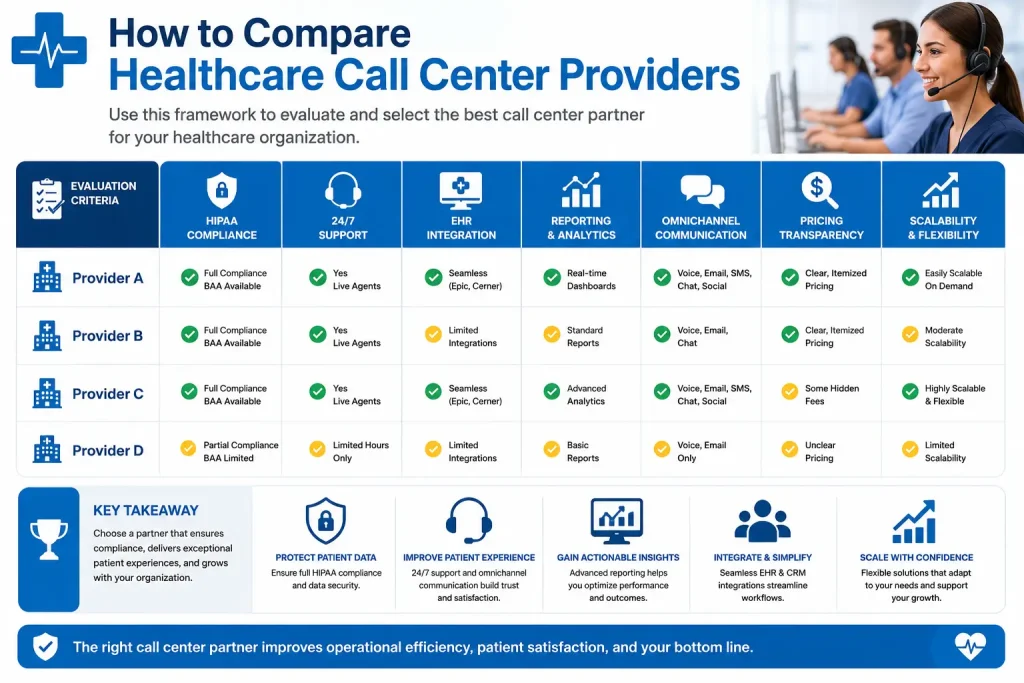
Sometimes the easiest way to choose a call center is to know what to avoid. One big warning sign is if a call center is not clear about their prices. If they avoid talking about how they charge or hide fees in their contract be careful. You might end up paying a lot more than you thought for things like setting up software, reports and extra time.
Another warning sign is if a call center does not specialize in healthcare. Some companies might promise prices but cannot provide the quality of service that healthcare needs. You should also be careful if a call center does not have a process for getting started. If they cannot explain how they train their staff how they ensure quality and how they handle problems they might not be consistent.
Watch out for call centers that cannot show you things like:
- certificates that prove they follow the rules
- stories from clients
- numbers that show how well they perform
- clear agreements about service
- reports
The best call centers are open organized and confident in what they do.
In-House vs Outsourced Healthcare Call Center Providers
Many healthcare organizations have to make a decision: should they handle patient calls themselves or hire someone else to do it? If you handle calls in-house you have control and can make sure everything fits with your brand. You can choose who to hire, how to train them and how to manage the workflow.. Handling calls in-house can be expensive.
You would need to pay for things like:
- salaries for the staff
- benefits for the staff
- office space
- equipment and systems
- software
- management
These costs can add up quickly. Hiring someone to handle calls can be more flexible and can grow with your needs. Of building everything yourself you can use trained professionals, technology and workflows that are already set up.
For organizations that are growing call center outsourcing can be a choice. It can help reduce calls make scheduling more efficient and provide help 24 hours a day without needing a lot of money upfront. This is why some healthcare organizations choose Vocals Connected healthcare call center services for their communication needs.
Cost Considerations and ROI
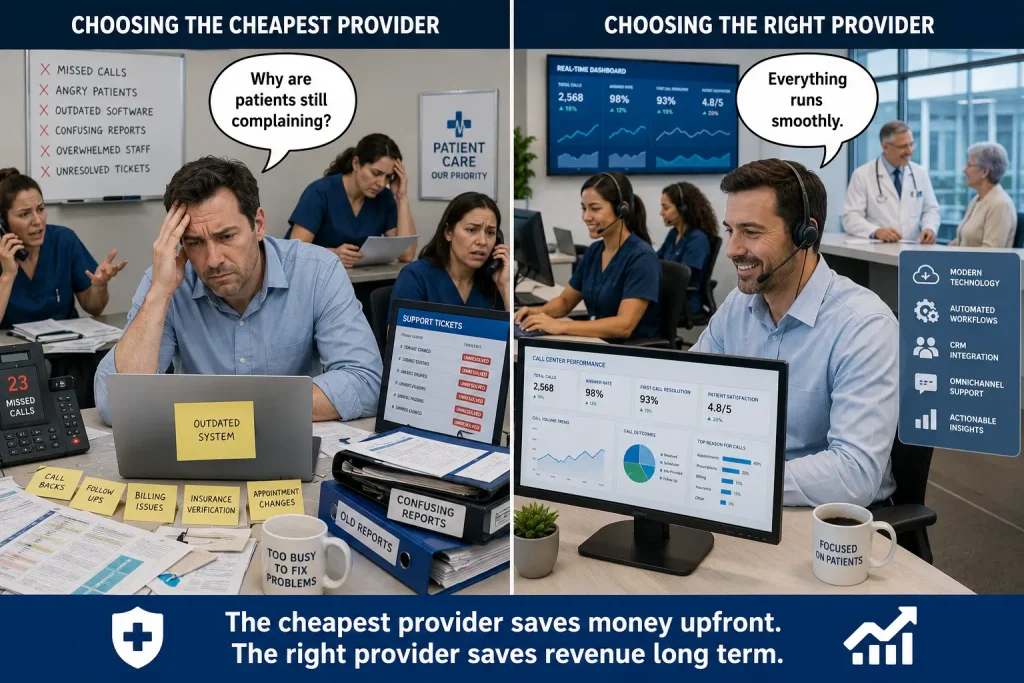
The cost is important. It should not be the only thing you consider. The cheapest option is often not the best. Of asking who is the cheapest ask who gives you the best value. Think about both the indirect benefits.
Direct benefits include saving money on staff and operations. Indirect benefits include things like:
- missed appointments
- patients staying with you longer
- scheduling appointments more efficiently
- patients being happier
- your reputation getting stronger
Consider an example. If your clinic misses 20 calls about appointments every week and 8 of those calls could have turned into appointments worth $200 each that’s 8 × 200 = $1,600 every week = $83,200 every year in lost revenue Suddenly it makes sense to invest in better patient communication.
This is where hiring someone to handle calls can make a big difference. Not just in saving money but also in bringing in more revenue. Organizations that invest in professional healthcare support providers often find that better communication helps both operations and finances.
How to Make the Final Decision
Choosing the call center comes down to finding the one that fits your needs. The best healthcare call center provider for you is not necessarily the biggest or the cheapest. It is the one that understands your patients your workflows, your goals and your challenges.
Before making a decision compare call centers based on these five things:
- Expertise in healthcare
- Being ready for rules and regulations
- Technology
- Quality of service
- Cost compared to value
If a call center does well in all these areas they might be a choice. Take the time to look at demos talk to their references and examine their reports. The relationship with a call center affects experience every day so it is important to do your research.
Conclusion
Patient communication is no longer about administrative tasks. It is a key part of healthcare. Every missed call, delayed response or frustrating interaction affects trust patients staying with you and revenue. Choosing the healthcare call center provider can change how patients experience your organization. The right partner can improve communication make operations more efficient reduce the burden, on staff and help your team focus on providing care.
If your organization wants to improve communication reduce missed opportunities and create better patient experiences Vocals Connected patient communication solutions can help. From scheduling appointments to healthcare communication services the right solution can turn every patient interaction into a chance to build trust and long-term loyalty.