
A patient wakes up at 11:30 PM with severe discomfort after a procedure and calls their doctor’s office. Instead of reaching a helpful voice, they hear voicemail. They leave a message. Now they wait. For medical practices, this scenario happens more often than many realize, and it highlights exactly why after-hours answering services have become essential in modern healthcare. Patient needs do not stop when office hours end. Questions about medications, appointment changes, post-treatment concerns, and urgent symptoms can arise at any time.
Unfortunately, many clinics and private practices still rely on voicemail or overloaded staff to manage these calls. The result? Missed opportunities, delayed care, frustrated patients, and growing pressure on internal teams. That is why more healthcare providers are turning to medical after-hours answering service solutions to ensure patients receive support even when the office is closed.
What Are After-Hours Answering Services?
How After-Hours Medical Call Handling Works
Better accessibility and professional patient communication solutions help patients feel supported even outside office hours. After-hours answering services provide professional call handling outside regular business hours, including evenings, weekends, holidays, and overnight periods. Instead of routing patients to voicemail, incoming calls are directed to trained live agents or support specialists. These specialists follow predefined call scripts, escalation workflows, and routing rules based on the medical practice’s requirements.
For example, a pediatric clinic may require urgent fever-related calls to be escalated immediately to an on-call physician, while non-urgent scheduling requests can be logged for callback the next morning. The goal is simple: no patient should feel ignored just because the office is closed.
Types of Calls Medical Practices Receive After Hours
Many people assume after-hours calls are always emergencies. In reality, most are not. Medical practices typically receive a wide range of calls outside business hours, including appointment changes, prescription refill requests, billing inquiries, lab result questions, and general patient concerns.
Some examples include:
- appointment rescheduling
- prescription refill requests
- medication concerns
- post-surgery questions
- insurance or billing inquiries
Some situations are routine. Others require urgent escalation. This is why healthcare-specific answering services are so important. Agents need training to identify urgency levels and follow proper escalation protocols.
Why 24/7 Patient Communication Matters
The U.S. Department of Health & Human Services emphasizes accessible communication as an important component of quality patient care. Healthcare is deeply emotional. Patients calling after hours are often anxious, confused, stressed, or scared. A voicemail box does not reduce anxiety. Human support does. When patients know they can reach someone at any time, they feel safer and more confident in their provider. Even if the issue cannot be fully resolved right away, speaking with someone knowledgeable helps reassure you. This is where strong patient communication becomes a competitive advantage.
Why Medical Practices Need After-Hours Answering Services
The Cost of Missed After-Hours Calls
Many practices underestimate the real cost of unanswered calls. A missed call is not just a missed conversation.
It could be:
- a new patient ready to book an appointment
- a worried parent needing urgent guidance
- a patient with post-op complications
- a returning patient considering another provider
Missed calls often translate directly into lost revenue. Imagine a clinic misses only 8 after-hours calls every week. If just 3 of those calls would have converted into appointments worth $200 each, that equals $31,200 in lost revenue annually. This is why after-hours support is not merely an expense—it protects revenue.
Improving Patient Trust and Satisfaction
Trust is everything in healthcare. Patients want to feel that their provider is available, responsive, and reliable. When calls go unanswered repeatedly, trust begins to erode. Think about a patient recovering from surgery. They experience unexpected pain late at night and call their provider. If nobody responds, their anxiety skyrockets. That single interaction can shape their perception of the entire practice. On the other hand, when a trained specialist answers promptly, listens carefully, and provides guidance or escalation, the patient feels supported. That feeling matters.
Supporting Urgent Call Escalation
Not every after-hours call is an emergency, but some absolutely are. The challenge lies in identifying which calls require immediate action. This is where professional medical call center services make a major difference. A strong answering service uses escalation protocols to categorize calls based on urgency. Non-urgent calls may include appointment requests or billing questions.
Urgent calls may include:
- severe symptoms
- breathing difficulties
- medication reactions
- post-surgical complications
When escalation systems are properly designed, urgent calls are routed immediately to on-call physicians, nurses, or emergency protocols.
Common Challenges of Handling Calls In-House
Managing after-hours calls internally sounds manageable in theory, but in reality, it creates serious operational challenges for many medical practices. Most clinics already run lean teams. Receptionists, administrative coordinators, and office managers spend their days juggling appointments, patient check-ins, billing issues, insurance verification, and provider coordination. Adding after-hours communication on top of that can quickly become overwhelming.
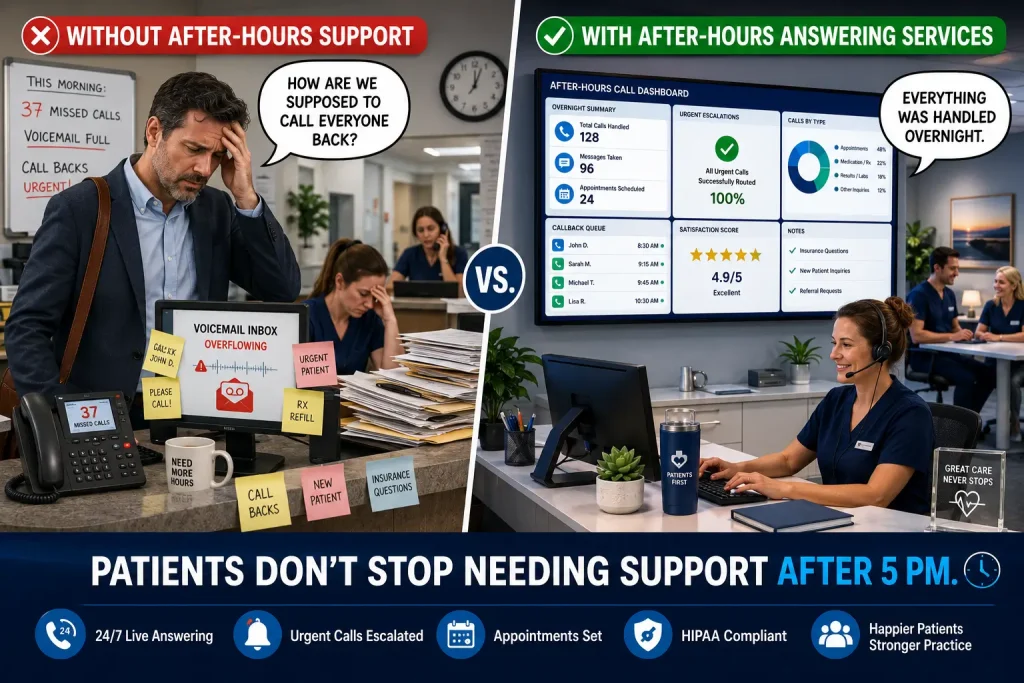
One major challenge is voicemail overload. Calls that come in during evenings or weekends often pile up overnight. By morning, staff walk into dozens of missed calls and messages, creating immediate backlog and stress.
Another issue is delayed response time. Even when practices try to return calls the next day, patients may already feel frustrated or anxious from waiting too long. Staff burnout is another growing problem. Asking in-house teams to manage both regular office operations and after-hours communication creates fatigue, increases errors, and lowers service quality over time. Without a dedicated system, even well-run practices can struggle to maintain consistent communication.
How After-Hours Answering Services Improve Patient Experience
Patient experience often comes down to one simple question:
“Could the patient get help when they needed it?”
That question matters more than many providers realize. Patients do not separate medical care from communication. To them, both are part of the same experience. Even if a physician provides excellent treatment, poor communication can still leave patients dissatisfied.
This is where after-hours answering services create real value. Instead of hearing voicemail or waiting until the next day, patients reach a trained live representative who can listen, reassure them, and guide them toward the next step.
That changes everything. A worried parent feels calmer. A recovering patient feels supported. Someone confused about medication gets direction instead of uncertainty. These interactions may seem small, but they have a powerful effect on trust.
Better communication improves:
- patient confidence
- patient loyalty
- satisfaction scores
- provider reputation
When patients know support is available beyond office hours, they feel more connected to their healthcare provider.
Improving Patient Trust and Satisfaction
Trust is one of the most valuable assets in healthcare. Patients need to believe that their provider will be available when it matters most. If calls repeatedly go unanswered after hours, that trust weakens. Imagine a patient dealing with unusual side effects late at night. They call the clinic hoping for reassurance, but nobody answers. That silence creates stress. Now imagine instead that a trained support specialist answers immediately, listens carefully, and routes the call properly. The emotional difference is huge. Patients remember how they were treated during vulnerable moments. Fast, compassionate communication helps build long-term trust and stronger patient relationships.
Supporting Urgent Call Escalation
Not all after-hours calls require immediate medical action—but some absolutely do. The challenge is quickly identifying which calls are urgent and which are routine. Professional answering services use escalation workflows designed specifically for this purpose. For example: Non-urgent calls:
- appointment changes
- billing questions
- referral requests
Urgent calls:
- severe pain
- breathing issues
- allergic reactions
- post-surgical complications
With proper triage protocols, urgent cases are escalated immediately to on-call providers, nurses, or emergency instructions. This ensures serious cases receive fast attention while routine inquiries are handled efficiently.
Appointment Scheduling and Message Routing After Hours
Appointment scheduling does not stop when offices close. Patients often remember they need to book, cancel, or reschedule appointments during evenings or weekends when they finally have free time. Without after-hours support, these calls usually go to voicemail. That creates friction. Some patients call back later. Others forget. Some simply choose another provider that is easier to reach. This is where after-hours answering services help protect both revenue and patient retention. Trained support teams can capture scheduling requests, collect patient details, and route messages accurately to the appropriate department or provider. Effective message routing ensures information reaches the right person quickly.
For example:
- new patient inquiry → scheduling team
- prescription concern → nursing staff
- urgent symptom → on-call physician
- billing question → admin team
This structured routing prevents confusion and reduces delays. The result is smoother operations and better patient experiences.
Emergency vs Non-Emergency Call Management
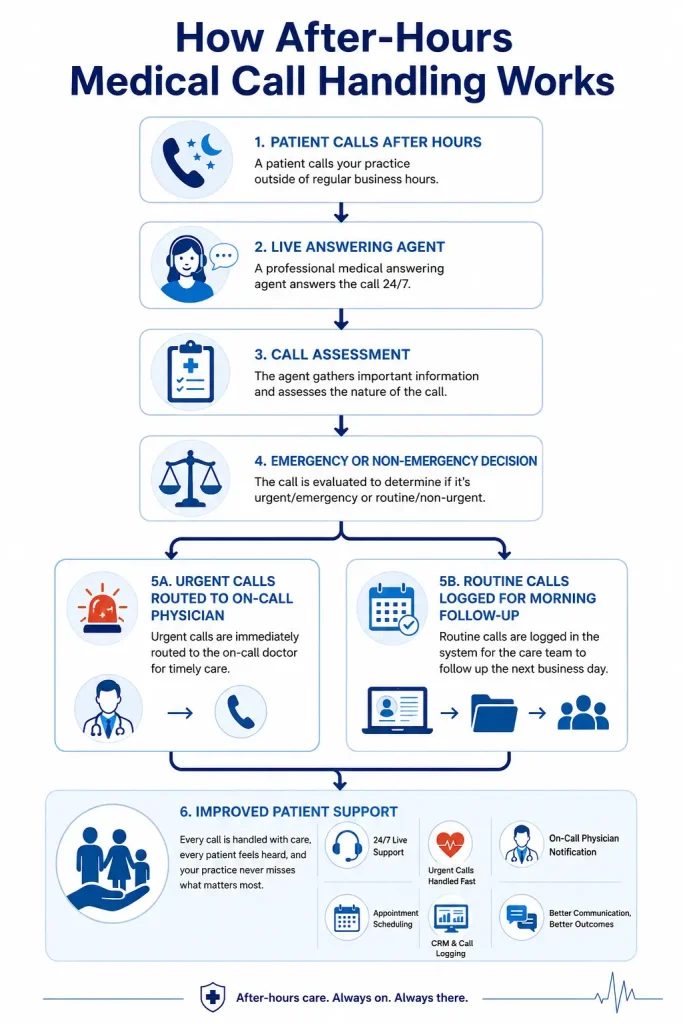
One of the biggest challenges in after-hours healthcare communication is distinguishing between calls that are urgent and those that can safely wait until morning. Not every patient concern is an emergency, but from the patient’s perspective, every concern can feel urgent. That’s what makes call triage so important. A patient calling about mild billing confusion does not need immediate physician intervention. A patient experiencing chest pain absolutely does. The difficulty lies in identifying the difference quickly and accurately.
This is why professional healthcare answering service providers rely on structured call handling protocols. Agents are trained to ask the right questions, follow escalation scripts, and determine whether the situation requires immediate action. Typical non-emergency calls include:
- appointment scheduling or rescheduling
- billing questions
- referral follow-ups
- prescription refill requests
- general administrative inquiries
Typical emergency or urgent calls include:
- severe breathing difficulty
- chest pain
- allergic reactions
- uncontrolled bleeding
- sudden post-operative complications
When urgent situations arise, calls can be immediately escalated to:
- on-call physicians
- nurses
- emergency response instructions
- hospital care teams
This structured triage protects both patients and providers. Patients get quicker help when it matters most, and practices avoid the risk of critical cases being lost in voicemail or callback queues.
Reducing Staff Burnout and Administrative Pressure
Burnout has become one of the biggest operational challenges in healthcare. Doctors feel it. Nurses feel it. Administrative teams feel it too. Front-desk and support staff often work under constant pressure. During office hours, they handle check-ins, appointments, phone calls, insurance verification, billing questions, and provider coordination—all at once.
Now imagine adding after-hours communication on top of that. It becomes unsustainable. Many practices expect office staff to return dozens of missed calls every morning while also managing regular daily operations. This creates immediate stress before the workday even begins.
Over time, that pressure causes:
- slower response times
- communication errors
- reduced productivity
- lower morale
- higher turnover
And turnover is expensive. Every experienced employee who leaves takes knowledge and workflow familiarity with them. Replacing and retraining staff costs time and money. After-hours answering services reduce this burden by offloading repetitive communication tasks to dedicated support professionals. This creates breathing room for in-house teams. Instead of spending hours clearing voicemail backlogs, staff can focus on higher-value responsibilities like patient care coordination and provider support. The result is healthier workflows and less stress across the practice.
Key Features to Look for in a Medical Answering Service
Not all answering services are built for healthcare. This is an important distinction. A generic call center may answer calls professionally, but healthcare communication requires much more than basic customer service skills. Medical calls involve urgency, privacy, empathy, and accuracy. That means choosing the right provider matters.
When evaluating a medical answering service, there are several essential features to prioritize. First, look for healthcare-specific experience. Agents should understand common medical workflows, patient communication standards, and escalation requirements. Second, prioritize HIPAA compliance. Patient information is sensitive, and your provider must follow strict security and privacy protocols. Third, assess 24/7 availability. A true after-hours solution should provide consistent support during nights, weekends, and holidays. Technology capabilities also matter.
Look for providers offering:
- CRM integration
- scheduling software compatibility
- secure message routing
- real-time reporting dashboards
- call analytics
Another valuable feature is bilingual support. Many practices serve diverse patient populations, and multilingual communication can significantly improve patient accessibility. Finally, evaluate service quality.
Ask questions such as:
- How fast are calls answered?
- What is your escalation process?
- How are urgent calls handled?
- Do you provide performance reporting?
- Can you customize call scripts?
The right provider should feel like an extension of your practice—not just an outsourced vendor.
Cost and ROI of After-Hours Answering Services
When medical practices first consider outsourcing after-hours call support, one of the first questions is usually: “How much will it cost?” That is a fair question—but it is not the only one that matters. A better question might be: “How much are missed calls already costing us?” Many practice owners focus only on the service fee while overlooking the hidden cost of poor communication.
Missed after-hours calls can lead to:
- lost appointments
- delayed care
- patient churn
- lower retention
- negative reviews
- reduced referrals
These losses add up faster than most providers realize. Let’s look at a simple example. Suppose your practice misses just 5 appointment-related calls per week after hours. If only 3 of those would have converted into appointments worth $180 each, that means: 3 × $180 = $540 per week
Over a year, that equals more than $28,000 in lost revenue. And that’s from only a small number of missed calls. Now compare that to the cost of a professional after-hours answering service. For many medical practices, outsourcing costs significantly less than the revenue lost from poor call coverage. That’s where ROI becomes clear. The value of after-hours answering services goes beyond answering calls. These services help practices:
- capture more appointments
- improve patient retention
- reduce staff overload
- protect provider reputation
- improve operational efficiency
In other words, you are not just paying for call handling. You are investing in better patient communication and long-term growth. For many practices, the return is substantial.
Is an After-Hours Answering Service Right for Your Practice?
Not every medical practice has the same needs. A solo physician practice has different challenges than a multi-location clinic or urgent care center. That said, certain warning signs strongly suggest your practice could benefit from after-hours support. Ask yourself:
- Are patients frequently leaving voicemails after hours?
- Are callbacks piling up every morning?
- Is your front-desk team constantly overwhelmed?
- Have patients complained about slow responses?
- Are missed calls affecting appointment volume?
If you answered “yes” to several of these questions, your current communication system may be under pressure. After-hours answering services are especially valuable for:
- private practices
- pediatric clinics
- specialty clinics
- dental practices
- urgent care centers
- multi-location healthcare groups
These organizations often deal with high call volume, urgent inquiries, and scheduling complexity. The right service can help you stay responsive without overloading internal staff. Ultimately, this decision is not just about convenience. It is about accessibility. Patients expect responsive communication. Practices that meet that expectation build stronger trust and better long-term relationships.
Conclusion
Healthcare does not stop at 5 PM. Neither do patient concerns. Questions about medications, appointment changes, post-treatment symptoms, and urgent health issues can happen at any hour. When patients cannot reach someone after hours, frustration and anxiety increase quickly. That is why after-hours answering services have become so important for modern medical practices. They do far more than answer calls.
They help practices reduce missed opportunities, improve patient satisfaction, support urgent escalation, and protect revenue. Most importantly, they ensure patients feel heard—even when the office is closed. In healthcare, that matters. A missed call might seem small, but sometimes it represents a worried parent, a patient in pain, or someone deciding whether to trust your practice again.
Reliable after-hours support ensures those moments are handled with care. If your medical practice wants to improve patient communication, reduce missed calls, and provide dependable after-hours support, Vocals Connected can help with scalable healthcare communication solutions designed for modern medical practices.