
A patient goes to a clinic for an important appointment. They took time off work. Traveled to get there. They also finished all the paperwork. Everything seems to be in order. Until the front desk finds out something, the patient’s insurance is not active. This causes a delay in the appointment. The patient gets frustrated. The staff at the desk have to scramble to check the insurance coverage. There are problems with the billing even before the patient gets any care.
This kind of thing happens every day in healthcare. It shows why insurance verification services are so important for healthcare providers today. Checking insurance coverage may seem like a task but it really affects how patients are treated, how accurate the billing is and how much money the healthcare provider gets.
For healthcare providers, missing details about insurance can cause big problems later. If there are issues with coverage or if the policy information is wrong or if the patient has not met their deductible. If there is no prior authorization, it can all lead to claims being denied and payments being delayed. That is why more healthcare organizations are using professional healthcare insurance verification services to reduce the workload of their staff and make their operations more efficient.
What Are Insurance Verification Services?
Insurance verification services involve checking a patient’s insurance coverage before they get any care. The goal is to make sure that healthcare providers understand the patient’s benefits, eligibility, financial responsibility and coverage limits before treatment starts. This process helps avoid surprises with billing denied claims and delays in getting paid. At first, verification may seem just checking if the insurance is active.. It is actually a lot more detailed. Healthcare providers have to check pieces of information to avoid making costly mistakes.
How Insurance Verification Works in Healthcare
Insurance verification usually starts when the patient registers or before a scheduled appointment. The front-desk staff, billing teams or outsourced specialists collect insurance information like the name of the insurance company, member ID, group number, and policy details. Then they check this information directly with the insurance company through clearinghouses or with insurance representatives.
The verification process usually includes checking:
- if the policy is active
- the coverage dates
- the plan benefits
- the co- amounts
- the deductible balance
- the out-of-pocket maximum
- if a referral is required
- if prior authorization is needed
This information helps healthcare providers understand what services are covered before treatment begins. Without verification healthcare organizations risk providing services that may not be paid for properly.
Key Information Verified Before Patient Visits
Accurate verification goes beyond just checking if a policy exists. Healthcare providers need to understand what the patients’ plan actually covers. For example a patient may have insurance but still not be covered for a specific specialist, treatment, test or procedure. That is a difference. Before a patient visit, verification teams usually check important details.
- First they check if the patient is eligible and if the coverage is active.
- Second they review the patients responsibilities like co-pays, deductibles and coinsurance.
- Third they check if referrals or prior authorizations are required.
- Finally they check if there are any limits or exclusions on services.
Missing any of these details can cause problems with billing
Why Eligibility Verification Matters
Eligibility verification is one of the important steps in the patient journey. Why? Because small mistakes on can cause big problems later. If eligibility is not verified correctly healthcare providers may give care under the assumptions about payment. This often results in denied claims, delayed payments, appeals and patient disputes. The impact is not just financial.
The Centers for Medicare & Medicaid Services (CMS) emphasizes accurate eligibility and billing processes to reduce claim issues and reimbursement delays. It also affects trust. Imagine a patient getting care thinking that insurance covers everything only to get an unexpected bill later. That damages the experience right away. Strong eligibility verification protects both healthcare providers and patients from these surprises.
Why Healthcare Providers Need Insurance Verification Services
Insurance has become more complex over the years. Healthcare providers now deal with insurance companies, changing policies, prior authorization rules, network restrictions and evolving payment requirements. Managing all of this manually puts a lot of pressure on teams. That is why insurance verification has become more than a task. It is a way to protect revenue.
Reducing Claim Denials and Billing Errors
Denied claims are one of the financial challenges in healthcare. Many denials can be prevented. A lot of denied claims are due to issues like:
- inactive coverage
- incorrect member ID
- missing authorization
- wrong insurance company information
- eligibility mismatch
These may seem like small administrative errors but they can delay payments significantly. Every denied claim creates work. Billing teams have to investigate the issue, records, resubmit claims or file appeals. This increases costs and slows down cash flow. Proper medical insurance verification helps catch these problems before claims are submitted. That proactive approach dramatically reduces denial rates.
Improving Patient Experience at Check-In
Patients expect healthcare visits to be smooth and predictable. They do not want surprises at the front desk. When insurance issues come up during check-in stress rises quickly. Patients may face out-of-pocket costs, appointment delays or rescheduling. That creates frustration before care even begins.
Accurate verification improves the check-in experience by making sure financial expectations are clear ahead of time. Patients appreciate transparency. When they understand their coverage, co-pays and financial responsibility in advance they feel more prepared and less anxious. That improves satisfaction and trust.
Preventing Revenue Leakage
Revenue leakage happens when healthcare organizations lose money due to inefficiencies missed billing opportunities or preventable claim issues. Insurance verification plays a role in preventing this. Even small verification errors can lead to financial losses over time. Consider a practice seeing hundreds of patients weekly. If only a small percentage of claims are denied due, to verification issues the cumulative revenue impact can be significant. This is why more healthcare providers are outsourcing verification to specialists. Professional ** insurance verification** teams help reduce errors improve billing accuracy and protect revenue at scale.
Common Challenges of Manual Insurance Verification
Many healthcare organizations still rely on internal staff to handle insurance verification manually. While this may work for smaller patient volumes, it quickly becomes difficult as practices grow. Manual verification is time-consuming. Front-desk staff often juggle multiple responsibilities at once—patient check-ins, appointment scheduling, phone calls, billing inquiries, and provider coordination. Adding detailed insurance verification to that workload creates serious pressure.
One of the biggest challenges is time. Verifying a single patient’s insurance can take anywhere from a few minutes to much longer depending on payer complexity, portal access, or missing documentation. Now multiply that across dozens or hundreds of patients each week. The workload becomes overwhelming. Human error is another major issue.
Even experienced staff can make mistakes when dealing with repetitive, detail-heavy tasks. A single incorrect digit in a policy number or missed authorization requirement can trigger claim denials later. Another challenge is constantly changing payer rules.
Insurance providers frequently update:
- eligibility requirements
- coverage policies
- authorization protocols
- reimbursement rules
Keeping up with these changes manually is difficult. This is why many practices struggle with verification bottlenecks.
How Outsourced Verification Improves Operational Efficiency
Outsourcing insurance verification allows healthcare organizations to remove a major administrative burden from internal teams. Instead of requiring front-desk staff or billing teams to spend hours verifying policies, specialized verification professionals handle the process efficiently and accurately. That creates immediate operational benefits.
First, outsourced teams bring focused expertise. Since verification is their core responsibility, they understand payer systems, eligibility workflows, and authorization processes far better than general administrative staff. Second, outsourcing improves turnaround time. Dedicated verification specialists can process higher volumes more efficiently, helping ensure patient eligibility is confirmed before appointments rather than during check-in.
That reduces last-minute surprises. Third, internal teams become more productive. When repetitive verification tasks are offloaded, staff can focus on higher-value responsibilities such as patient service, scheduling coordination, and care support. This improves workflow across the entire practice. For growing healthcare organizations, outsourced insurance verification often becomes one of the fastest ways to improve operational efficiency without increasing headcount.
Preventing Revenue Leakage
Revenue leakage is one of the most overlooked problems in healthcare operations. It happens when organizations lose money because of preventable administrative inefficiencies. Insurance verification errors are a major contributor. A missed deductible update, invalid policy, or overlooked authorization may seem small at first, but these mistakes often lead to delayed or denied reimbursements. Over time, these losses accumulate.
For example, imagine a practice processes 1,000 patient visits monthly. If only 3% of claims face verification-related issues, that means 30 problematic claims every month. That can translate into significant delayed revenue or permanent losses. Professional verification services help reduce this risk by catching issues early. The earlier problems are identified, the easier they are to fix. That directly protects revenue.
The Role of Insurance Verification in Revenue Cycle Management
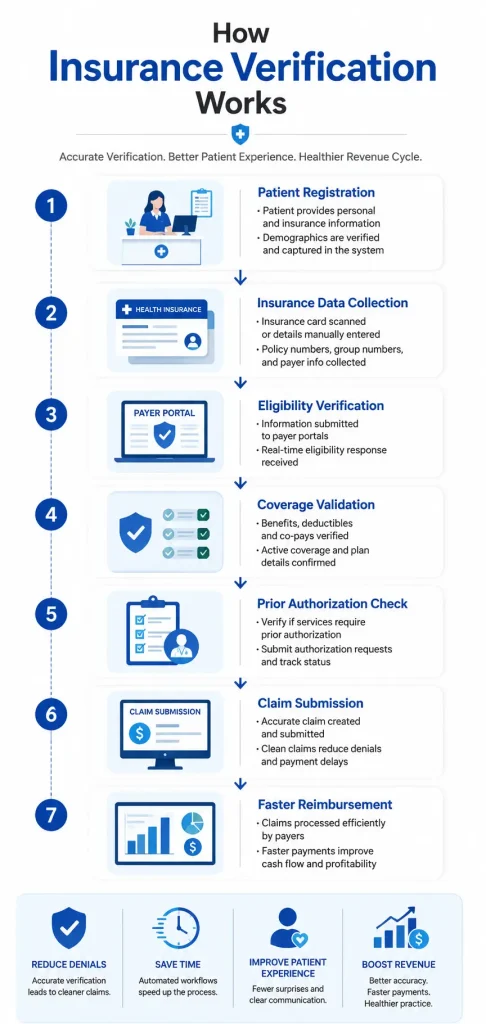
Insurance verification plays a critical role in revenue cycle management (RCM). Revenue cycle management covers the entire financial journey of a patient—from appointment scheduling to final payment collection. Every stage depends on accurate information. If verification fails at the beginning, the rest of the revenue cycle becomes vulnerable. Think of verification as the foundation. Without a strong foundation, billing processes become unstable.
Accurate insurance verification supports nearly every financial process in healthcare, including:
- clean claim submission
- faster reimbursement
- reduced denials
- fewer appeals
- better cash flow
- improved collections
According to AHIMA revenue cycle best practices, accurate front-end data collection is critical for clean claims and healthy cash flow.
When eligibility is verified upfront, billing teams can submit claims with greater confidence. That improves first-pass claim acceptance rates. It also helps practices communicate patient financial responsibility early. Patients are more likely to pay when costs are explained before treatment rather than after receiving a surprise bill. This improves both collections and patient satisfaction. In short, strong verification strengthens the entire revenue cycle.
Prior Authorization and Coverage Validation
Prior authorization has become one of the most frustrating administrative burdens in healthcare. Certain procedures, treatments, imaging services, medications, and specialist visits require payer approval before services are provided. If authorization is missed, reimbursement may be denied—even if the treatment was medically necessary. That creates a major risk. This is why coverage validation must include more than eligibility checks.
Verification teams must also determine:
- whether prior authorization is required
- whether referrals are needed
- whether services fall within coverage limitations
- whether network restrictions apply
Missing these details can delay care or create financial losses. Consider a patient scheduled for an expensive MRI. If prior authorization was required but not obtained, the claim could be denied entirely. That means the provider may absorb the cost or face lengthy appeal processes. Strong insurance eligibility verification services reduce these risks by ensuring coverage requirements are fully validated before treatment begins.
Reducing Administrative Burden for Front-Desk Teams
Front-desk teams are the backbone of any healthcare practice. They do a lot of work. They check in patients, schedule appointments answer phone calls and handle paperwork. They also have to respond to questions about bills. All of this work can be very demanding.
Adding insurance verification to their tasks can be a big help. This is when healthcare practices start to feel overwhelmed. When front-desk employees spend much time verifying insurance other tasks suffer. Phone calls are not answered patients wait longer. Scheduling takes more time. This makes the whole process less efficient.
The result is that patients wait longer, they get frustrated staff get. There are more mistakes. Over time this pressure can cause staff to burn out. Burnout is expensive because when experienced staff leave the practice loses knowledge and productivity. It takes time and money to train staff. Outsourcing insurance verification can help reduce this burden. Front-desk teams spending hours on the phone with insurance company specialists can handle these tasks. This gives front-desk teams time to focus on patients.
Key Features to Look for in an Insurance Verification Partner
Not all insurance verification companies are the same. Choosing the partner is important because verification affects how much money the practice makes, how accurate the bills are and how happy patients are. A good verification partner should feel like part of the team not someone outside the practice.
First, look for a partner who knows a lot about healthcare. Insurance verification in healthcare is complicated. The partner should understand the rules of insurance companies how to get permission for treatments and how to get paid. Experience is important. Second, look for a partner who’s accurate and consistent. Mistakes in verification can cause problems later so it is important to be precise. Ask partners about their quality control processes and how accurate they are.
The technology they use is also important. Good verification partners should have tools like integration with insurance company websites, automatic checks for eligibility, secure handling of documents and reports that show what is happening in real-time. Security is also very important. Since verification involves patient information, partners must follow strict rules to keep data safe.
Finally, consider if the partner can grow with the practice. As the practice gets patients, the verification partner should be able to handle more work without slowing down or making mistakes. The right partner can improve how efficiently the practice runs and how money it makes.
Cost and ROI of Outsourced Insurance Verification
Healthcare leaders often ask if outsourcing insurance verification is worth the cost. The answer is usually yes. It depends on how you look at the cost. Most practices only think about the fee they have to pay for the service. This is a mistake. A better question is how many mistakes in verification are already costing the practice. Manual verification can hide costs like staff time delayed payments, denied claims and lost productivity. These costs add up quickly.
Lets look at an example. Suppose a practice handles 800 insurance claims each month. If 4% of these claims have problems with verification, that’s 32 claims. If each of these claims loses or delays $250 that’s a loss of $8,000 each month. Over a year that’s $96,000 in lost revenue.
Now compare this to the cost of outsourcing verification. For practices, outsourcing costs less than the financial damage caused by billing errors and denials. This is where the value of outsourcing becomes clear. It saves money protects revenue, speeds up payments and improves how the practice runs.
Is Insurance Verification Outsourcing Right for Your Practice?
Every practice is different. Has different needs. A small clinic might handle insurance verification differently than a healthcare system. However, there are signs that outsourcing might be helpful. Ask yourself if claim denials are increasing, if front-desk staff are overwhelmed, if there are delays in getting permission for treatments, if there are disputes about bills or if payments are taking longer. If you said yes to many of these your verification process might be causing problems.
Outsourcing is especially helpful for specialty practices, diagnostic centers, surgical clinics, urgent care facilities and big healthcare groups. These places often deal with a lot of verification and complicated insurance rules. The right outsourcing solution can improve accuracy, reduce delays and make financial workflows smoother.
Conclusion
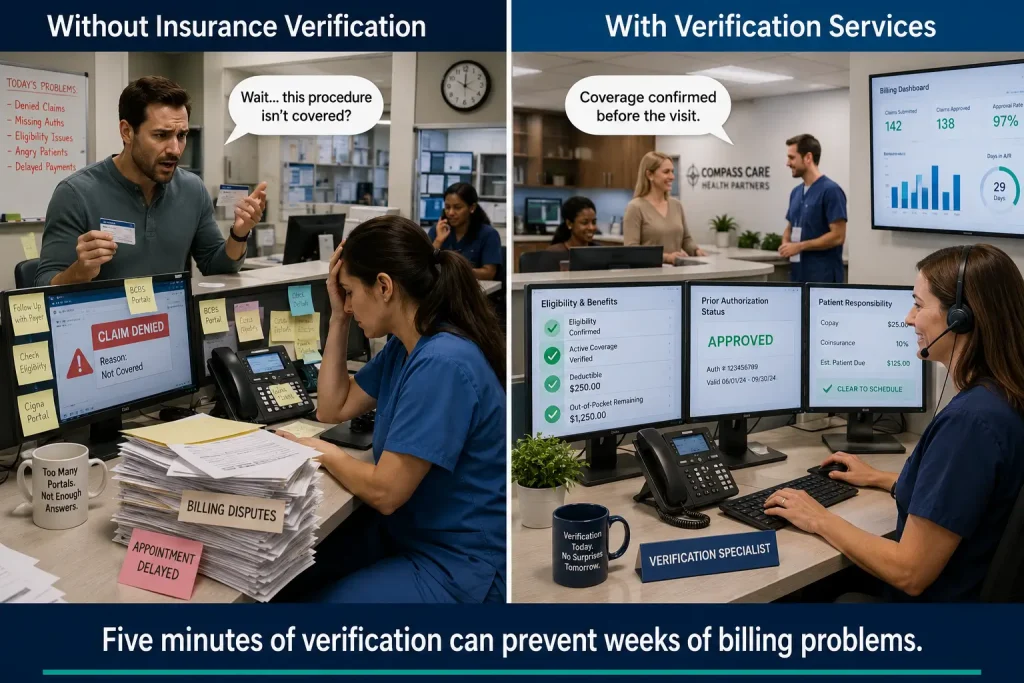
Insurance verification happens behind the scenes. Affects the whole healthcare organization. It affects how patients feel, how accurate the bills are and how quickly payments are made. Importantly, it affects how much money the practice makes.
One mistake in verification can lead to denied claims, delayed payments, frustrated patients and extra administrative work. That’s why insurance verification services are so important for healthcare providers today. They confirm coverage, protect cash flow, improve efficiency, reduce staff burden and create patient experiences.
In today’s insurance environment, accurate verification is not optional it’s necessary. If your healthcare organization wants to reduce denied claims improve billing accuracy, and streamline insurance workflows, Vocals Connected can help with verification support designed for modern healthcare operations.