
HVAC call center services have become essential for growing service businesses, especially in a competitive market where every missed call can mean lost revenue. It is 3:15 PM on a hot summer afternoon in Texas. One of your technicians is on a rooftop fixing an air conditioning unit while another is driving to an emergency service call. Meanwhile, your office manager is already juggling dispatch, scheduling, customer follow-ups, and billing. Then the phone rings—and nobody answers.
The homeowner calling has no air conditioning, and the temperature inside their home is rising fast. Frustrated, they wait a few seconds, hang up, and call your competitor. Just like that, you lost a job. For HVAC businesses, situations like this happen more often than many owners realize. Every missed call can mean lost revenue, reduced customer trust, and missed opportunities to gain long-term customers. That is why growing HVAC companies are increasingly relying on professional support providers like Vocals Connected to ensure every customer inquiry is answered quickly, efficiently, and professionally.
That is why professional air conditioning call center services have become very valuable for growing service businesses. As air conditioning companies get bigger handling every call internally becomes difficult. Seasonal demand spikes, emergency breakdowns, after-hours service requests and dispatch coordination can quickly overwhelm office staff. The right call center does more than just answer phones. It helps air conditioning companies get leads schedule more appointments, improve dispatch efficiency and deliver better customer experiences.
What Are Air Conditioning Call Center Services?
Air conditioning call center services are communication solutions built specifically for heating, ventilation and air conditioning businesses. These services help manage customer calls, service inquiries, appointment scheduling, emergency dispatch requests and after-hours communication. Of letting calls go to voicemail or forcing already busy office teams to manage everything dedicated support agents handle customer communication in a structured and professional way. Companies using inbound support solutions often notice immediate improvements in response speed and booking efficiency.
In the air conditioning business this matters a lot because customers rarely wait. When someone loses cooling during a heat wave or heating during freezing weather they lose patience quickly. Most customers will call the available provider if no one answers. That makes fast response a big advantage.
How Air Conditioning Call Center Services Work
When customers call your air conditioning business calls can be routed directly to trained support agents of relying entirely on in-house staff. These agents follow workflows designed around your business operations. They gather customer details identify service needs, assess urgency and route requests appropriately. A professional air conditioning call center can assist with appointment booking, emergency dispatch coordination, lead qualification, technician routing and customer support.
For example if a homeowner reports that their air conditioning system failed during peak summer heat the support team can classify that request as urgent. Prioritize dispatch immediately. That speed improves service quality and customer satisfaction.
Common Types of Air Conditioning Customer Calls
Air conditioning businesses receive different types of calls every day. Some involve emergencies. Others involve maintenance or installation planning. Typical customer calls include air conditioning repair requests, furnace breakdown reports, seasonal tune-up bookings, installation consultations, pricing questions, warranty support and technician ETA requests. Even routine calls matter. A simple pricing inquiry today may become a system replacement job later. Every call represents either money or future business potential.
Why Fast Response Matters in Air Conditioning
Speed matters more in the air conditioning business than in other service industries. Why? Because air conditioning problems often feel urgent to customers. A homeowner dealing with a failed air conditioning system during July is not thinking about comparing ten providers. They want the available solution. The same applies during winter heating failures.
According to industry standards promoted by Air Conditioning Contractors of America service responsiveness plays a role in customer satisfaction and long-term retention. The first company to respond often gets the job. Faster response improves lead conversion, customer trust, appointment bookings and money capture. In terms faster response means more booked jobs.
Why Growing Air Conditioning Businesses Need Call Center Services
Growth sounds exciting—and it is. Growth also creates operational complexity. When air conditioning companies are small owners often answer calls themselves or rely on one office administrator. That may work temporarily. As the business grows communication becomes harder to manage. More technicians mean active jobs. More customers mean incoming calls. More service areas create more dispatch complexity.
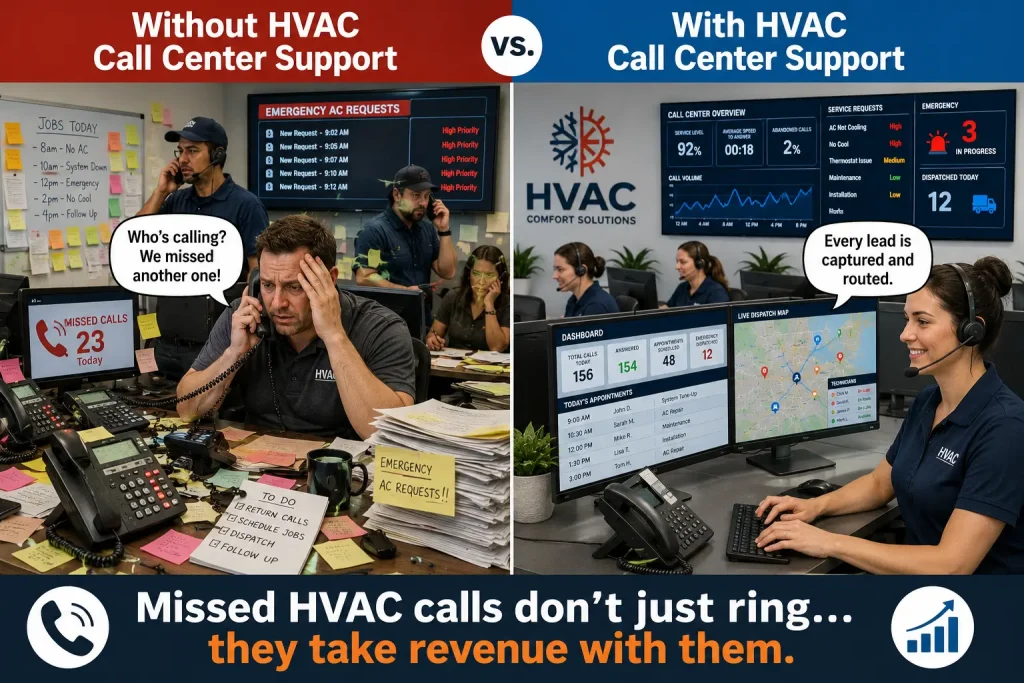
Eventually bottlenecks appear. Phones ring while technicians are inside crawlspaces, attics, rooftops or driving between service calls. Office staff become overwhelmed trying to manage scheduling, dispatch, billing and customer communication at the time. This creates missed opportunities.
Growing air conditioning businesses need systems that can absorb rising demand without sacrificing service quality. Modern field-service platforms such as ServiceTitan have helped many air conditioning businesses improve operations but software alone cannot answer every customer call. That is where professional call center support creates an advantage.
The Cost of Calls in Air Conditioning
A missed air conditioning call is not just a missed conversation. It can easily become a job worth hundreds—or even thousands—of dollars. Consider an example. Suppose your business misses eight calls per week. If 40 percent of those calls were leads and your average service ticket is $750 the weekly revenue loss becomes significant. That equals $2,400 in lost revenue every week. Over a year that becomes than $124,000. That estimate is conservative. Installation projects can push losses higher. Missed calls slow growth.
Managing Seasonal Call Surges
Air conditioning demand is highly seasonal. During weather call volume can spike dramatically. Summer heat waves and winter cold snaps often create service demand. Calls flood in faster than office teams can respond. Voicemails pile up. Response times slow. Customers grow frustrated. This is where strong 24/7 customer support services become essential. A professional call center helps absorb call surges without compromising service quality. That allows air conditioning businesses to scale during peak demand of losing opportunities.
Improving Customer Experience and Retention
Customers remember how easy—or difficult—it was to get help. That memory shapes whether they call you again. If customers repeatedly reach voicemail experience long hold times or wait hours, for callbacks trust starts to fade. On the hand fast and professional communication builds confidence. Customers feel valued. That improves retention. Retention matters because repeat customers often purchase maintenance plans, tune-ups, repairs, system replacements and upgrades. Better communication creates long-term customer relationships.
Common Communication Challenges for HVAC Companies
Most HVAC business owners do not lose money because they do not know how to fix things. They lose money because people in the company do not talk to each other well especially when it is busy. This happens a lot more than people think. The people who fix things called technicians spend most of their time outside the office. They are in attics under houses on roofs in rooms or driving to see customers.
When they are doing these things it is very hard for them to answer phone calls. At the time the people in the office are doing many things at once. They are scheduling appointments sending technicians to jobs sending bills to customers answering customer questions and keeping track of what the technicians are doing. When a lot of people call at the time something will go wrong.
Usually it is talking to customers that goes wrong. Messages from customers start to pile up. Customers do not get called back away. People who might want to buy something from the company called leads get cold. Do not want to buy anything anymore. Frustrated customers go to companies. The problem gets even worse when it is hot or very cold outside.
When it is very hot the company might get two or three times calls than usual. What normally seems okay becomes very crazy. HVAC companies have some problems with talking to people. These problems include not calling customers right away missing emergency calls scheduling things wrong getting technicians to the wrong place and not following up with leads.
These problems hurt the company’s ability to grow. It is not because people do not want to buy things from the company it is because the company cannot handle all the people who want to buy things
How HVAC Call Center Services Improve Lead Conversion
In the HVAC business speed is very important. When someone’s air conditioner is not working and it is hot outside they do not spend a lot of time looking around. They call the company they find. If nobody answers they call the company. Then they call the one. That means every call that is not answered is a problem. This is why having someone to answer calls is very important for HVAC companies.
A team of professionals makes sure every call is answered quickly and in a way. Of missing leads, the company can catch them in real time. It is not about answering calls it is about answering them the right way. This includes getting the information from the customer, finding out how urgent the problem is, making sure the lead is a good one sending emergency calls to the right people and scheduling appointments quickly.
This makes it easier for the customer to go from calling the company to having someone come to their house to fix the problem. When someone calls because their air conditioner is not working they do not want to wait on the phone for a time or be transferred to a lot of different people. They want to feel confident that someone is going to help them.
They want to know what is going to happen When the team that answers calls is good at their job, customers feel better. This makes it more likely that the company will get the job. The result is simple. Answering calls means getting more jobs scheduled. Getting jobs scheduled means making more money.
Appointment Scheduling and Dispatch Coordination
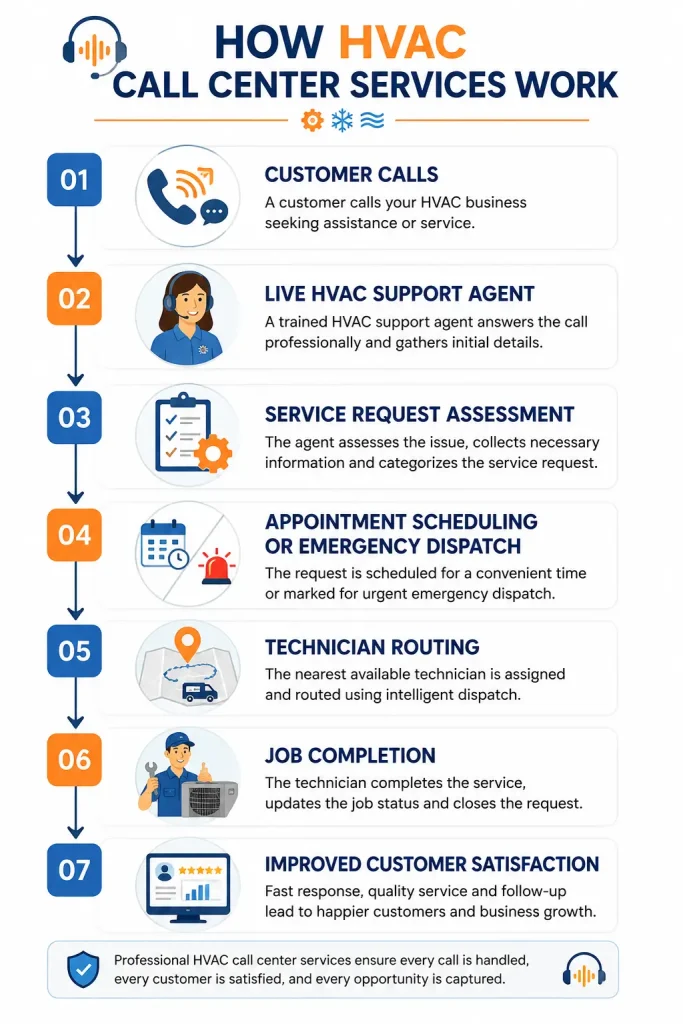
Scheduling appointments is one of the important things an HVAC company does. Even if the technicians are very good at their jobs they cannot make money if the schedule is a mess. This is where a lot of companies that are growing struggle. When the company gets busier, scheduling appointments becomes more complicated. The company has to keep track of appointments, emergency calls, regular maintenance, cancellations, which technicians are available, where the technicians are and how long it takes to get from one place to another.
Many growing HVAC businesses use professional inbound support solutions to improve appointment scheduling, dispatch coordination, and service request handling during peak demand. Small mistakes in scheduling can cause problems. Technicians might be scheduled for two things at the same time. Appointments might be missed. Technicians might arrive late. They might have to wait a while before their next job. The routes they take might not be very efficient. All of these things make the company less efficient. Having someone to answer calls helps the company schedule appointments. Send technicians to the right place.
When customers call the team that answers calls can schedule appointments away based on what kind of service is needed, how urgent it is, which technician is available and where the customer is. Emergency jobs get priority. Regular maintenance can be scheduled for times when the technicians are not busy This kind of communication builds trust.
Scheduling appointments and sending technicians to the place leads to:
- fewer missed appointments
- technicians being more productive
- routes being more efficient
- customers being happier
- more jobs being completed every day
For companies that are growing, having a good system for scheduling appointments and sending technicians to the right place is very important. It helps the company grow.
After-Hours and Emergency Call Handling
HVAC emergencies do not happen at times. They happen at night. On weekends. On holidays. Usually, when the weather is very bad. If someone’s air conditioner breaks at 11 PM when it is hot outside they do not care that the office is closed. They need help away. The same thing happens when the heating system breaks during cold weather. This is why it is very important to have someone to answer calls after hours. If the company does not have someone to answer emergency calls they will lose some of their opportunities.
Customers who call after hours are usually people who really need help away. They are not just looking around. They are ready to schedule someone to fix their problem. If nobody answers, they will call another company. Having a team to answer calls after hours makes sure emergency calls are never ignored. The team can answer calls 24 hours a day find out how urgent the problem is and send the call to the technician or dispatcher. This is very good for the company.
- First the company does not lose money.
- Second customers get help faster.
- Third the people, in the office do not get burned out from working at night.
For HVAC companies paying for someone to answer calls after hours is one of the best investments they can make.
Reducing Administrative Burden for Office Staff
Behind every heating, ventilation and air conditioning (HVAC) business, there is usually a team working hard behind the scenes to keep things running smoothly. Office staff often serve as the point of contact for the business. They answer phone calls, schedule appointments, coordinate dispatch, process invoices, follow up with customers and handle updates for technicians throughout the day. As the business grows that workload can become overwhelming.
What starts as daily communication can quickly turn into constant pressure. Incoming calls increase scheduling becomes complex and urgent service requests demand immediate attention. Eventually the office team becomes overloaded.
When office teams become overwhelmed their performance suffers.
- Calls get missed.
- Messages get delayed.
- Scheduling errors increase.
- Customer frustration rises.
Over time this constant pressure contributes to staff burnout. Burnout is expensive. When experienced office staff leave HVAC businesses lose knowledge about how to run the operation. Hiring and training replacements takes time, money and effort from management. HVAC call center services can significantly reduce this burden. Of forcing internal teams to manage every incoming inquiry, dedicated support specialists handle repetitive communication tasks such as answering calls taking leads, scheduling assistance and after-hours support.
This creates breathing room. Office staff can focus on higher-value work like optimizing dispatch, managing customer relationships, billing and business operations. That improves efficiency across the organization.
Key Features to Look for in an HVAC Call Center Partner
Not all call center providers understand the HVAC industry. This matters more than many business owners realize. A generic answering service may know how to answer calls but HVAC communication requires an understanding of the industry. Support teams must understand urgency, service terminology, dispatch workflows and customer expectations. The right partner should feel like an extension of your team—not a vendor reading a script. One of the things to evaluate is industry experience.
Ask whether the provider has worked with HVAC companies before. Experience with home service businesses is an advantage because these operations have unique communication needs. Speed is another factor. In HVAC, response time affects conversions. A provider that takes too long to answer calls can cost you revenue. Technology compatibility also matters. Your call center partner should integrate smoothly with scheduling and dispatch platforms, CRM systems and service management tools.
Look for capabilities such as:
- Live appointment scheduling
- Emergency dispatch routing
- CRM integration
- support
- Call recording
- Real-time reporting
- Lead qualification workflows
Many HVAC companies already use platforms like ServiceTitan for dispatch and field-service management, so your call center partner should integrate smoothly with similar systems. Customization is also important. Your business has its service areas, pricing structure, emergency rules and dispatch priorities. A quality provider should adapt to your workflows, not force you into theirs. Ultimately, the right HVAC call center partner helps improve revenue, efficiency and customer satisfaction simultaneously.
Cost and ROI of Outsourced HVAC Call Center Services
One of the questions HVAC business owners ask is: “How much will this cost?” That is the first question. A better question is: “How much are missed calls already costing us?” Most owners underestimate the impact of poor call handling. They focus on outsourcing cost while ignoring losses caused by missed opportunities.
These hidden costs include:
- Lost service calls
- Lost installation jobs
- Delayed callbacks
- Lead conversion
- Reduced customer retention
- Staff inefficiency
These losses accumulate quickly. Consider a simple example. Suppose your HVAC company misses 10 calls per week.
Assume:
- 35% were leads
- Average service ticket = $650
That means: 10 × 0.35 × $650 = $2,275 weekly revenue loss. Over one year: $2,275 × 52 = $118,300 annual revenue loss. This estimate excludes high-ticket installation projects, which can be worth several thousand dollars each. Now compare that to the cost of outsourcing call handling. For growing HVAC companies, outsourcing costs far less than the revenue lost from missed calls. That is where return on investment (ROI) becomes obvious. You are not simply paying someone to answer phones.
You are investing in:
- booked jobs
- Lead conversion
- Better dispatch efficiency
- Stronger customer retention
- growth
For many service businesses the return is substantial.
Is HVAC Call Center Outsourcing Right for Your Business?
If your HVAC business is growing and communication challenges are slowing you down, Vocals Connected offers scalable 24/7 customer support services designed to keep your business responsive, efficient, and ready to grow. Not every HVAC company operates at the scale. A small local contractor has needs than a multi-truck regional service business. However, certain warning signs strongly suggest your company may benefit from call support.
Ask yourself:
- Are calls frequently going to voicemail?
- Are callbacks delayed?
- Is your office staff overwhelmed?
- Are after-hours emergency leads being missed?
- Are technicians struggling with customer communication while in the field?
If you answered yes to several of these questions your current communication system may be limiting growth. HVAC call center outsourcing is especially valuable for businesses with:
- Multiple technicians
- Growing service areas
- seasonal demand
- Frequent emergency calls
- Rising lead volume
These businesses often reach a point where internal communication systems cannot scale efficiently. That is when outsourcing becomes a growth decision than just an operational one.
Conclusion
Growing an HVAC business requires more than expertise. You can have the technicians, excellent service quality and strong customer reviews—but if customers cannot reach you when they need help growth becomes difficult. That is the hidden cost of communication. Missed calls lead to missed revenue. Slow response times hurt customer trust. Overloaded office teams create bottlenecks. This is why HVAC call center services* have become increasingly valuable for growing service businesses. They do more than answer phones. They help HVAC companies capture leads improve dispatch coordination reduce administrative pressure, support after-hours emergencies and create better customer experiences. Importantly, they help ensure that valuable service opportunities are not lost simply because no one answered the phone. If your HVAC business is growing and communication challenges are slowing you down Vocals Connected can help with support solutions designed to keep your business responsive, efficient and ready to grow.