
In-house vs outsourced healthcare call center services is a debate many hospital leaders know all too well. One hospital COO once said she would rather be in charge of the surgical wing than the patient access call center. The surgical wing runs by the book. The call center is a different story. Someone is always absent on the busiest morning, the software contract always seems to need renewal at the worst possible time, and patient hang-ups spike the same week she has to present performance metrics to the board. She was not exaggerating—she was describing the real challenges of managing patient communication in-house.
That weight is exactly why the in-house versus outsourced question keeps landing on healthcare leaders’ desks. It’s rarely about ideology. It’s about cost, control, risk, and whether your phone lines are helping you grow or quietly bleeding revenue. Most comparisons you’ll find online stop at a surface-level cost table. This one goes further — into hidden costs, ROI timelines, scalability, AI, and which model actually fits a two-provider clinic versus a multi-hospital system. If you’re evaluating your options, Vocals Connected works directly with U.S. healthcare organizations on exactly this decision. Let’s make this a comparison you can defend to your board.
What Are Healthcare Call Center Services?
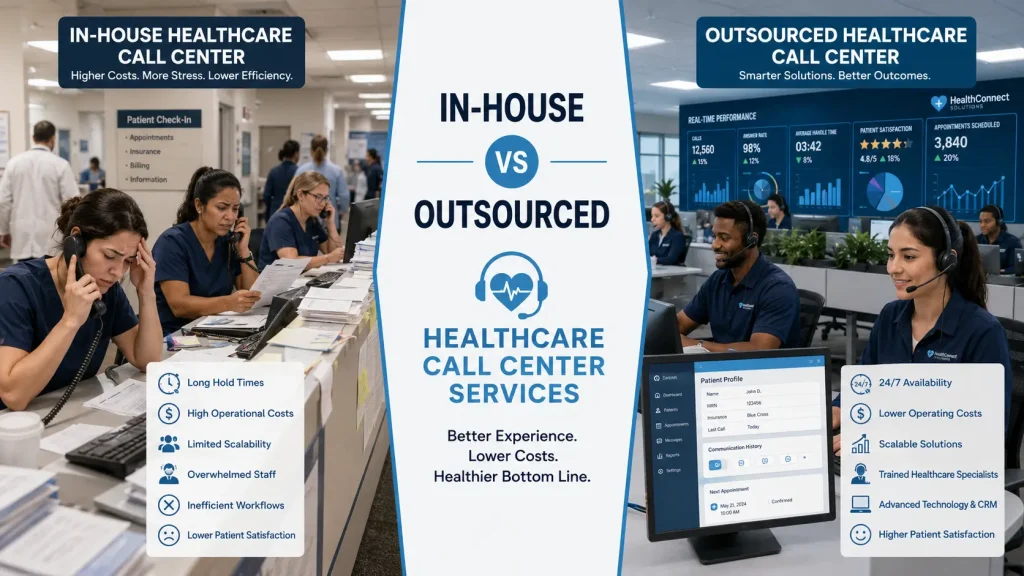
Before we compare models, we need to be clear about what Healthcare call center services actually do. The term “call center” does not fully describe what they do. Healthcare call center services take care of all communication for a practice, clinic, hospital, or telehealth provider. This includes scheduling appointments. Rescheduling them checking insurance and eligibility helping with prescription refills, handling clinical calls and routing them to the right person, covering after hours following up after visits and dealing with patients who do not show up. The best Healthcare call center services also do outreach such as reminding patients about appointments, sending reminders for preventive care, and following up on balances.
This matters to your business because every interaction with a patient affects revenue or whether they stay with you. When you schedule an appointment, that’s revenue. When you prevent a patient from not showing up, that is revenue protected. When you verify a patient’s insurance benefits, you prevent claims from being denied. When a patient talks to a knowledgeable person, they are more likely to stay with your practice. The phone is not a cost it is the main way patients interact with your practice, and how you handle these interactions determines whether patients stay with you. So the real question is not whether you need Healthcare call center services. You do need them. The question is how you will provide them: will you do it yourself, hire a specialist, or do a combination of both?
The American Medical Association has consistently tied strong patient-provider communication to better trust, adherence, and clinical outcomes. The resources at the American Medical Association reinforce that reachability isn’t a convenience feature — it’s part of the care itself. Every one of those call center interactions touches revenue or retention. A captured appointment is revenue. A reduced no-show is revenue protected. A verified insurance benefit prevents a denied claim. A patient who reaches a calm, knowledgeable person on the first try is a patient who stays.
So the real question isn’t whether you need this capability. You do. The question is how to deliver it — build it internally, hand it to a specialist, or blend both. You can see a full breakdown of what modern Healthcare Call Center Services cover and how they map to different provider types before weighing the model comparison below.
In-House Healthcare Call Center Services
What is an In-House Healthcare Call Center?
An in-house healthcare call center is a team of employees who work for you. They are usually part of your office or a special department that deals with patients. They answer phones. Talk to patients directly. They use your phone system and your computer software. They do what you tell them to do and report to the leaders in your organization.
For medical offices, the front desk people often handle phone calls when they are not busy with other things. For offices, they might have a whole department just for handling phone calls. This department would have supervisors and people who check to make sure everything is done correctly. They would also have schedules to make sure someone is always available to answer phones.
Benefits of In-House Support Teams
Having an in-house team is a thing. It has some advantages. You are in control. You get to decide how things are done. You can watch what is happening. Fix any problems right away. You do not have to talk to someone to get things done. Your team knows your office and your doctors. They understand what your office is like and what your patients need. They can talk to patients in a way that sounds like your office.
When someone on your team has a question, they can just go ask a nurse. This helps get answers, especially for complicated cases. You can make rules and processes that work for your office. You do not have to use someone’s system. For offices where patients have a relationship with their doctors, having an in-house team is very important.
Challenges of Managing Internal Teams
However, having an in-house team can be expensive and difficult. You have to pay for everything. You have to pay salaries, benefits, and taxes. You have to buy software and computers. You have to pay for managers. It is hard to keep people working at the desk. They often leave their jobs. Then you have to find someone new and train them. This can take time, and it can be hard to get everything done. It is hard to handle an increase in phone calls. If a lot of people call at once, you might not have enough staff to answer the phones. You cannot just hire someone right away.
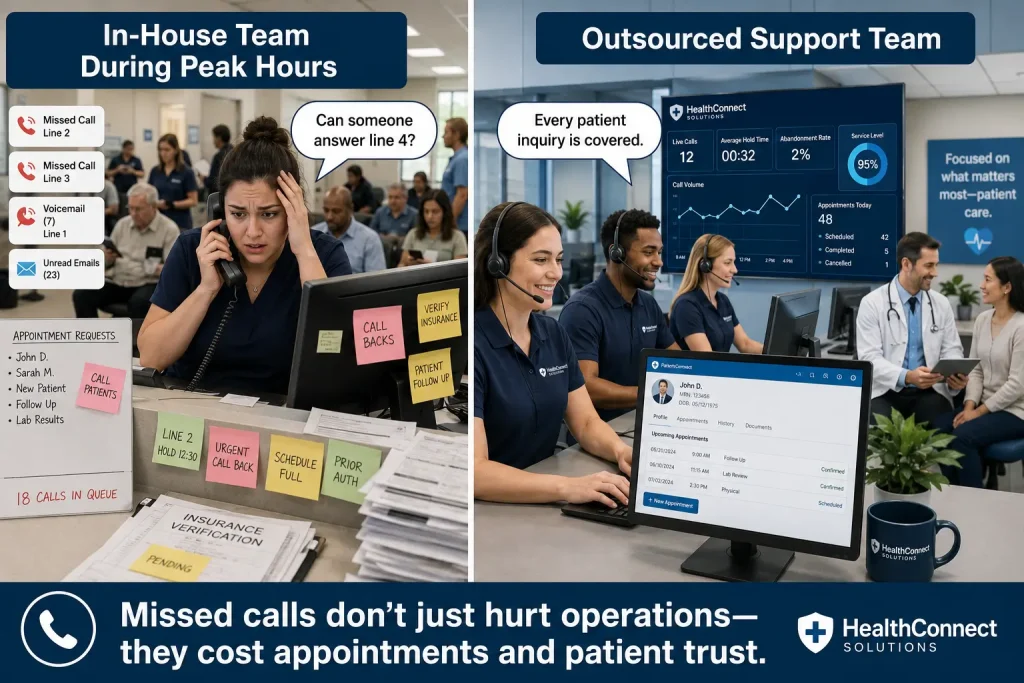
If you do not have enough people working, they can get very stressed. This can cause them to leave their jobs. Then you have even fewer people working. It can be hard to get out of this cycle. You might miss phone calls when you are busy. If you don’t have enough staff, you may not be able to answer all phone calls. This can happen at the times of day when the most people are calling. The in-house model gives you control over your In-House Healthcare Call Center. It can be expensive and hard to manage.
Outsourced Healthcare Call Center Services
What is an Outsourced Healthcare Call Center
An outsourced healthcare call center is a company that helps with communication for you. They have people who are trained to do this job. They follow the rules you set. These people work with the system you use to schedule appointments. They keep all the patient information safe. The company that does this job for you is responsible for making sure everything runs smoothly not you.
A good company that does this is not a call center that happens to take medical calls. They are a company that knows a lot about healthcare and their people understand how to help patients who’re worried or scared. They know about terms and they can help figure out what is wrong with a patient. When you work with a company like this you pay for the calls they handle. The results they get not for the number of people they have working for them.
Benefits of Outsourcing Call Center Services
When you work with a company that does this job for you it can be very helpful.
- You do not have to pay for people to sit around when it is slow.
- You do not have to pay to recruit and train people.
- If you get really busy the company can handle it without you having to hire people.
- Patients can talk to a person at any time even on weekends and holidays.
- The company has people who’re experts in healthcare and they have good systems in place to make sure everything runs smoothly.
- You can start working with the company without having to spend a lot of time and money setting everything up.
The downside is that you have control over what is happening but for many people it is worth it.
How to Choose the Right Model
To make a decision you need to think about a few things.
- Do you have money to pay for a team of people to do this job for you or is it better to pay for each call?
- How big is your practice and how patients do you have?
- When are your patients most likely to call and how calls do you get at those times?
- Are you planning to grow your practice. If so do you need a system that can handle that?
- You have to make sure that whoever you work with is following all the rules about keeping information safe.
A good company that does this job for you can actually be better at following the rules, than a team of people who work for you because they have experience and better systems in place.
The Hidden Costs of In-House Teams
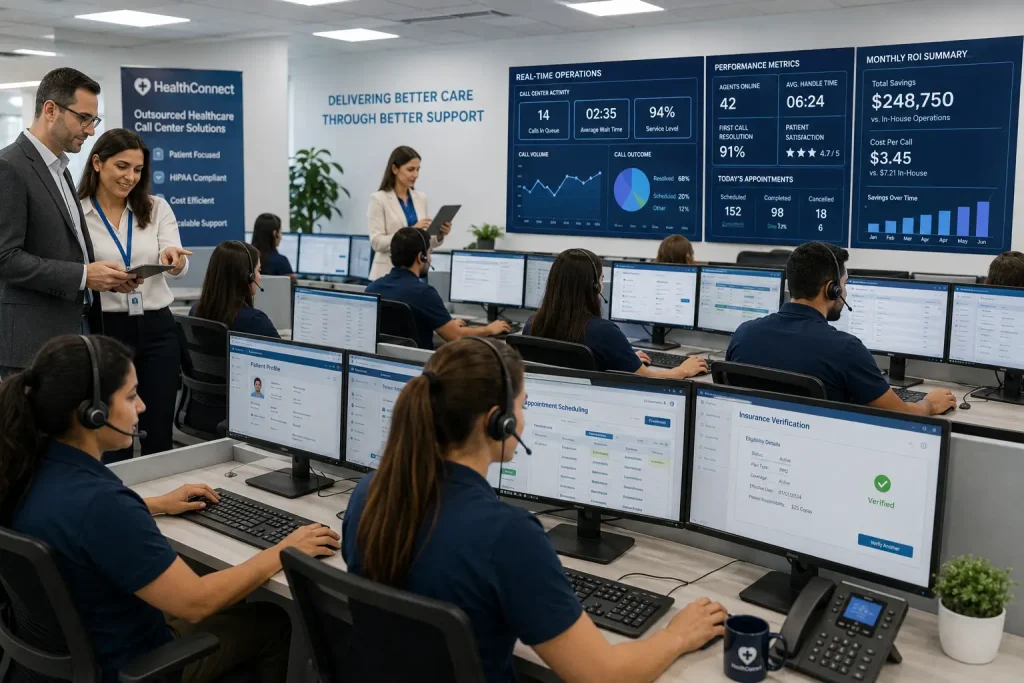
This is where most comparisons go shallow, so let’s go deep—because the sticker cost of an in-house team is never the real cost.
| Hidden Cost | What It Actually Means |
|---|---|
| Hiring | Job postings, recruiter fees, interview time, and the productivity lost while roles sit vacant |
| Training | Weeks of ramp-up per hire on systems, scripts, HIPAA, and your specialty workflows—repeated with every turnover |
| Turnover | High-churn roles mean you pay hiring and training costs over and over, with coverage gaps in between |
| Absenteeism | Sick days and no-shows blow holes in your coverage on exactly the days you can least afford it |
| Benefits & payroll taxes | Health insurance, PTO, retirement, and employer taxes can add 25–40% on top of base salary |
| Software licensing | Phone systems, call recording, QA tools, and integrations—recurring costs you own entirely |
| QA management | Monitoring, scoring, coaching, and reporting require supervisors and their salaries |
| Compliance overhead | Ongoing HIPAA training, audits, documentation, and breach-prevention infrastructure |
| After-hours staffing | Covering evenings, weekends, and holidays means premium pay or a separate answering solution |
Add these up and the “affordable” in-house team often costs far more per handled call than leadership assumes. The salaries are visible; everything around them isn’t.
The Hidden Benefits of Outsourcing
Just as in-house has hidden costs, outsourcing has hidden benefits that rarely appear in a basic comparison.
- Faster onboarding. A vendor can be live in a fraction of the time it takes to build a department, meaning you stop the revenue leak sooner.
- Built-in 24/7 coverage. No premium-pay scheduling headaches—after-hours coverage is simply part of the service.
- Overflow support. During peaks, calls that would have been missed get answered, with no permanent staffing commitment.
- Reduced missed calls. More answered calls means more booked appointments and fewer frustrated patients defecting to competitors.
- Better scheduling efficiency. Dedicated agents focused solely on patient communication book faster and more accurately than a multitasking front desk.
- Lower administrative burden. Your leadership stops managing recruiting, QA, and shift schedules and gets that attention back for higher-value work.
- Revenue recovery from missed appointments. Systematic reminders, easy rescheduling, and waitlist backfill turn empty chairs back into revenue—often enough to pay for the service outright.
That last point deserves emphasis. For many practices, the appointments recovered through better communication more than cover the entire cost of outsourcing. The service doesn’t just save money; it generates it.
The AI and Hybrid Model
The conversation has moved beyond a simple binary, and any modern comparison that ignores AI is already dated. AI chatbots handle routine web inquiries—hours, directions, basic FAQs, and even simple scheduling—deflecting volume before it ever reaches a human. Voice AI can answer calls, understand patient intent, manage straightforward requests, and route complex or urgent matters to live agents. Used well, it shortens wait times and frees humans for the conversations that need judgment and empathy. Used poorly, it becomes a frustrating maze—so thoughtful design is everything. Automated appointment reminders across text, email, and voice cut no-shows dramatically with almost no human effort, and they’re now table stakes rather than a luxury.
But here’s the insight competitors gloss over: AI is a layer, not a replacement. A scared, confused, or grieving patient does not want a bot. The winning model uses automation to handle the predictable and humans to handle the meaningful. That’s why the hybrid model is increasingly the smart default. Keep a lean in-house team for relationship-heavy, complex, and clinical calls. Route overflow, after-hours, and high-volume routine traffic to an outsourced partner. Layer AI underneath both to deflect and accelerate. You get local knowledge where it matters, elastic capacity where it counts, and automation efficiency throughout.
HealthIT.gov has tracked how relentlessly digital health adoption keeps expanding patient communication channels, and the data at HealthIT.gov makes clear that as care goes digital, the support burden grows alongside it. The winning model uses automation to handle the predictable and humans to handle the meaningful — not one replacing the other.
That’s why the hybrid model is increasingly the smart default. Keep a lean in-house team for relationship-heavy, complex, and clinical calls. Route overflow, after-hours, and high-volume routine traffic to an outsourced partner. Layer AI underneath both to deflect and accelerate. You get local knowledge where it matters, elastic capacity where it counts, and automation efficiency throughout.
Cost Comparison: In-House vs Outsourced
| Factor | In-House | Outsourced |
|---|---|---|
| Staffing costs | Full salaries + benefits + payroll taxes, paid even during idle hours | Pay for usage or dedicated capacity; no idle-time burden |
| Training | You fund recruiting and weeks of ramp-up per hire, repeatedly | Vendor trains and maintains agents at their expense |
| Software | You license, integrate, and maintain all systems | Included in the service; vendor owns the tech stack |
| Infrastructure | Hardware, phone systems, workspace, redundancy—all yours | Vendor-provided and maintained |
| Flexibility | Slow to scale; reactive hiring | Scales up or down on demand |
| Availability | Extended hours require premium pay or a separate solution | 24/7 typically built in |
| ROI timeline | Long; high upfront and ongoing investment before stabilizing | Faster; value often appears within the first months |
The pattern is clear: in-house front-loads cost and risk, while outsourcing converts fixed costs into variable ones and shortens the path to ROI.
Pros and Cons at a Glance
| Pros | Cons | |
|---|---|---|
| In-House | Direct control, brand consistency, tight internal communication, custom workflows | High fixed costs, turnover, limited scalability, burnout risk, missed calls during peaks |
| Outsourced | Cost efficiency, scalability, 24/7 coverage, specialized expertise, fast implementation, revenue recovery | Less direct control, requires careful onboarding, vendor dependency |
| Hybrid | Best of both—control where it matters, elasticity where it counts, AI efficiency | Requires thoughtful coordination between internal and external teams |
Which Model Fits Which Organization? A Decision Matrix
There’s no universal answer, but there are clear patterns by organization type.
| Organization Type | Best-Fit Model | Why |
|---|---|---|
| Small clinics (1–3 providers) | Outsource (often after-hours + overflow first) | Limited budget and a lean front desk make hidden in-house costs especially punishing; each missed call is a larger share of revenue |
| Growing / multi-location practices | Hybrid or Outsource | Need elastic capacity that scales with growth; centralizing overflow across sites eliminates duplicated staffing |
| Hospitals & large health systems | Hybrid or In-House | Volume and complexity can justify an internal department, but hybrid adds surge capacity and after-hours coverage without over-hiring |
| Specialty providers (cardiology, ortho, derm, dental) | Hybrid | Complex, long calls (authorizations, referrals) benefit from in-house expertise; routine and overflow calls suit outsourcing |
| Telehealth providers | Outsource | Digital-speed patient expectations and 24/7 demand favor a partner fluent in both scheduling and basic tech support |
The thread running through every row: the right model matches your size, volume patterns, complexity, and growth trajectory—not a one-size-fits-all rule.
Final Verdict: Which Is Better?
So which one is better? The truth is that what is better depends on the situation of the practice. But there are some patterns that can help us make some good recommendations. For medical practices that are on their own, it is usually a good idea to get some outside help, at least for nights and weekends when the office is closed and for when they get too many calls. If a small medical practice tries to handle everything on its own, it can be expensive. If they miss calls, it can really hurt their business because every patient is very important.
Big hospitals and health systems can probably handle things on their own. They can use a mix of their own staff and outside help. These big places have a lot of patients, and things can get complicated, so they might need their team. But it is still a good idea for them to get some outside help to cover nights and weekends and to help when things get really busy.
For practices that are growing, it is probably a good idea to use a mix of their own staff and outside help, or to just get all their help from outside. When a medical practice is getting bigger, they need a system that can grow with them and not one that they have to keep changing all the time. Getting outside help when a medical practice is growing can save them from having to try to keep up with all the new work.
For medical practices that are in the middle, using a mix of their own staff, outside help for nights and weekends, and computer systems to help with some tasks is probably the best way to go. This way, they can have control over what’s happening, save money, be able to grow, and still give their patients a good experience.
The worst thing a medical practice can do is just stick with what they’re used to without really thinking about it and end up losing patients and money because they are not doing things in the best way. Medical practices should really think about what they’re doing and make sure it is the best choice for them rather than just doing what they have always done.
Frequently Asked Questions
- Is it cheaper to outsource a healthcare call center or keep it in-house?
For mid-sized practices outsourcing a healthcare call center is more cost-effective. You have to consider the hidden costs of keeping it in-house like benefits, payroll taxes and training. Large systems with a lot of calls may find keeping it in-house competitive. They often save money with a hybrid model that combines both.
- Will outsourcing my patient calls hurt the patient experience?
Not if you choose a vendor that specializes in healthcare and onboard them correctly. A good partner trains their agents on your way of doing things so patients get an caring person quickly. This is often an experience than dealing with a busy front desk that can’t answer the phone right away. Patients reach a person who understands their needs.
- Are outsourced healthcare call centers HIPAA compliant?
Reputable outsourced healthcare call centers are HIPAA compliant. They should show you how they handle information train their agents and protect their systems. They should also have a signed agreement that says they will follow the rules. Sometimes a specialized vendor can do a job with compliance than an internal team that has a lot on their plate.
- How long does it take to set up an outsourced call center?
It takes less time than building an internal department. Setting up a call center usually involves loading your protocols integrating with your scheduling system and Electronic Health Record (EHR) training agents and running test calls. This process typically takes a weeks. It does not take months like recruiting and training in-house staff does.
- Can an outsourced call center integrate with my EHR and scheduling software?
Yes it. It should. This is important, for efficiency. Agents should be able to see availability, patient history and insurance status. When you talk to a partner ask them specifically how they integrate with your systems and what the process looks like. Outsourced healthcare call centers should be able to work with your existing software.