
These days people do not just look at the quality of care they get from a hospital or clinic. They also think about how easy it’s to make an appointment get help with bills and get support when they need it. A lot of the time a persons experience with a healthcare place starts with a phone call or a message on the computer before they even see a doctor. That is why patient support services are so important now.
For a lot of hospitals and clinics it is getting harder to handle communication on their own. There are many phone calls, not enough staff and people are getting really tired of doing the same tasks over and over. Patients are also expecting more which is making it tough for healthcare places to keep up. Of just relying on the people at the front desk many healthcare places are now working with outside companies like Vocals Connected to make things more efficient and better for patients.
Outsourcing is not about saving money anymore. It is a way to make communication better make things run smoothly and make sure every time a patient talks to someone it is a good experience. From making appointments to handling phone calls after hours outsourcing is helping healthcare places work better in a world that is getting more and more demanding.
What Are Patient Support Services in Healthcare?
Core Functions of Patient Support Teams
Patient support services are about helping patients and talking to them before during and after they get care. These services are like a bridge between patients and healthcare providers making sure everyone is on the page and things are running smoothly.
Some common things that patient support teams do include making appointments reminding patients about them checking insurance helping with bills refilling prescriptions and following up after visits. In healthcare systems support teams might also help with telehealth getting patients ready for care and sending them to the right departments.
These tasks might seem like office work but they really affect how patients feel about their care. When support teams do their job well healthcare places run smoothly and patients feel like they are getting good care.
Why Patient Communication Matters
Good communication with patients builds trust. Patients want to get answers get the right information and feel like someone is listening to them. If things get delayed or messages get mixed up patients get. Might not trust their healthcare provider. Imagine a patient calling to change an appointment after surgery. If the phone just rings and rings or they have to wait a time to talk to someone they will get stressed and worried. They might even start to question if they should go to that healthcare place all.
According to CDC patient communication research, clear communication improves treatment adherence and patient engagement. When patient communication services are good patients feel informed and supported. They are happy with their care and more likely to come The CDC says that good communication is key to patients being involved in their care following treatment plans and getting better.
Common Challenges Healthcare Organizations Face
Most healthcare places know how important communication is,. It is hard to keep it up all the time. One big challenge is getting many phone calls at once. Clinics can get really busy during times of the day or year and even if they have a lot of staff it can be tough to keep up.
Another challenge is. Keeping good staff. The people at the desk have to do a lot of different things at the same time like answer phones help patients who come in do paperwork and work with doctors. This can be overwhelming.
The third challenge is burnout. Doing the tasks over and over dealing with frustrated patients and having too much work can really wear down support staff. When they get tired and leave it disrupts everything. These challenges are why a lot of healthcare places are looking for help.
Why Healthcare Organizations Are Outsourcing Patient Support
Rising Patient Expectations
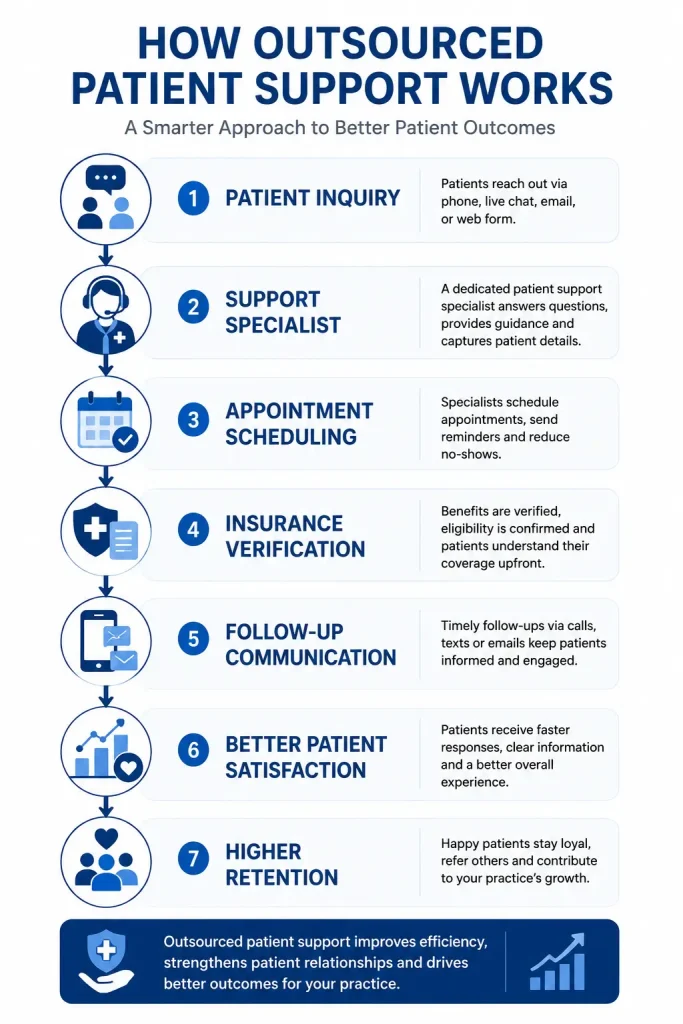
Patients expect now than they used to. They want to be able to talk to their healthcare place easily as they can talk to a bank or an airline. They want to be able to make appointments get reminders and talk to someone fast. Healthcare places that do not meet these expectations might lose patients to places that’re more convenient. Being easy to work with has become an advantage.
Outside companies that help with support can make sure patients get the kind of communication they want. They can provide consistent help that scales up or down as needed.
Staffing and Burnout Challenges
Burnout is a problem in healthcare. The people at the desk often have to do the same tasks over and over like making appointments checking insurance and calling patients back. When there are not staff patients might not get the help they need and that can lead to missed appointments and lost revenue.
Outsourcing can help by taking some of the pressure off the teams. It lets them focus on patients who’re there in person and on more important tasks. Places that use help for healthcare support outsourcing often see big improvements in how well things run and how happy their staff are.
Cost and Scalability Benefits
Hiring and taking care of support staff in-house can be really expensive. There are salaries, benefits, training and equipment to pay for. Outsourcing is flexible. Can grow or shrink as needed. Healthcare places can quickly add staff during busy times without having to spend a lot of money upfront. This makes outsourcing especially helpful, for places that are growing or have locations.
How Outsourced Support Improves Patient Experience
Patients do not just think about how good their doctor’s at treating them. They also think about how easy it’s to get help when they need it. Think about what it’s like to be a patient. You call your doctor to ask about your appointment or your bill. Nobody answers the phone. You have to wait for a time. Then you get transferred to someone else. You still do not get the answer you need. This makes you feel frustrated.
Outsourced patient support can make a difference. When it is easy to talk to someone and get help patients feel better about their doctor. They feel like someone is listening to them. They feel important. They feel like they have support.
This might seem like a thing but it is actually very important in healthcare. When someone is nice and helpful on the phone it can make patients feel less worried. They can answer questions. Help patients understand things that might be confusing. Good support does not just make things run smoothly. It also helps patients trust their doctor more.
Reducing Missed Calls and Missed Appointments
If someone calls the doctor and nobody answers it might not seem like a deal. In healthcare it can be a big problem.
It could be someone who wants to make an appointment.
- It could be someone who needs to talk to the doctor after a treatment.
- It could be someone who’s confused about their medicine.
- It could be someone who has a question about their bill.
Now imagine if this happens times every week. This is not a problem, with how things run. It is also a problem because it means patients do not get the help they need. It can also mean that the doctor loses money. Many doctors do not realize how money they lose when they do not answer the phone. Even if it only happens a times it can add up to a lot of money over time.
That is why more doctors are getting help to answer the phone. Of letting the phone ring and ring someone is there to answer it and help the patient. The result is that fewer patients get frustrated and fewer appointments are missed.
Cost. Roi of Outsourcing
People who make decisions often ask if it is worth it to pay someone else to answer the phone. In cases the answer is yes. Most people only think about how they pay their employees.. There are many other costs to think about. You have to pay for:
- salaries
- benefits
- finding employees
- training
- software
- equipment
- managers
Then there is the problem of employees quitting, which can be very expensive. Now think about how money you lose when you do not answer the phone. Let us say you miss 15 calls every week from people who want to make an appointment. If 6 of those people would have made an appointment that would have cost $250 that is: $1,500 every week. In a year that is $78,000 that you lost. Suddenly paying someone to answer the phone does not seem like a waste of money. It seems like a way to protect your business. That is the picture that many people miss. Good patient support does not just save you money. It also helps you stop losing money.
24/7 Support and Better Accessibility
Healthcare doesn’t follow office hours.. Neither do patient concerns. A parent might need advice about their childs symptoms late at night. A patient who just got out of the hospital may have questions about their medication after dinner. Someone with a morning appointment may realize at midnight that they need to reschedule.
The problem is many healthcare organizations still don’t offer support 24/7. When patients call after hours and only hear voicemail they get frustrated quickly. Some will call back later. Others won’t. In cases they just move on to another provider who is easier to reach.
That’s one reason 24/7 support has become really valuable. Outsourced patient support teams make it possible for clinics or hospitals to offer support around the clock without having to build overnight teams. Patients can get help when they actually need it. Not when the front desk is open.
This matters more than many providers think. Offering 24/7 support sends a message. It tells patients: We’re here when you need us. That reassurance builds trust. It also makes operations more efficient. After-hours teams can handle appointment requests, FAQs, urgent issues and callback scheduling so the morning staff doesn’t have to deal with chaos. Of starting each day with a backlog of voicemails and frustrated callbacks internal teams can focus on delivering care.
How Outsourcing Reduces Administrative Burden
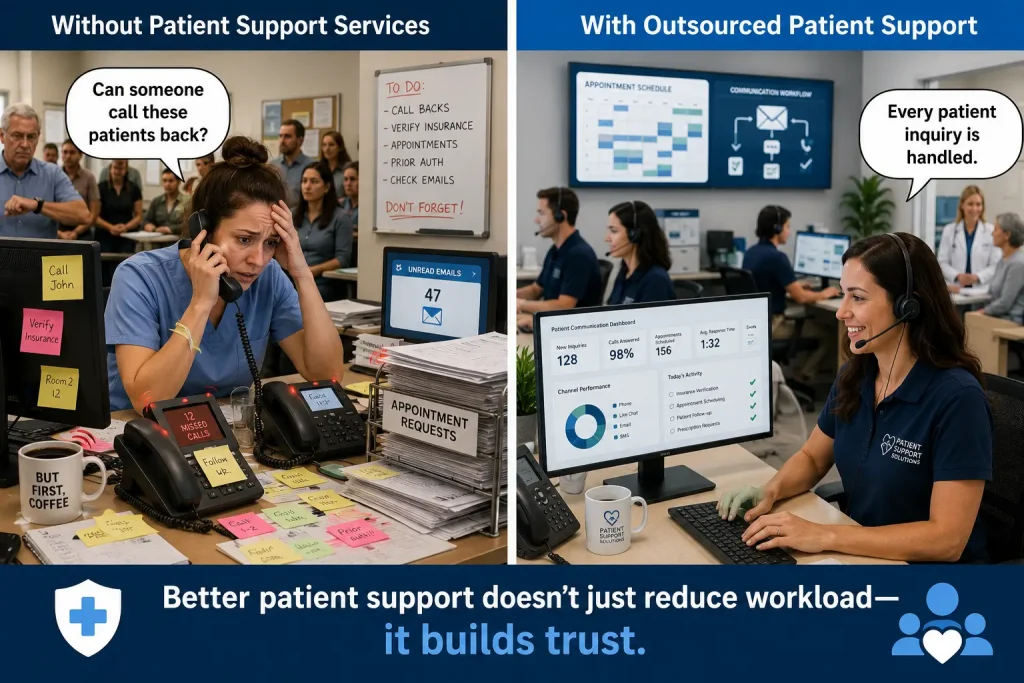
If you’ve ever watched a busy clinic receptionist work during peak hours you already know how intense the workload can get. The phone rings nonstop. Patients are waiting at the desk. Someone needs to verify insurance. Another patient wants to reschedule. A provider needs paperwork. Billing questions are piling up.
Somehow all of this happens at the same time. This is where many healthcare operations start to struggle. Administrative teams are often expected to do much with too little support. Highly capable employees eventually get overwhelmed. When that happens errors increase, response times slow down and burnout becomes unavoidable. Outsourcing helps by taking high-volume communication tasks off the shoulders of in-house staff.
Of spending hours answering routine questions internal teams can focus on work that truly requires their presence, such as:
- supporting providers
- assisting patients in person
- managing documentation
- coordinating care
That shift creates a noticeable difference. Staff feel less overwhelmed. Workflows become smoother. Productivity improves. Importantly burnout decreases. And in healthcare reducing burnout isn’t, about employee wellness. It directly affects patient experience too.
Technology and Automation in Modern Patient Support
Patient support has changed a lot over the five or ten years. It is no longer about answering phone calls. Modern patient support uses technology to help healthcare organizations communicate faster and more efficiently. Think about all the tasks that happen every day in a healthcare office. These include appointment confirmations, reminder calls and routing patients to the department.
There are also billing questions and collecting intake information. Handling all of these tasks manually takes a lot of time and energy. That is why more healthcare organizations are using automation. Modern support providers use tools like AI-assisted call routing, automated SMS reminders and chatbots for inquiries. They also use CRM integration, analytics dashboards and predictive staffing systems.
The U.S. Department of Health & Human Services emphasizes digital communication and care coordination as essential parts of modern healthcare delivery. Some healthcare leaders worry that automation will make patient interactions feel cold or robotic. Good automation does the opposite. It helps human agents focus on conversations that need empathy and problem-solving.
For example an automated reminder system can reduce no-shows by sending notifications about upcoming appointments. AI-powered routing can quickly direct calls to the department. That saves time for everyone. The best providers combine technology and human support. Technology handles speed and efficiency while humans handle trust and care. That combination creates the patient experience.
Cost Savings and ROI of Outsourcing
Cost is often one of the reasons healthcare organizations consider outsourcing. Many decision-makers only look at cost and not the full picture. Running support in-house involves more than just payroll. There are hidden expenses like hiring, onboarding, training and employee benefits. Turnover can be especially expensive. Every time an experienced staff member leaves the organization loses knowledge and productivity.
There is also the hidden cost of missed revenue. Poor communication can cost money. For example if a clinic misses 15 appointment-related calls each week that can equal $78,000 in lost revenue per year. When looking at outsourcing the conversation changes. It is about protecting revenue improving efficiency and creating growth. Good patient support helps healthcare organizations save money and stop losing money.
Is Outsourced Patient Support Right for Your Organization?
Outsourcing is not automatically the solution, for every healthcare organization. For many it solves problems that internal teams struggle to manage alone. A small clinic may benefit from overflow support during peak hours. A growing multi-location practice may need communication systems. The right choice depends on pain points.
Ask yourself a honest questions. Are missed calls becoming common? Is your front desk constantly overwhelmed? If you answered yes to several of these outsourced support may be worth considering. The goal is to create a communication system that supports both patients and staff effectively.
Conclusion
If your organization wants scalable healthcare call center services, Vocals Connected can help reduce missed calls and improve patient support. Patient support is no longer an administrative function. It has become a part of the healthcare experience. Every call is answered quickly. Every patient question handled professionally contributes to trust. Trust matters in healthcare. As patient expectations continue to rise, healthcare organizations need communication systems that’re responsive and reliable.
That is why more providers are outsourcing. They want to protect the touch and focus on caring for patients. Organizations that invest in communication today will be better positioned to deliver exceptional care tomorrow. If your healthcare organization is looking to improve communication Vocals Connected can help with scalable patient support solutions.